
Septic Tank Size for Residential Homes: Gallons, Bedrooms, and How Sizing Really Works
If you are building a new home on vacant land around Fontana, one of the first numbers you need is your septic tank size. Residential systems get sized by a formula tied to local code, not by guesswork, and getting that number right the first time is what keeps your permit moving and your build on schedule. This guide walks through how residential septic tank sizing works in plain English, what the county looks for, and how to leave yourself room to grow.
Most articles on this topic jump straight to a size chart and a sales pitch. This one starts with the reasoning behind the numbers, because once you understand why a tank is sized the way it is, the chart makes sense on its own. You will also be able to have a smarter conversation with your designer, your installer, and the county desk that signs off on your plans.
Why Septic Tank Size Matters More on New Construction
On an existing home, the tank is already in the ground. On new construction, the size is a decision you make once, in concrete, and live with for decades. Undersize the tank and solids push out into the drain field before they settle, which is the fastest way to kill a leach field. Oversize it within reason and you buy yourself longer pumping intervals and headroom for a future bedroom addition.
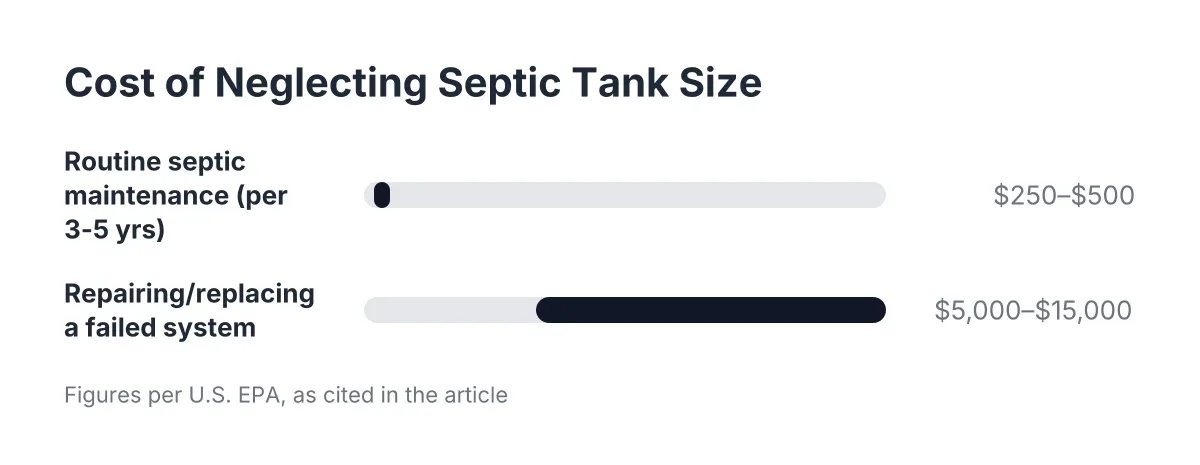
The stakes are real money. According to the U.S. Environmental Protection Agency, routine septic maintenance runs about $250 to $500 every three to five years, while repairing or replacing a failed conventional system costs $5,000 to $15,000. A tank that is too small does not fail on day one. It fails quietly, by sending grease and solids into soil that was never meant to filter them.
Septic is also less common in California than in much of the country, which means fewer neighbors who can tell you what to expect. EPA data puts California at about 10% septic use, one of the lowest rates among states, compared to a high of 55% in Vermont. That is exactly why a plain primer helps before you sign an installation contract.
How Residential Septic Tank Size Is Calculated
Residential septic tank size is calculated from the number of bedrooms in the home, not the number of people living there today. Bedrooms are a proxy for maximum occupancy. A three-bedroom house might hold two retirees now and a family of six after the next sale, so the code sizes the tank for the house, not the household.
Here is the logic. Every bedroom represents potential occupants, and every occupant represents a daily wastewater load from toilets, showers, laundry, and the kitchen sink. The tank has to hold that flow long enough for solids to settle to the bottom and grease to float to the top before the clarified liquid moves on to the drain field. Too small a tank means the water leaves before it separates.
Local code turns that logic into a table. In San Bernardino County, the minimum capacity table requires a 1,000-gallon tank for a 3-bedroom home and 1,500 gallons for a 5-to-6-bedroom home, according to the San Bernardino County Department of Public Health. Your designer will pull the exact figure for your bedroom count when the plans are drawn, but those two anchors tell you the range most Fontana homes land in.
A few practical points follow from the bedroom rule:
- Adding bedrooms later usually means the county expects a larger tank, so plan for the house you might build, not just the one on this permit.
- An office or den that could count as a bedroom on the plans may push you into the next tank size.
- Sizing above the minimum is common practice; the extra capacity is cheap insurance during installation and expensive to add later.
- The tank is only half the sizing question. The drain field gets sized from soil conditions and your septic perc test results, and it often costs more than the tank.
Common Residential Septic Tank Sizes in Gallons
Common residential septic tank sizes run from about 1,000 to 1,500 gallons for single-family homes, with 1,000 gallons serving as the working standard for a typical three-bedroom house. Smaller tanks exist, and larger homes step up from there. The right number for your build comes from the county table, not from what a supplier has on the lot.
You will see a 500 gallon septic tank mentioned online and in older listings. In practice, a tank that small rarely meets modern residential code for a full-time home in this area. Where 500-gallon vessels still show up is in secondary roles, such as pump chambers or holding tanks for specific uses, and in older properties built under earlier rules. If an existing Fontana-area property you are buying has one, expect the county to require an upgrade when you pull permits for new construction or a major remodel.
For orientation, here is how the ladder tends to run for a residential septic tank size, stated as general ranges rather than a quote:
- 1,000 gallons: the county minimum for a 3-bedroom home in San Bernardino County, and the most common size in the ground.
- 1,200 gallons: a frequent step-up choice for 4-bedroom homes or owners who want margin.
- 1,500 gallons: the county minimum for 5-to-6-bedroom homes, and a sensible choice for large households with heavy laundry and long showers.
Physical dimensions vary even at the same rated capacity. Two 1,000-gallon tanks from different manufacturers can have different lengths, widths, and depths, because the liquid level height figures into the capacity math. A common footprint for a rectangular residential tank is roughly four feet by eight feet and about five feet deep, with inspection ports at the front and rear compartments. Do not order excavation based on a generic chart; wait for the spec sheet on the actual tank your installer is setting.
What Goes Into a Septic Tank Size for a Residential Building Permit
For a residential building permit, the septic tank size gets locked in during the design and permitting phase, before anyone digs. The county reviews your bedroom count, your soil test results, and your site plan, then approves a system design that names the tank capacity and the drain field layout. That approved design is what the inspector checks against at final.
The sequence matters if you are trying to protect a construction timeline. First comes the perc test, which measures how fast water soaks into your soil. Slow soil does not change the tank size much, but it can balloon the drain field and reshape your whole site plan. Next comes the system design and permit submission, then excavation, tank set, drain field construction, and county inspection before backfill.
Suppose you are building a four-bedroom home on a half-acre parcel in the Fontana area in 2026. In that scenario, the perc test comes back workable, the design calls for a tank at or above the county minimum for four bedrooms, and the plans get stamped. The installer sets a concrete tank, plumbs the single line that carries all household drains to the tank inlet, builds the drain field with perforated pipe in gravel trenches, and calls for inspection. If the inspector finds the tank matches the approved capacity and the field matches the approved layout, you backfill and move on with the build. If the tank in the hole is smaller than the tank on the plans, you dig it back out. That is the rework everyone is trying to avoid.
One honest caution: sizing rules, setback requirements, and design standards are county-specific and they change. Nothing in this article replaces the current San Bernardino County requirements for your parcel, and a licensed designer or installer should confirm the numbers before you order a tank. Designing and installing systems is licensed work beyond pumping; according to the New Hampshire Department of Environmental Services, licensed septic installers must pass exams covering soil types, percolation rates, system design, and local regulations, and California counties impose their own equivalents.
Concrete, Plastic, and Tank Shape: Does Material Change the Size Question?
Material does not change the required capacity, but it does change the footprint, the excavation, and the lifespan conversation. A concrete septic tank is the regional standard for new residential installs in the Inland Empire. Concrete is heavy, which keeps the tank from floating in wet soil, and it holds up well under yards where vehicles might someday cross.
Shape varies by region and manufacturer. Per the International Code Council, some areas favor rectangular concrete tanks while others use circular tanks; around here, the rectangular concrete box is what you will most often see lowered off a boom truck. Plastic and fiberglass tanks exist at the same rated capacities and can make sense on sites with difficult crane access, though they need careful bedding and can shift if backfilled poorly.
Whichever material you choose, the tank works the same way. According to the US EPA, a typical residential system has two main components: a tank that clarifies the wastewater and a drain field that disperses the clarified liquid into the soil. Solids settle in the tank and stay there until a pump-out removes them. The pumped waste does not stay on your property either; as the New Hampshire Department of Environmental Services notes, it is trucked to a sewage treatment plant for disposal.
If the rest of the system is new to you, it is worth spending twenty minutes on septic system basics before your design meeting, so terms like baffle, effluent, and leach field do not slow the conversation down.
How Tank Size Affects Your Pumping Schedule
Tank size sets your pumping interval more than any other single factor. A larger tank holds more settled solids before they reach the level where they threaten the outlet, so it goes longer between pump-outs at the same household load. A smaller tank with a big family fills fast.
As a general guide, Penn State Extension advises that an active family of four should pump the tank every two to three years because of the higher solids and liquid load. A two-person household with a 1,500-gallon tank might stretch that interval considerably. The honest answer is that no calendar beats an actual measurement; a septic tank inspector can open the lid, measure the sludge and scum layers, and tell you whether this is a pump year or not.
Water habits matter as much as tank volume. The EPA reports that a single leaky or running toilet can waste as much as 200 gallons of water per day. On city sewer that is a water bill problem. On septic, that is a fifth of a 1,000-gallon tank's capacity flushing through every day, pushing solids toward your drain field before they settle. Fix running toilets fast, spread laundry loads across the week, and keep grease out of the kitchen drain. Grease is the quiet killer; the EPA notes a single restaurant can discharge 800 to 17,000 pounds of grease a year without proper management, and while your kitchen is no restaurant, the same physics clogs a residential tank and field at smaller scale.
A few habits that stretch any tank size:
- Pump on schedule rather than waiting for a slow drain or a backup to force the issue.
- Skip chemical drain cleaners; harsh products can knock back the bacteria the tank depends on. Have a stubborn line cleared mechanically instead.
- Keep wipes, grease, and food solids out of the drains, even the ones labeled flushable.
- Know where your lids are, and keep them accessible so an inspection does not start with an hour of digging.
Sizing Questions Fontana Owners Ask
Should I install a bigger tank than the county minimum?
Installing a tank one size above the county minimum is a reasonable choice for most new builds, because the incremental cost at installation is small compared to replacing a tank later. Extra capacity means longer intervals between pump-outs and headroom if you ever add a bedroom. The trade-off is a larger excavation and a modestly higher tank price, and past a certain point the extra volume buys you little; a 2,000-gallon tank under a two-bedroom cabin is money in the ground.
There is one caution. A bigger tank does not fix bad soil. If your perc test shows slow percolation, the drain field is the constraint, and no amount of tank capacity compensates for soil that cannot absorb the water. Spend the design budget where the test says the risk is.
Does an average residential septic tank size change for an apartment or multi-unit building?
Multi-unit buildings size differently from single-family homes because total occupancy, not a single home's bedroom count, drives the wastewater load. A duplex or small apartment building on septic gets engineered from the combined fixture and occupancy numbers, and it lands well above the standard residential septic tank size for a house. If your project is anything beyond a single-family residence, treat it as an engineered system from the start and budget design time accordingly.
How long will a properly sized system last?
A properly sized and maintained septic system commonly serves a home for decades, with the concrete tank often outlasting the drain field. Lifespan depends less on the tank and more on habits: regular pump-outs, sane water use, and keeping grease and solids out of the lines. Skip the maintenance and the same system can fail in a fraction of that time, and drain field replacement is where the $5,000-to-$15,000 EPA repair range gets real.
Getting the Size Right the First Time
The bedroom count on your plans sets the minimum. San Bernardino County's table gives you the floor, your perc test shapes the drain field, and a licensed designer turns both into a permit the county will stamp. Your job as the owner is simpler than it looks: confirm the bedroom count matches your long-term plans, ask whether stepping up one tank size makes sense for your household, and make sure the quote spells out whether design and permit work are included or billed separately.
Once the system is in the ground, the size question turns into a maintenance question. Mark your calendar for an inspection within the first few years, learn where your lids are, and treat the tank like the settling chamber it is rather than a garbage can with plumbing. A local septic pumper who works Fontana yards every week can measure your sludge layer and tell you, plainly, when your specific tank actually needs a pump-out. That straight answer, matched to your actual tank size, is worth more than any chart.
If you need septic tank pumping, Fontana Septic can help.
Prefer to talk it through? Call (909) 316-2368 — a quick call is usually the fastest way to get a straight answer for your situation.