
Concrete Septic Tank Durability: Lifespan, Maintenance, and How It Compares to Plastic
If you own a rental house or two on septic in Fontana, the tank material matters more than most people think. Concrete septic tank durability is the main reason installers keep setting concrete tanks decade after decade, but plastic tanks have their place too. Understanding concrete septic tank lifespan—how long each material lasts, what actually fails first, what maintenance each one needs, and how to decide which fits your property—helps landlords and homeowners make informed decisions. No sales pitch, just the plain facts a landlord or homeowner needs before a pump-out, an inspection, or a replacement quote.
Before comparing materials, it helps to know what the tank actually does. According to the U.S. Environmental Protection Agency, a conventional septic system has two main components: the septic tank and the drain field. The tank separates solids from wastewater. The clarified liquid then flows out to the leach field, where perforated pipes spread it through gravel and soil. Additionally, the tank material does not change that process. It changes how long the tank holds up while doing it.
Understanding Concrete Septic Tank Lifespan and Durability
A well-built concrete septic tank commonly lasts 40 years or more, and some keep working past 50 when the owner pumps on schedule and keeps harsh chemicals out of the drains. The concrete shell itself rarely fails first. The weak points are the baffles, the lids, and the pipe connections, which corrode over decades.
That matters for how you think about concrete septic tank life. People ask, do concrete septic tanks go bad? They can, but the structure usually outlives the parts bolted to it. Modern concrete tanks are built thick, generally several inches of reinforced concrete, and they resist crushing from soil pressure and vehicle traffic near the tank.
However, concrete is not immune to decay. Gas builds up inside a tank that never gets pumped or opened. Over time, that gas eats at the concrete above the waterline, especially the lid and the inlet and outlet baffles. A tank that has sat 15 years without a pump-out can have a solid shell and a crumbling baffle. That is one reason a septic system inspection matters even when the drains seem fine.
Shapes vary by region too. According to the International Code Council, some areas use rectangular concrete tanks while others use circular ones. In the Fontana area, a septic tank inspector can tell you what you have once the lid is uncovered.
How Long Do Plastic Septic Tanks Last?
A plastic (poly) septic tank typically lasts 20 to 30 years under good conditions, though lifespan varies widely with soil, groundwater, and installation quality. Plastic does not corrode the way concrete and metal components do. Its risks are structural: shifting, floating, and crushing.
Plastic tanks are light. That makes them easier to deliver to a tight or sloped lot, but it also means an empty plastic tank can float upward when groundwater rises. A plastic tank can also deform or collapse under heavy soil loads or if a vehicle drives over it. Many installers are reluctant to set plastic tanks for exactly these reasons and prefer concrete when the site allows it.
On the plus side, plastic tanks arrive in one piece, resist chemical corrosion, and work well on lots where a crane truck cannot reach. For unusual site conditions, plastic is sometimes the practical answer rather than the budget one.
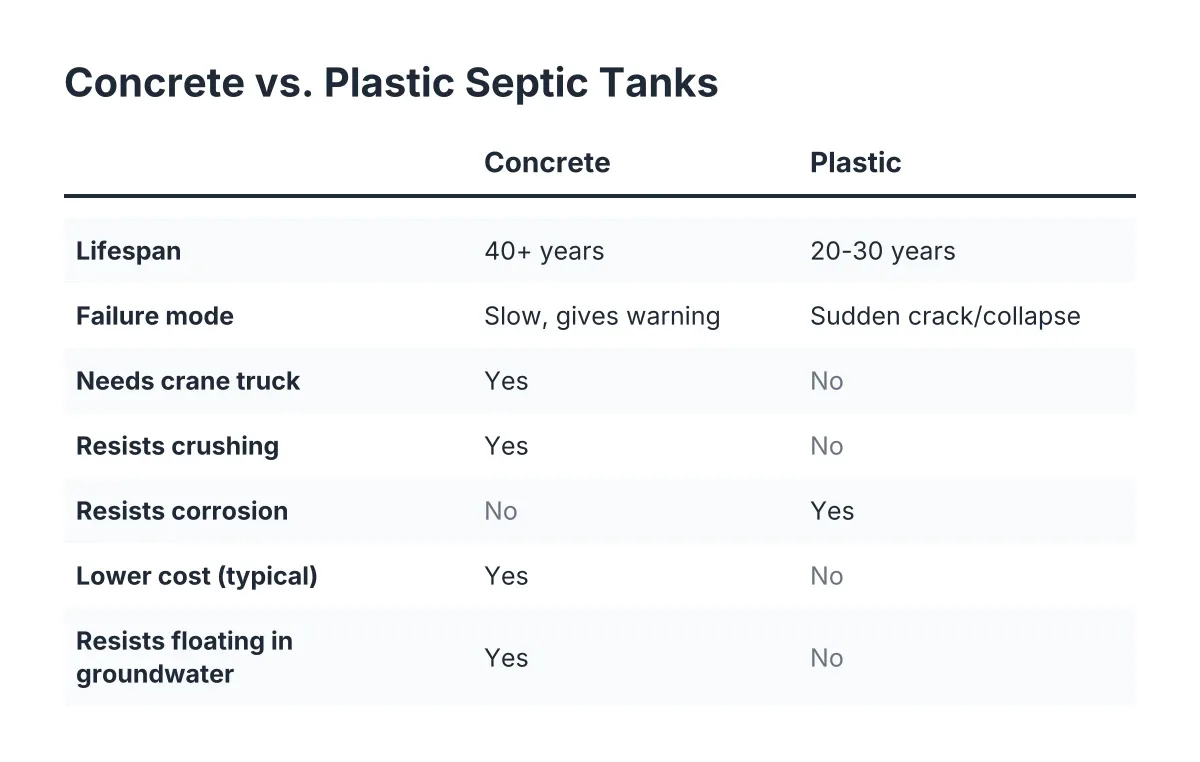
Concrete Septic Tank Lifespan and Performance vs. Plastic: Side by Side
Here is how the two materials compare on the points that drive real decisions:
- Lifespan: Concrete commonly runs 40 or more years; plastic typically runs 20 to 30. Concrete wins on raw longevity.
- Failure mode: Concrete fails slowly, usually at the baffles and lid, and gives warning during inspections. Plastic can fail suddenly by cracking, collapsing, or floating.
- Weight and installation: Concrete needs a crane truck and good access. Plastic can be carried in by hand on tough lots.
- Resistance to crushing: Concrete handles soil pressure and incidental surface loads far better. Plastic needs careful backfill and should never sit under traffic.
- Corrosion: Plastic shrugs off septic gases. Concrete corrodes above the waterline over decades, faster in a tank that never gets pumped.
- Cost: In many markets concrete tanks cost less than poly tanks of the same size, which surprises buyers who assume plastic is the cheap option.
- Buoyancy: Concrete stays put in high groundwater. Plastic can pop out of the ground if the tank is pumped empty while the soil is saturated.
For most Fontana-area lots, with stable soil and decent access, concrete septic tank durability tips the comparison toward concrete. Plastic earns its spot on sites a concrete truck cannot serve.
What Actually Wears Out a Concrete Tank
The shell is rarely the problem. Three things shorten concrete septic tank life in practice:
- Skipped pump-outs. Solids build up, gases concentrate, and the lid and baffles corrode faster. According to Penn State Extension, an active family of four should pump every two to three years because of higher solids and liquid production.
- Harsh drain habits. Heavy chemical drain cleaners, grease, and non-flushables stress the whole system. Grease is a system killer; research in the International Journal of Environmental Science and Technology estimates fat, oil, and grease deposits cause about 30 to 40 percent of sewer clogs.
- Installation shortcuts. The fill around the pipe penetrations must be compacted thoroughly after the tank is set, according to Onsite Installer. Poor compaction lets the ground settle and crack the connection, and that leak gets blamed on the tank.
In addition, a quiet water leak inside the house loads the tank constantly. The U.S. Environmental Protection Agency notes a single running toilet can waste as much as 200 gallons of water per day. In a rental, tenants rarely report a running toilet. That steady flow pushes solids into the leach field before they settle, and the drain field pays the price.
One honest caveat: nobody can promise an exact lifespan for any tank, concrete or plastic. Soil chemistry, water table, usage, and installation quality all move the number. An on-site septic system inspection is the only way to know what shape a specific tank is in.
Maintenance: Does the Material Change What You Do?
Maintenance for a concrete septic tank and a plastic one looks nearly identical: pump on a regular schedule, watch what goes down the drains, and inspect the tank and leach field every few years. The material changes what the inspector looks for, not what the owner does.
For concrete, the inspector checks the baffles and lid for corrosion and the seams for leaks. For plastic, the check focuses on deformation, cracking, and whether the tank has shifted. Either way, the pump-out is the moment to catch problems early, because the tank is open and empty.
The payoff for staying on schedule is large. EPA guidance puts regular septic maintenance at $250 to $500 every three to five years, versus $5,000 to $15,000 to repair or replace a failed conventional system. One skipped decade of pump-outs can cost more than 30 years of routine service.
Skip the shortcut products. Commercial septic additives marketed to dissolve sludge lack strong scientific backing, according to Washington State University Extension. Nothing poured down a drain replaces a pump truck.
A Landlord Scenario Worth Running the Numbers On
Suppose you own three rental houses on septic around Fontana and Bloomington, each with a concrete tank. Say each tank gets pumped every three years on a rotating schedule, one property per year. At a few hundred dollars per pump-out, that is a predictable, documented line item for your accounting. Compare that with the alternative: a tenant calls about a backup on a Friday, the inspection finds a corroded baffle and a stressed drain field, and you are suddenly pricing a five-figure repair plus a habitability complaint. In that scenario, the recurring schedule is not a convenience; it is the cheapest insurance the property has.
This is also where septic system basics pay off for owners managing multiple properties. Knowing that the tank clarifies and the drain field disperses, and that the baffle is the usual concrete failure point, lets you ask a septic pumper the right questions and read an inspection report without guesswork.
Does Tank Material Affect the Rest of the System?
Tank material has little direct effect on the drain field, but tank failures do. A cracked or corroded tank lets solids escape into the leach field, and the field clogs. According to the U.S. Environmental Protection Agency, the drain field is built from layers of gravel around perforated pipes, buried under soil, and it filters wastewater through sand and soil. Once solids plug those layers, no tank repair brings the field back.
Therefore, the durability question is bigger than the tank itself. A 50-year concrete tank protecting a drain field is worth more than the price difference between materials. In California, septic owners are a minority; EPA data shows about 10 percent of California homes use septic, among the lowest rates of any state. That means fewer contractors understand these systems well, and it puts more weight on choosing a local septic system services crew that does this work daily rather than as a sideline to drain cleaning.
Sizing is governed locally too. San Bernardino County's minimum capacity table requires a 1,000-gallon tank for a 3-bedroom home and 1,500 gallons for a 5 to 6 bedroom home, according to the San Bernardino County Department of Public Health. If you are replacing a tank in 2026, the county table, not the old tank's size, sets your floor.
How to Choose Between Concrete and Plastic
For most Fontana-area homes and rentals, choose concrete when the site allows truck access and the budget covers it. Concrete septic tank durability, crush resistance, and resistance to floating make it the lower-risk choice for a tank you want to forget about between pump-outs. Choose plastic when access is the deciding factor: a steep lot, a backyard a crane cannot reach, or soil conditions an installer specifically flags.
A short checklist for the decision:
- Access: Can a delivery truck reach the excavation? If yes, concrete is on the table.
- Groundwater: High water table? Concrete resists floating; plastic needs anchoring.
- Load: Any chance of vehicles near the tank? Concrete only.
- Budget: Get quotes on both; concrete often costs less than buyers expect.
- Timeline: Plastic installs faster on difficult sites.
Whichever material ends up in the ground, the owner's habits decide most of its life. Pump on a multi-year schedule, keep grease and chemicals out of the drains, and open the tank for a septic system inspection every few years. A concrete tank treated that way can outlast the mortgage. A neglected one, concrete or plastic, fails early and takes the leach field with it. When in doubt about an older tank's condition, have a septic tank inspector open it and look; guessing from above ground is how small baffle repairs turn into full replacements.
If you need septic tank pumping, Fontana Septic can help.
Prefer to talk it through? Call (909) 316-2368 — a quick call is usually the fastest way to get a straight answer for your situation.