
How Often Should Fontana Homeowners Pump Their Septic Tanks by Size?
How often should Fontana homeowners pump their septic tanks? For most homes, the honest answer is every three to five years, but establishing the right septic tank pumping schedule depends on tank size and household size, which can push that number in either direction. A 1,000-gallon tank serving a family of five fills with solids faster than a 1,500-gallon tank serving a retired couple. This guide breaks down pump-out schedules by tank size, in plain language, so you can set a schedule and stop guessing.
If you own one home on septic, this helps you plan. If you are a landlord with three or four rentals on septic in Fontana, Bloomington, or the surrounding unincorporated pockets, it matters even more. One missed pump-out at a rental can turn a slow drain into a backup, and a backup into a tenant habitability complaint. A schedule is cheaper than a scramble.
Why Pumping Frequency Matters More Than Anything Else You Do
Regular pumping is the single most important thing you can do to extend the life of a septic system. Everything else, from what you flush to which septic tank cleaner you buy, is secondary. The tank collects solids. Solids do not break down completely, no matter what an additive label says. Someone has to remove them.
Here is why. According to the US EPA, a typical residential septic system has two main parts: a tank that clarifies wastewater and a drain field that disperses the clarified liquid into the soil. Solids settle in the tank; liquid flows out to the leach field. When nobody pumps the tank, the solids layer rises until it starts flowing out with the liquid.
That is the failure everyone wants to avoid. Solids that reach the drain field clog the soil, and a clogged drain field often cannot be pumped clean. The U.S. Environmental Protection Agency puts routine maintenance at $250 to $500 every three to five years, versus $5,000 to $15,000 to repair or replace a failed conventional system. That gap is the whole argument for a schedule.
Septic systems are less common in California than in most states. EPA data shows about 10% of California homes use septic, compared to a high of 55% in Vermont, according to the U.S. Environmental Protection Agency. That means many people who buy a home on septic in Fontana have never owned one before. Nobody teaches this at closing. So the schedule below is written for someone starting from zero.
How Often Should Fontana Homeowners Pump by Tank Size?
Fontana homeowners should pump a 1,000-gallon tank about every 3 to 4 years for a household of three to four people, and a 1,500-gallon tank about every 4 to 5 years for the same household. Smaller tanks and larger households shorten the interval. Larger tanks and lighter use stretch it.
Two things drive the math: how much wastewater the household produces, and how much room the tank has to store solids between pump-outs. Elapsed time matters less than people think. A vacation home can go longer. A full-time rental with five occupants cannot.
For context, San Bernardino County's minimum septic tank capacity table requires a 1,000-gallon tank for a 3-bedroom home and 1,500 gallons for a 5-6 bedroom home, according to the San Bernardino County Department of Public Health. Most Fontana-area homes on septic fall in that range. If you do not know your tank size, your county permit records or a septic system inspection can tell you.
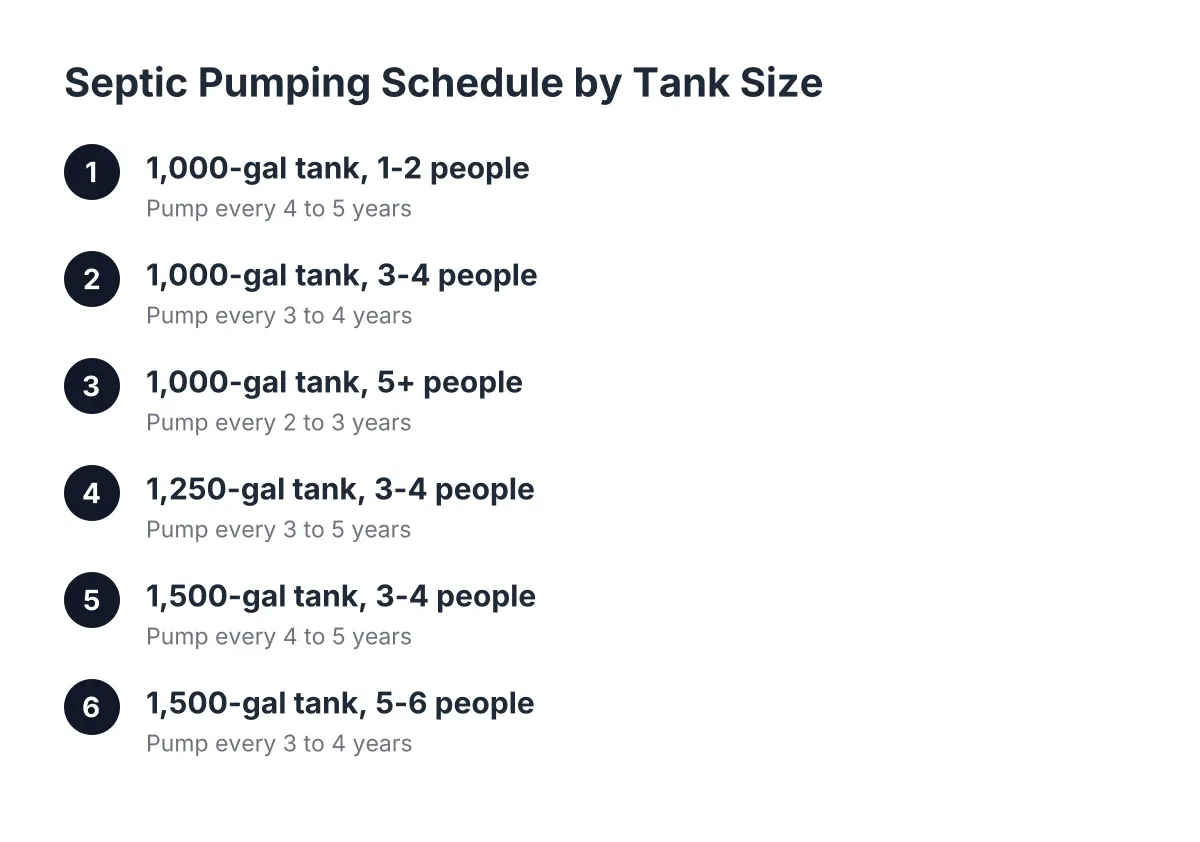
Here is a working guide by tank size and household size. Treat these as planning numbers, not promises; actual condition is what a septic pumper checks at each visit.
- 1,000-gallon tank, 1-2 people: pump every 4 to 5 years
- 1,000-gallon tank, 3-4 people: pump every 3 to 4 years
- 1,000-gallon tank, 5+ people: pump every 2 to 3 years
- 1,250-gallon tank, 3-4 people: pump every 3 to 5 years
- 1,500-gallon tank, 3-4 people: pump every 4 to 5 years
- 1,500-gallon tank, 5-6 people: pump every 3 to 4 years
These intervals line up with broader guidance. Penn State Extension notes that for an active family of four, pumping every two to three years is generally advisable because of higher household solids and liquid production. If your household runs a garbage disposal daily, does heavy laundry, or hosts often, lean toward the shorter end of your range.
One more note on frequency. Pumping too rarely lets solids build up and reach the drain field. Pumping too often wastes money. The right interval is the one matched to your tank size and occupancy, then adjusted by what the pumper finds in the tank. A good crew measures the sludge and scum layers at each pump-out and tells you whether to tighten or stretch the next interval.
Determining How Often Your Tank Needs Pumping
A 1,000-gallon septic tank typically needs a pump-out every 3 to 4 years for a household of three or four people. A household of five or more should plan on every 2 to 3 years, while one or two light users can often stretch to 4 or 5 years between pump-outs.
The 1,000-gallon tank is the most common size you will run into in the Fontana area, since the county requires it as the minimum for a 3-bedroom home. It is also the size most likely to be under-pumped, because a 3-bedroom house often holds more people than the tank was sized for.
For example, suppose a landlord owns a 3-bedroom rental in Bloomington with a 1,000-gallon tank. The last owner had two occupants and pumped every five years without trouble. The new tenants are a family of six. That same tank now needs a pump-out roughly every two years. Nothing changed about the tank; the load changed. Occupancy, not the calendar, is what fills a tank.
Can a Septic Tank Go 20 Years Without Being Pumped?
A septic tank should not go 20 years without being pumped, even if the drains still work. Solids keep accumulating whether or not you see symptoms, and by the time a backup or soggy leach field appears, the damage often extends beyond the tank into the drain field.
This question comes up because plenty of people have done it. A lightly used tank can run for many years without an obvious problem, and the owner concludes pumping is optional. Then the house sells, occupancy doubles, and the system fails within a year or two under the new load.
The trouble is that "no symptoms" is not the same as "no problem." A tank must be pumped periodically regardless of how long you have gone without trouble. Homeowners who skip maintenance altogether tend to end up needing pump-outs, and repairs, more often than those who keep a schedule. If the drain field clogs, you are in the $5,000 to $15,000 replacement range the EPA cites, not the few hundred dollars a routine pump-out costs.
If you just bought a Fontana home on septic and cannot find any pumping records, treat the tank as overdue. Get a pump-out and a septic system inspection at the same time, then start the clock on a regular interval from there.
What Changes the Schedule for Fontana Homeowners
How often should Fontana homeowners adjust the standard 3-to-5-year interval? Whenever household habits or fixtures change the load on the tank. Tank size sets the baseline, but daily use moves the needle. Watch for these load factors:
- Garbage disposal use. Ground food scraps go straight into the solids layer. Daily disposal use can shorten your pump-out interval by a year or more.
- Leaking fixtures. A single leaky or running toilet can waste as much as 200 gallons of water per day, according to the U.S. Environmental Protection Agency. That extra water pushes wastewater through the tank too fast and can carry solids toward the leach field.
- Grease down the drain. Fat, oil, and grease build deposits that clog lines. Research in the International Journal of Environmental Science and Technology estimates roughly 30-40% of sewer clogs come from grease deposits. On a septic system, grease also thickens the scum layer in the tank.
- Laundry habits. Spreading laundry across the week is easier on the drain field than running six loads every Saturday.
- Occupancy changes. A new baby, an adult child moving home, or new tenants in a rental all raise the load.
Between pump-outs, what you send down the drain matters too. Flush only human waste and toilet paper. Wipes labeled "flushable" are not septic safe; they do not break down in the tank. For cleaning, ordinary household amounts of standard cleaners are fine, but heavy use of bleach or antibacterial products can slow the bacteria that digest waste in the tank. If you want to be careful, look for septic safe bathroom cleaners, which are labeled for septic use and easy to find in 2026.
As for septic tank additives, be skeptical. No additive replaces pumping, and a healthy tank does not need help growing bacteria; every flush adds more. A system lasts longest when the owner pays attention to what goes down the drain and follows a septic tank pumping schedule on a regular multi-year basis. That combination beats any product in a jug.
One caution belongs here. Some situations call for a professional judgment, not a chart. If you have an aerobic system, standing water over the leach field, sewage odor indoors, or a system with no service history, get a septic tank inspector out before you assume a standard interval applies. Aerobic systems in particular need periodic full service, including filter cleaning and pump checks, which goes beyond a simple pump-out.
A Pumping Schedule for Landlords with Multiple Rentals
Landlords with several septic properties should put every tank on a fixed, written schedule keyed to tank size and current occupancy, then adjust after each pump-out based on what the pumper measures. Reactive pumping, meaning waiting for a tenant to report a slow drain, is the most expensive way to run rentals on septic.
The reason is simple. Tenants do not report early symptoms. They report backups. By the time you get the call, the slow drain has been building for weeks, and you are now paying for an emergency visit instead of a scheduled pump-out. Worse, a sewage backup in a rental can become a habitability issue fast.
Here is an illustrative setup. Say a landlord owns three septic rentals near Fontana: a 2-bedroom with a 1,000-gallon tank and two tenants, a 3-bedroom with a 1,000-gallon tank and a family of five, and a 4-bedroom with a 1,500-gallon tank and four tenants. In that scenario, a sensible starting schedule is 4 years, 2 years, and 4 years respectively. The landlord staggers the dates so no two pump-outs land in the same quarter, keeps the receipts and tank-condition notes in one folder per property, and updates the interval whenever tenants change.
A few habits make this work across multiple properties:
- Record tank size and location for each property. Do it once, at the first pump-out or inspection, so no future visit starts with a search for the lid.
- Use one local septic company for all properties. A crew that has seen each tank before can tell you whether the solids load is normal for that house.
- Ask for written condition notes at every pump-out. Sludge and scum measurements turn the next interval from a guess into a decision. The paper trail also helps at tax time and protects you if a tenant dispute ever comes up.
- Re-check the schedule when occupancy changes. New tenants reset the math, especially in the smaller tanks.
- Add a leach field inspection when a property changes hands or shows wet spots. Catching a drain field problem early is the difference between a repair and a replacement.
Documented septic system maintenance also pays off when you sell. A buyer's inspector will ask for pumping records, and a folder of dated receipts answers the question before it becomes a negotiation point.
How Often Should a Septic System Be Serviced Beyond Pumping?
A septic system should get a full inspection every 1 to 3 years in addition to pump-outs, with the tank pumped every 3 to 5 years for most Fontana homes. Inspection and pumping are different jobs; pumping removes solids, while an inspection checks the parts that pumping does not touch.
During a septic system inspection, a septic tank inspector checks the inlet and outlet baffles, looks for cracks or intrusion in the tank, and evaluates the leach field for ponding or saturation. The outlet side matters more than most owners realize. According to University of Nebraska-Lincoln Extension, the outlet pipe must sit lower than the inlet, since solids float on the liquid and only clarified liquid should exit toward the drain field. A damaged or missing outlet baffle lets solids escape, and that is how drain fields die quietly.
The easiest approach is to pair the two. Have the crew inspect the tank while it is open for a pump-out, since an empty tank is the only time anyone can see its walls and baffles clearly. Between visits, a walk over the leach field twice a year costs nothing: look for soggy patches, unusually green grass strips, or sewage odor, and treat any of them as a reason to call rather than wait.
If you are searching phrases like "septic pumper near me" or "septic tank pumping companies near me," the more useful question is who will keep records on your tank over years, not just who can come this week. A local Fontana crew that logs tank size, condition, and dates gives you something a one-time dispatch never will: a schedule that fits your actual system.
The Short Version
Pump a 1,000-gallon tank every 3 to 4 years for a typical household, sooner with five or more occupants, and a 1,500-gallon tank every 4 to 5 years. Adjust for garbage disposals, leaks, grease, and occupancy changes. Inspect when the tank is open. Never let a quiet system talk you into skipping the schedule; solids build whether or not the drains complain.
Routine pumping runs a few hundred dollars. A failed drain field runs $5,000 to $15,000 by EPA figures. For a homeowner, the schedule protects the single most expensive buried asset on the property. For a landlord, it is the difference between a planned line item and a tenant call at 9 p.m. Set the interval by tank size, write it down, and let the pump-out receipts do the remembering.
If you need septic tank pumping, Fontana Septic can help.
Prefer to talk it through? Call (909) 316-2368 — a quick call is usually the fastest way to get a straight answer for your situation.