
How Do Septic Systems Work? Tank, Drain Field, and Waste Flow Explained Step by Step
If you are building on unsewered land in or around Fontana, you need to understand how the septic systems work. The tank, drain field, and the flow between them are the whole story. This guide walks you through the path your wastewater will take, step by step, so you can talk to a designer, a county health inspector, or a septic pumper without guessing at what they mean.
This matters more here than in most states. According to U.S. Environmental Protection Agency data, only about 10% of California homes use septic systems, compared to a high of 55% in Vermont. That means most local builders and buyers have never lived with one.
Step 1: Trace the Wastewater From the House to a Single Pipe
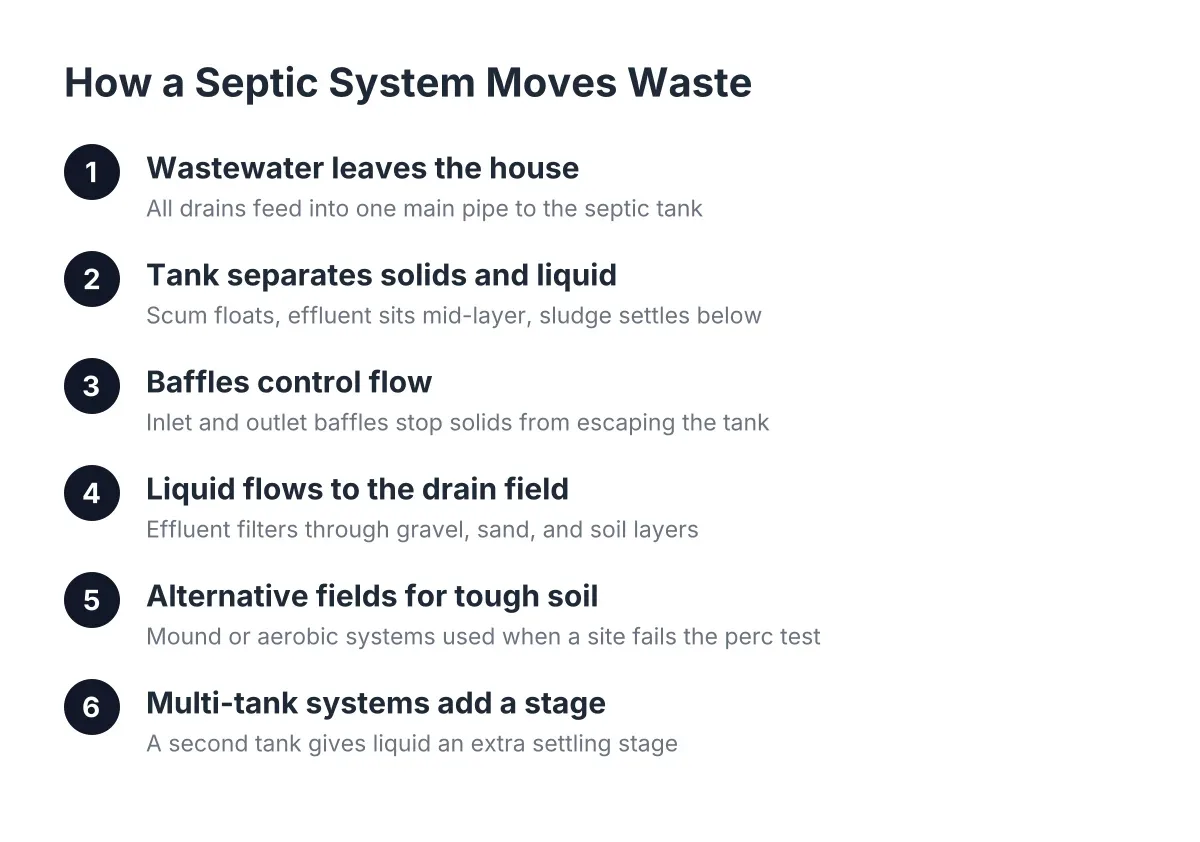
Start at the house. Every drain in the home, including toilets, showers, sinks, and the washing machine, feeds into one main line. According to US EPA, a single pipe connects all household drains to the septic tank. There is no separate path for "gray water" in a standard setup; it all goes to the same place.
With a city sewer connection, that pipe runs to a treatment plant someone else operates. With septic, the pipe runs to a tank buried on your own lot, and everything downstream of the house is your responsibility.
For a new build, the location of this line matters early. The tank has to sit where a pump truck can reach it later, and the drain field needs open soil away from the driveway, the pool, and future structures. Suppose a builder in an unincorporated San Bernardino County parcel pours a driveway over the planned tank access; in that scenario, every future pump-out becomes an excavation problem. Plan the site layout around the system, not the other way around.
Step 2: Trace What Happens Inside the Septic Tank
The tank is a buried, watertight box, usually concrete, that does one main job: it separates solids from liquid. According to the U.S. Environmental Protection Agency, a conventional septic system consists of two main components, the septic tank and the drain field.
Inside the tank, wastewater settles into three layers:
- Scum layer on top. Fats, oils, and grease float. They collect at the surface.
- Liquid layer in the middle. This clarified wastewater, called effluent, is what eventually leaves the tank.
- Sludge layer on the bottom. Heavy solids sink and accumulate over time.
Bacteria inside break down organic waste continuously, which slows how fast the sludge layer grows. That digestion happens on its own; a healthy tank does not need additives or chemicals to do its basic job.
Size is set by county rule, not preference. San Bernardino County Department of Public Health's minimum capacity table requires a 1,000-gallon tank for a 3-bedroom home and 1,500 gallons for a 5-6 bedroom home. If you are pricing a new build, confirm the bedroom count on your plans matches the tank size in your septic design, because the county checks exactly that.
What the Baffles Do
Two small parts inside the tank do a lot of work. According to University of Nebraska-Lincoln Extension, septic tanks use a baffle at both the inlet and the outlet, a downward-facing tee that stops floating solids from escaping and forces them to settle. The same source notes the outlet pipe must sit lower than the inlet, since solids float on top and only liquid should exit toward the drain field. When a septic tank inspector opens your lids, the condition of these baffles is one of the first things they check.
Step 3: Follow the Liquid Out to the Drain Field
Once the liquid level in the tank rises to the outlet, effluent flows out toward the drain field, which many people around Fontana call the leach field. This is where the actual treatment finishes. According to the U.S. Environmental Protection Agency, the wastewater moves through perforated lateral pipes into the absorption field, then filters through gravel or stone, and finally through sand and soil layers.
Per US EPA, crews lay a thick bed of gravel in trenches, set perforated pipe on top, cover the pipe with more gravel, and bury the whole assembly with soil. The soil itself is the final filter. Microbes in the ground remove harmful bacteria and nutrients before the water rejoins the groundwater below.
This is why the county requires a septic perc test before it issues a permit. The perc test measures how fast water soaks into your specific soil. Fast-draining sandy soil needs less trench; tight clay needs more, or a different system entirely. No contractor can honestly quote your cost to install a septic tank and leach field until that test result exists.
When a Standard Drain Field Will Not Work
Not every parcel passes. Where soil drains poorly or groundwater sits high, the county may require an engineered alternative. Two common ones:
- Mound septic system. The drain field is built above grade in a constructed sand mound, giving effluent enough soil depth to treat before it reaches groundwater.
- Aerobic septic system. An aerobic treatment unit adds oxygen to speed up bacterial digestion, producing cleaner effluent for difficult sites. Aerobic septic system cost runs higher than a conventional setup, both to install and to maintain, because it has mechanical parts.
For example, say a small builder is developing four lots near Sunnyslope and one lot fails the perc test. That single lot may need a mound or aerobic design while the other three get conventional systems. Budget per lot, not per project, and get the perc results before you commit to a construction timeline.
Step 4: Know How Multi-Tank Septic Systems Work
On some properties, wastewater passes through more than one tank before reaching the drain field. In a two tank septic system, the first tank captures most of the solids and the second gives the liquid a second settling stage, sending cleaner effluent to the field. A three tank setup extends the same idea, and some designs add a pump tank when the drain field sits uphill from the house.
Solids settle, bacteria digest, and clarified liquid moves on. If your county-approved design shows two tanks, it usually means the site conditions or the home size called for extra settling capacity, not that anything is wrong with the lot.
A distribution box often sits between the tank and the field. It splits the flow evenly across the drain field lines so one trench does not take all the load and fail early.
Step 5: Plan for Pumping, Because the Tank Fills No Matter What
Bacteria slow sludge buildup, but they never eliminate it. Solids accumulate, and eventually a septic pumper has to remove them through a pump-out. According to US EPA, solids settle in the tank and are later removed by pumping. That waste does not stay local; per the New Hampshire Department of Environmental Services, pumped septic waste is trucked to a sewage treatment plant for disposal.
Skipping pump-outs is the most expensive mistake a septic owner makes. When sludge rises high enough to push solids past the outlet baffle, those solids clog the drain field, and drain fields are not cheap to replace. EPA guidance puts regular septic maintenance at $250 to $500 every three to five years, versus $5,000 to $15,000 to repair or replace a failed conventional system. The math is not close.
Water habits matter too. According to the U.S. Environmental Protection Agency, a single leaky or running toilet can waste as much as 200 gallons of water per day, which floods the tank and pushes effluent to the field faster than it can absorb. On the kitchen side, grease is the enemy; EPA's report to Congress found grease is the most common cause of reported sewer blockages, at 47%. Homes on septic should keep grease out of the drain for the same reason, and commercial kitchens rely on grease trap cleaning to manage it.
Watch for early warning signs: a slow drain throughout the house, a sewage smell in the yard, unusually green grass over the field, or a backup at the lowest fixture. Any of those calls for a septic system inspection, not a bottle of drain cleaner, since harsh chemicals kill the bacteria the tank depends on.
Step 6: Match the System Basics to Your Permit Timeline
If you are the one pulling permits in 2026, here is how these septic system basics map to your build sequence in San Bernardino County:
- Perc test first. The county health department needs soil results before it reviews a septic design.
- Design and permit approval. The engineered design sets tank size by bedroom count and drain field size by soil rate. Approval comes before construction, not after.
- Installation and county inspection. The system typically gets inspected open in the ground, before backfill.
- Ongoing service. Once occupied, the system needs routine pump-outs and periodic inspection to protect the drain field.
A well-built conventional system commonly lasts decades; tanks often outlast the drain field, and how long the whole system lasts depends mostly on soil, water load, and whether pump-outs happened on schedule. That is the honest answer to lifespan questions: maintenance decides it more than materials do.
One limitation worth stating plainly: this article explains how the pieces work, but it cannot replace a site-specific design. Soil, slope, groundwater, and setbacks vary lot by lot, so have a qualified designer and the county health department confirm what your parcel actually needs before you schedule grading.
Once you can trace the flow from house pipe to tank to leach field, the rest of septic ownership gets simpler. Quotes make sense, inspection reports read clearly, and when a local Fontana septic pumper explains what they found in your tank, you will know exactly what they are talking about.
If you need septic tank pumping, Fontana Septic can help.
Prefer to talk it through? Call (909) 316-2368 — a quick call is usually the fastest way to get a straight answer for your situation.