
Septic System Installation Timeline: Permits, Excavation, and Testing Explained
If you are building on unsewered land in the Fontana area, the septic installation timeline can make or break your construction schedule. The framing crew cannot pour a slab schedule around a hole in the ground that the county has not approved. Most delays do not happen during the dig. They happen before it, in the perc test and permit stage, and after it, waiting on the final inspection. This guide walks through each stage in order so you know where the time actually goes and what you can do to keep the build moving.
One note before we start. In California, septic work is treated as a public health matter. Counties require permits and licensed contractors for installation because a bad system can contaminate wells and neighboring property. That is also why California sits at about 10% septic use statewide, one of the lowest rates in the country, according to U.S. Environmental Protection Agency data. Fewer systems means fewer county staff who process them, which is one reason the paperwork stage takes longer than most owners expect.
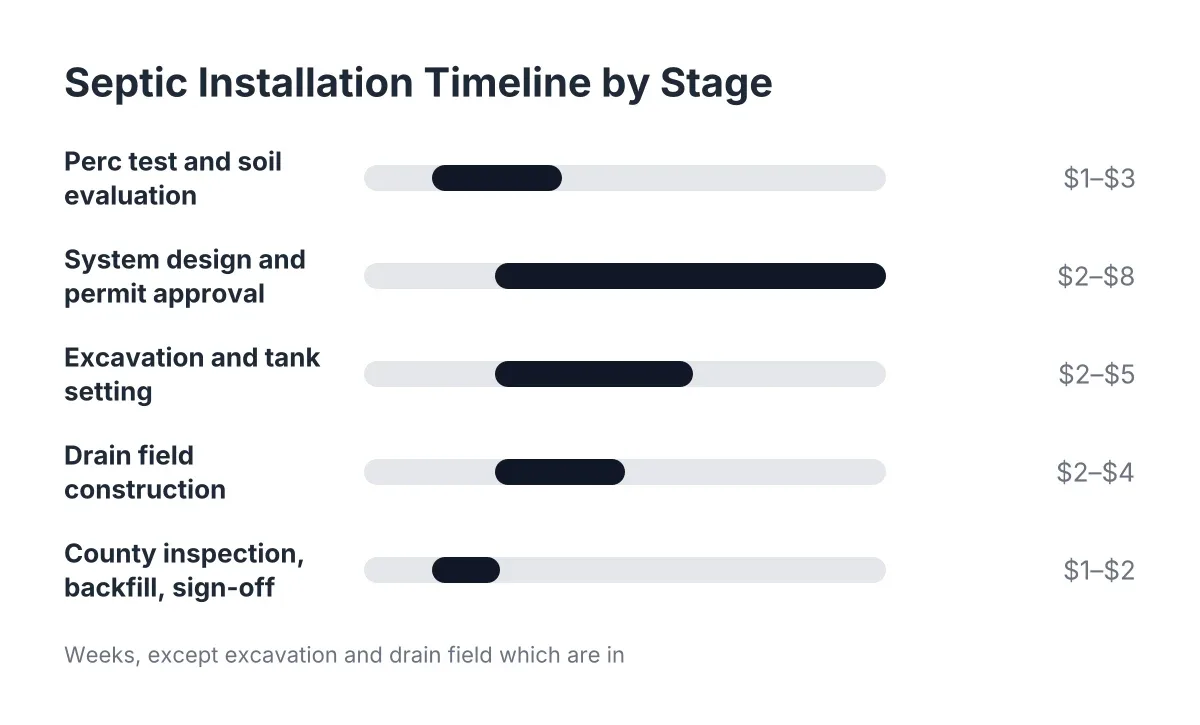
Here is the short version of the full septic system installation timeline:
- Perc test and soil evaluation: 1 to 3 weeks, plus county scheduling
- System design and permit approval: 2 to 8 weeks, depending on the county queue
- Excavation and tank setting: 2 to 5 working days
- Drain field construction: 2 to 4 working days
- County inspection, backfill, and sign-off: 1 to 2 weeks
Those working-day figures are illustrative estimates for a straightforward site, not a promise. Rocky ground, a sloped lot, or a busy county calendar can stretch any stage. Now, step by step.
Step 1: Get the Perc Test Done Before Anything Else
A percolation test must be dug and performed before installing a septic system, according to University of Nebraska-Lincoln Extension. The test measures how fast your soil absorbs water, and it decides whether a standard leach field will work on your lot at all. No perc test, no permit. No permit, no dig.
In San Bernardino County, this is the first gate on your septic installation timeline. The test itself takes a day or two of field work, but the soil often needs to be pre-soaked, and the county has to accept the results. Budget one to three weeks for this stage, and more if the county calendar is full.
Here is the part that catches new construction owners: if the soil drains too slowly or too fast, you may need an engineered or alternative system instead of a conventional one. That changes the design, the cost, and the whole septic system installation timeline. Find this out before you lock in your build schedule, not after.
Should I do the perc test before buying the land?
Yes, whenever possible. A failed perc test on land you already own is an expensive surprise. A failed perc test on land you have not closed on yet is a negotiating point or a reason to walk away. Sellers of unsewered parcels in the Fontana area are used to perc contingencies in offers.
Step 2: Submit the Design and Pull the County Permit
County-approved septic design plans have to be submitted before the project can move forward. The design ties directly to your perc results and your house plans, because tank size is set by bedroom count. San Bernardino County's minimum capacity table requires a 1,000-gallon tank for a 3-bedroom home and 1,500 gallons for a 5-6 bedroom home, according to the San Bernardino County Department of Public Health.
This is usually the longest stage in the entire septic installation timeline approval process. The digging takes days; the approval takes weeks. Plan for two to eight weeks depending on how busy the county is and whether the plans come back with corrections. In 2026, county review queues in the Inland Empire still run longer during spring and summer building season, so submit early if you can.
Placement rules matter here too. Most local regulations require at least 10 feet between the septic system and the building it serves, per the Minnesota Pollution Control Agency, and setbacks from wells and property lines add more constraints. A tight lot can force a redesign, which resets the clock.
When you get bids, ask each contractor one direct question: does this quote include the design and permit work, or just the labor and materials? Some crews handle the county paperwork start to finish. Others expect you to manage it. If nobody owns the permit, the permit owns your schedule.
Can I install my own septic system in California?
In California, homeowners generally cannot handle a septic system installation on their own, because counties treat septic as a public health matter requiring permits and licensed work. Installation calls for knowledge of soil types, percolation rates, system design, and local rules; becoming a licensed installer requires certification and exams beyond what a pumping operation needs, according to the New Hampshire Department of Environmental Services. Even if you dig well, an unpermitted system cannot be legally connected, and the county can make you tear it out.
Step 3: Excavate the Tank Pit and Set the Tank
Once the permit is in hand, the crew excavates a pit for the tank and a trench connecting it to the house. Then the tank gets craned or lowered into place. On a cooperative lot, this stage runs two to five working days.
Two things drive delays here. First, tank delivery. Precast concrete tanks come from a supplier on their schedule, and the excavator cannot set a tank that is not on site. Second, weather. Once the hole is open, work should continue without pause, because rain can collapse the pit walls and change the soil conditions the design was based on. A good crew watches the forecast before they break ground.
Detail work at this stage prevents problems years later. The fill around the point where the pipe enters the tank should be compacted thoroughly so the connection does not settle and crack, a standard practice noted by Onsite Installer. A cracked inlet is the kind of defect that shows up as a slow drain or a backup two winters from now, and then you are paying for a repair on a system that never got a fair start.
Keep the approved site permit on the job site through this whole stage. The crew will reference it repeatedly for setbacks, depths, and layout, and the inspector will expect it to match what is in the ground.
Step 4: Build the Drain Field
The drain field, also called a leach field, is where the clarified water actually goes. A typical residential system has two main parts: the tank, which separates solids and clarifies wastewater, and the drain field, which disperses that liquid into the soil, per US EPA. Construction follows a set sequence: the crew digs the trenches, lays a thick bed of gravel, places perforated pipes on top, covers the pipes with more gravel, and buries the whole assembly with soil.
For example, on a 3-bedroom new build with good perc results, drain field construction typically takes two to four working days. Slow-draining soil means longer trenches or more of them, which adds time and materials.
Do not backfill everything yet. In most counties, the inspector has to approve the installation before it is fully covered. Crews may partially backfill just to hold components in place, but burying an uninspected system is a fast way to be told to dig it back up.
Step 5: Pass the Final County Inspection and Backfill
The county inspects the open system, checks it against the approved plans, and signs it off before it can go into service. Health department inspection after installation is a standard part of the process, as the Caroline County Health Department notes. Scheduling this visit is another point where the timeline sits outside anyone's direct control; plan for one to two weeks between requesting the inspection and getting the green tag.
After sign-off, the crew backfills, grades the site, and marks the tank lids and access risers. Take photos and keep a site sketch. Ten years from now, when it is time for a routine pump-out, you or the next owner will want to know exactly where those lids sit instead of paying a septic pumper to probe the yard looking for them.
Where the Septic Installation Timeline Actually Slips
Suppose a small builder in the Fontana area plans a 3-bedroom spec home and pencils in three weeks for septic. The dig fits in three weeks fine. But the perc test scheduling, the design corrections, and the final inspection wait push the true start-to-finish window to two or three months. In that scenario, the builder who submitted the perc test application the same week escrow closed stays on schedule; the one who waited until framing is stuck.
The pattern holds for landlords too. Say a duplex owner in Rialto or Colton has a shared system that failed inspection and needs full replacement. Tenants are still flushing during the whole process, so every week of permit delay is a week of pumping the old tank to limp it along, or worse, a vacancy. Repairing or replacing a failed conventional system runs $5,000 to $15,000, versus $250 to $500 every three to five years for routine maintenance, according to U.S. Environmental Protection Agency guidance. The permit stage, not the excavation, is where that owner loses or saves the most time.
The takeaway is simple. Start the perc test and permit process as early as your project allows, hire a contractor who tells you plainly what the quote covers, and keep a buffer in your build schedule for the county's calendar. If your lot has slopes, questionable soil, or tight setbacks, bring in a licensed installer and the county early; those sites need professional design judgment, and no article replaces it. The digging is the fast part. The paperwork is the schedule.
If you need septic tank pumping, Fontana Septic can help.
Prefer to talk it through? Call (909) 316-2368 — a quick call is usually the fastest way to get a straight answer for your situation.