
Drain Field Installation Failure in Fontana, CA: Causes, Prevention, and Soil Prep Mistakes
A new septic system should work for decades, but drain field installation failure can sink a build before the county ever signs off. Most of these failures trace back to the same handful of mistakes: skipped or rushed perc testing, poor soil preparation, undersized fields, and trenches put in the wrong spot. If you are building on unsewered land in Fontana, CA and need the system to pass inspection the first time, this FAQ covers what goes wrong, what it costs, and how to pick an installer who will not put your construction schedule at risk.
What causes drain field installation failure?
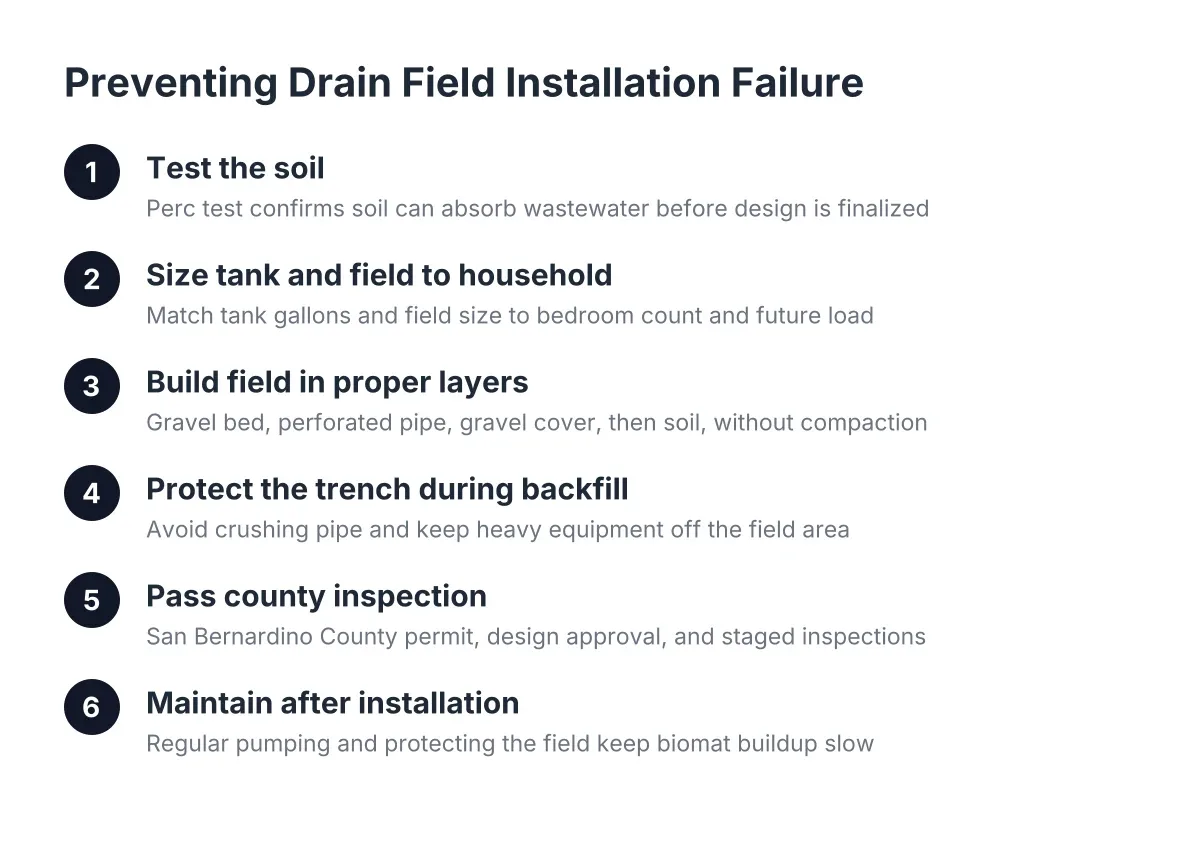
Drain field installation failure usually comes from four sources: inadequate soil testing, an undersized absorption area, poor trench construction, or bad siting. Each one lets wastewater back up instead of soaking into the ground. The frustrating part for a new construction owner is that none of these show up on day one; they surface months later, after the installer is gone.
A conventional septic system has two main components, the septic tank and the drain field, according to the U.S. Environmental Protection Agency. The tank settles out solids, and the drain field disperses the clarified liquid into the soil. When the field cannot absorb that liquid, wastewater backs up into the tank and can push into the house. That is the failure every homeowner in Fontana, CA wants to avoid on a brand-new system.
Common installation mistakes include:
- Skipping or shortcutting the septic perc test, so the field is built in soil that drains too slowly
- Compacting the trench soil with heavy equipment, which seals the pores the field depends on
- Building the field too small for the tank size and bedroom count
- Placing trenches too close to drainage ditches, wells, or high groundwater
- Crushing corrugated pipe during backfill or leaving pipe unprotected from roots
How does a perc test prevent drain field installation failure?
A percolation test measures how fast water drains through the soil at the exact spot where the drain field will go. According to University of Nebraska-Lincoln Extension, a perc test must be dug and performed before installing a septic system to confirm the soil can handle the load. If the soil fails, you change the design or the location before any pipe goes in.
San Bernardino County requires this testing as part of the permit process for new septic system installation. For a permit-driven build, the perc test is not red tape; it is the single cheapest insurance against problems with drain field installation. Redesigning on paper costs a few hundred dollars. Replacing a clogged field costs thousands and puts your build months behind.
What soil preparation mistakes ruin a new drain field?
The most damaging soil prep mistake is compaction. When excavators or trucks drive over the future drain field area, they crush the soil structure, and effluent can no longer seep through. A careful installer flags off the field area before grading starts and keeps heavy equipment out of it for the whole build.
A proper field is built in layers, per US EPA guidance: a thick layer of gravel, perforated drain pipes set on top, another gravel layer over the pipes, and then soil to bury the assembly. Skip the gravel bedding, smear wet clay along the trench walls, or backfill with the wrong material, and the field starts life half clogged. In addition, the fill around the pipe where it enters the tank should be compacted thoroughly so settling does not break that connection later.
Why do drain fields fail even when the tank is fine?
Drain fields fail independently of the tank because the soil interface, not the tank, does the final work of absorbing wastewater. Over time a tar-like organic layer called biomat builds up where effluent meets soil. It seals the pores around one section of pipe, flow shifts to the next section, and eventually the whole field clogs.
On a well-built system with regular septic tank pumping, that process takes decades. On a system with installation failure baked in, it can take two or three years. An undersized field saturates fast because every square foot works overtime. That is why sizing the field to the household, not just meeting the tank minimum, matters so much.
How many bedrooms will a 1,500 gallon septic tank support?
A 1,500 gallon tank supports a 5 to 6 bedroom home under San Bernardino County rules. The county's minimum capacity table requires a 1,000-gallon tank for a 3-bedroom home and 1,500 gallons for a 5 to 6 bedroom home, according to the San Bernardino County Department of Public Health. The drain field must be sized to match, based on your perc test results.
However, the tank is the cheap part of sizing. A larger tank with a cramped drain field still fails. If you plan to add bedrooms or an ADU later, size the field for the future load now, while the excavator is already on site.
Can I install my own septic system in California?
In California, septic installation runs through your local health department, and in the Fontana area that means San Bernardino County permits, approved design, and inspections at set stages. As a practical matter, the design, perc test documentation, and construction standards push nearly all new construction owners to a licensed installer. Septic installation is its own trade; as the New Hampshire Department of Environmental Services notes about licensing generally, installers must show knowledge of soil types, percolation rates, system design, and local regulations beyond what a pumping operation needs.
For a permit-driven build, the real question is not whether you can dig the hole. It is whether the county will approve what you dug. A failed final inspection means rework, and rework means your framing crew sits idle while you fix trenches.
What does it cost to fix a failed drain field?
Repairing or replacing a failed conventional system runs $5,000 to $15,000, according to the U.S. Environmental Protection Agency, while routine maintenance costs $250 to $500 every three to five years. Drain field failure cost sits at the high end of that range because the fix means digging up or abandoning the old trench lines and installing new ones, often in a fresh section of yard that also has to perc.
For example, suppose a builder in north Fontana finishes a four-bedroom home and the field saturates within 18 months because trucks compacted the soil during construction. In that scenario, the fix is not a patch. It is a new field in untouched soil, a revised permit, and another round of county inspection, easily a five-figure bill on an illustrative budget. Compare that to the cost of flagging off the field area on day one, which is close to zero.
How do I choose septic system installers near me in Fontana, CA?
Choose an installer who handles both the county paperwork and the digging, and who can show you perc test results and an approved design before breaking ground. When you search "septic tank installation near me" or "septic system installers near me," the thin one-page listings all look alike. The difference shows up in how they answer questions about San Bernardino County permitting.
Ask these before you sign:
- Does the quote include the perc test, design, and permit fees, or just labor and materials?
- How will you protect the drain field area from equipment traffic during the rest of my build?
- How did you size the field, and what happens if the first test area fails to perc?
- What setbacks from wells, drainage, and property lines does the design maintain?
- Who schedules and meets the county inspector at each stage?
A straightforward crew answers these on the phone without a script. If you get vague answers on soil prep or permits as of 2026, keep looking; those are the two places where drain field installation failure starts.
How do I protect a new drain field after installation?
Protect a new field by keeping vehicles off it, directing roof and surface water away from it, and sticking to a pump-out schedule for the tank. Regular septic tank pumping keeps solids out of the field, which is what slows biomat buildup. A septic system inspection every few years catches slow drains and soggy patches before they become a backup.
One honest trade-off: even a flawless installation has a finite life, and unusual site conditions like shallow groundwater or heavy clay may call for an engineered design beyond a standard field. If your lot perced poorly or your household load is heavy, have a local septic system inspector or designer look at the site before you commit to a layout. Getting that call right on a Fontana lot is the difference between a system that quietly works for 30 years and one you dig up before the paint inside is dry.
If you need septic tank pumping, Fontana Septic can help.
Prefer to talk it through? Call (909) 316-2368 — a quick call is usually the fastest way to get a straight answer for your situation.