
Septic Tank Installation Costs in Fontana: Permits, Labor, and Equipment Breakdown
If you are building on an unsewered parcel near Fontana, septic tank installation costs are probably the biggest unknown line item on your budget sheet, and understanding the cost of new construction septic installation is essential before you break ground. You have a building permit filed, a construction loan ticking, and a county health department that will not let you pour a foundation until the septic design is approved. This guide breaks the cost down the way a local contractor would over the phone: permits, perc testing, the tank itself, excavation and labor, drain field materials, and the equipment that moves the dirt. It also covers what San Bernardino and Riverside County permitting actually requires, because the paperwork is where most builds lose time, not the digging.
Why Septic Costs Start With the County, Not the Contractor
Most cost guides start with the tank. That order is backwards for new construction in this area. In unincorporated San Bernardino County and nearby Riverside County parcels, the health department must approve your septic design before construction proceeds. No approved design, no system, no occupancy.
Counties treat septic work as a public health matter. A leaking system can contaminate wells and neighboring property, so the work generally requires a licensed contractor and permits. That is why you cannot price a system off a national calculator. Your cost depends on what your soil, your lot, and your county say it depends on.
This matters for your schedule as much as your wallet. According to U.S. Environmental Protection Agency data, only about 10% of California households use septic systems, compared to a high of 55% in Vermont. Septic is the exception here, not the rule, and county reviewers handle it that way. Expect review cycles, required inspections, and a process that rewards builders who submit clean paperwork the first time.
What Drives the Cost of New Construction Septic Installation
Septic tank installation costs on a new construction lot are driven by five things: the permit and design work, the perc test results, the tank size the county requires, the drain field footprint your soil demands, and the site conditions your excavator hits once the digging starts. Two identical house plans on two different parcels can land thousands of dollars apart because of soil and slope alone.
Here is the practical breakdown of where the money goes on a typical project:
- Design and permitting. Perc test, engineered design if required, county plan review fees, and the installation permit itself.
- The tank. A concrete tank sized to the bedroom count, delivered and set by crane or boom truck.
- Excavation and labor. Digging the tank hole and drain field trenches, setting the tank, laying pipe, and backfilling.
- Drain field materials. Chambers or pipe and gravel, a distribution box, clean-outs, and risers for future access.
- Equipment and fuel. Excavator time, trucking for spoils or gravel, and compaction equipment.
A lot with gentle slope, decent soil, shallow trench depth, no rock, and no need for a pump system sits at the low end of the range. Deep trenches, poor percolation, rock removal, or a pump and alarm setup push the number up fast. That is the honest answer behind every wide cost range you see online.
How much does it cost to install a septic system in California?
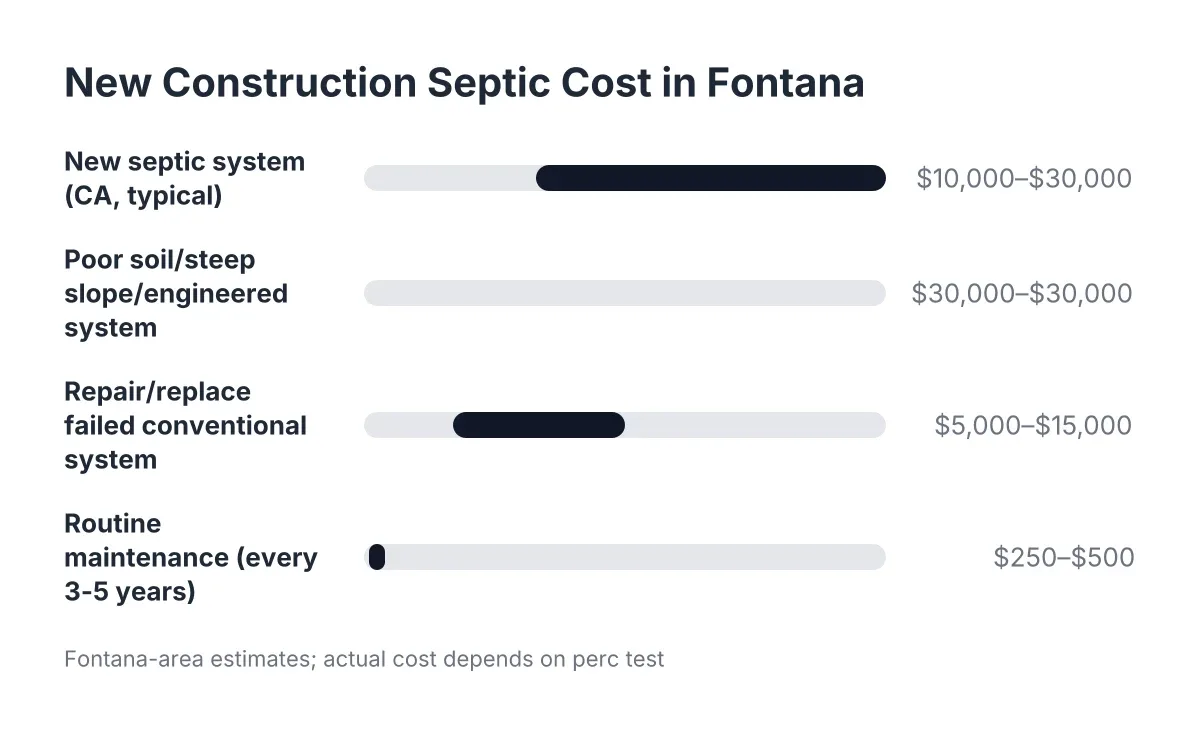
A new septic system in California generally runs from the low five figures for a straightforward conventional system to $30,000 or more where soil is poor, slopes are steep, or an engineered or pump-assisted system is required. In the Fontana area, many new construction installs land in the $10,000 to $30,000 range as an estimate, depending on design and site conditions.
Treat those numbers as planning figures, not quotes. The perc test and county design review determine which category your lot falls into, and nobody can price your system honestly before that work is done. Any contractor who gives you a firm number before seeing perc results is guessing with your money.
For comparison, EPA guidance notes that repairing or replacing a failed conventional system runs $5,000 to $15,000, while routine maintenance costs $250 to $500 every three to five years. The lesson for a new build is simple. Spend the money on correct design and installation now, then protect it with cheap, regular pump-outs later.
The Permit and Design Costs Nobody Puts on the Flyer
Before anyone digs, you pay for paper. On a new construction lot in San Bernardino or Riverside County, that paper trail typically includes a percolation test, a septic system design, health department review, and the installation permit. On some parcels you also need separate sign-offs from both the local jurisdiction and the county, so confirm early which desks your plans must cross.
The perc test comes first. According to University of Nebraska-Lincoln Extension, a percolation test must be dug and performed before installing a septic system; it measures how well the soil drains water, which determines whether the system will function. In this region, perc results drive the drain field size, and drain field size drives a large share of your total new construction septic cost. Fast-draining soil means shorter trenches and less material. Slow soil means a bigger field, or in tough cases an engineered alternative system with a bigger price tag.
Next comes the design. Builders searching for "septic system design and permit" services are looking for the right thing: one party who handles both the drawings and the county submittal. Designing a system takes real knowledge. The New Hampshire Department of Environmental Services notes that licensed septic installers must pass exams covering soil types, percolation rates, system design, and local regulations, beyond what a pumping operation requires. The same logic applies here. Design is not a formality; it is the document the county holds your installer to.
Budget time as carefully as money. County plan review is not instant, and inspection scheduling is outside any installer's control. A clean submittal that matches county setback and sizing tables moves through review faster than one that bounces back for corrections. That is where local knowledge of San Bernardino and Riverside County requirements pays off; a resubmittal can cost you weeks on a construction timeline where every week has a carrying cost.
Tank Size, Bedrooms, and What the County Requires
The county, not your budget, sets the minimum tank size. San Bernardino County's minimum septic tank capacity table requires a 1,000-gallon tank for a 3-bedroom home and 1,500 gallons for a 5-6 bedroom home, according to the San Bernardino County Department of Public Health. Bedroom count is the sizing driver because it predicts occupancy and daily wastewater flow.
How many bedrooms will a 1500 gallon septic tank support?
In San Bernardino County, a 1,500-gallon septic tank supports a home with 5 to 6 bedrooms under the county's minimum capacity table. A 3-bedroom home needs at least a 1,000-gallon tank. If you are planning a larger custom home or might add bedrooms later, size the tank for the final bedroom count now.
Upsizing at install is one of the cheapest insurance policies in the whole project. The incremental cost of a larger concrete tank is small compared to replacing an undersized one after the house is finished. However, a bigger tank does not shrink your drain field. The field is sized to flow and soil, so do not expect a 1,500-gallon tank to buy you a smaller leach field.
It helps to remember what you are actually buying. According to U.S. Environmental Protection Agency guidance, a conventional septic system has two main components: a tank that clarifies wastewater and a drain field, also called a soil absorption area, that disperses the clarified liquid into the ground. Inside the tank, baffles at the inlet and outlet force solids to settle rather than float through, as described by University of Nebraska-Lincoln Extension. The tank is the visible purchase. The drain field is usually the bigger variable in your septic tank installation costs.
Labor, Excavation, and Equipment: Where the Dollars Actually Go
Once permits clear, the spend shifts from paper to iron. Labor and equipment typically make up the largest share of the install, and they are also where surprises live. The crew digs the tank excavation, sets the tank, trenches the drain field, lays chambers or pipe and gravel, installs the distribution box and clean-outs, and backfills.
Site conditions set the pace. Trench depth, rock, groundwater, and access all change how many machine hours the job takes. A lot where the excavator can work close to the trenches costs less than one where material gets moved twice. Rock is the classic budget breaker; hitting hardpan or cobble mid-dig means slower progress and sometimes different equipment.
Detail work matters here too, and it is worth asking any installer about it. For example, Onsite Installer notes that after a tank is set, the fill around pipe penetrations should be compacted thoroughly to prevent settling or damage at that connection. A settled inlet pipe is a future backup waiting to happen, and it is invisible once backfilled. Placement rules apply as well; most local regulations require at least 10 feet between the septic system and the building it serves, per the Minnesota Pollution Control Agency, and local setbacks from wells and property lines can be stricter.
Plan for three trades, not one. A complete install typically involves a licensed septic installer for the tank and drain field, a licensed plumber to connect the house plumbing to the system, and an electrician if the design includes a pump or alarm. On a new build, your general contractor usually coordinates this, but confirm whose quote covers which scope so the connections do not fall between subcontractors.
A hypothetical Fontana-area build, line by line
Suppose a small builder is putting a 4-bedroom home on an unsewered parcel near the Fontana area, with decent soil and a gentle slope. In that scenario, an illustrative budget for new construction septic work might look like this, as estimates only:
- Perc test and engineered design: a few thousand dollars, plus county review fees.
- Installation permit: several hundred dollars, varying by jurisdiction.
- Concrete tank, delivered and set: a few thousand dollars.
- Excavation, drain field trenches, materials, and backfill: the largest block, often half the project or more.
- Plumbing connection and final grading: the remainder.
Now change one variable. Say the perc test comes back slow. The drain field doubles in length, trenching hours climb, and gravel trucking goes up with them. Nothing about the house changed, but the septic budget moved by thousands. That single variable is why experienced builders perc test early, before they lock the construction budget.
Inspections, Delays, and Keeping the Build on Schedule
Permitted septic work gets inspected, and inspections set your schedule. After the perc test, local health department inspection is typically part of the installation process, as the Caroline County Health Department outlines. In practice, that often means an inspector looks at open trenches and tank placement before backfill, with a final check before the system is approved for use. Pump-assisted and aerobic systems usually add visits, since alarms and electrical hookups get checked too.
Two schedule risks deserve a line in your project plan. First, tank delivery depends on the precast supplier's schedule, not your framing calendar. Second, county inspectors book out, and an open trench waits until they arrive. Neither is the installer's fault, but a local crew that works with these county offices regularly can usually sequence the work so the waiting overlaps with other site tasks instead of stopping the job cold.
Can I install my own septic system in California?
In California, owner-installed septic systems are heavily restricted, and in San Bernardino and Riverside County the work generally requires permits and a licensed contractor because septic is regulated as a public health matter. Even where an owner-builder path technically exists, the county still requires an approved design, permits, and passed inspections before the system can be used.
For a new construction project, self-installing rarely pencils out. The design must be county-approved regardless, the excavation requires equipment most owners rent at retail rates, and a failed inspection means rework on a timeline that is already costing you money. Where an owner can realistically save is on coordination: get the perc test done early, hand the installer a complete site plan, and keep the drain field area free of construction traffic so compacted soil does not fail the design. If your lot has steep slopes, suspected high groundwater, or a history of failed perc tests, bring in a qualified designer before you commit to the parcel's building footprint at all; that is a judgment call beyond any general guide.
Comparing Quotes Without Getting Burned
Quotes for septic system installation are hard to compare because contractors draw the scope line in different places. One number includes the perc test, design, permits, tank, and drain field. Another covers labor only and assumes you handle the county yourself. Both can be honest quotes, but they are not the same job.
Before you sign, get written answers to these questions:
- Does the price include the perc test, design, and all county permit fees, or just installation labor?
- Who submits to the health department and attends inspections, you or the contractor?
- What happens to the price if the crew hits rock, groundwater, or soil that does not match the perc results?
- Is the tank size per the county table for your final bedroom count, with risers to grade for future pump-outs?
- Which trades are covered: septic installer, plumber, electrician, or only one of the three?
The rock-and-groundwater question matters most. Hidden conditions are the main source of mid-project price changes, so you want the contingency terms in writing, not discovered in a change order. A contractor familiar with soils in the Fontana area and the surrounding unincorporated parcels can usually tell you before digging which surprises your neighborhood tends to produce.
One more consideration for anyone planning multiple lots. If you are developing several parcels, consistency across installs is worth as much as price. The same designer, the same county reviewer relationships, and the same crew sequence means lot two and lot three move faster than lot one.
Protecting the Investment After the County Signs Off
A passed final inspection is the start of the system's life, not the end of your involvement. The economics favor maintenance by a wide margin. As noted earlier from EPA guidance, routine maintenance runs $250 to $500 every three to five years, while a failed conventional system costs $5,000 to $15,000 to repair or replace. For a builder, that is also the handoff conversation with the eventual homeowner: pump-outs are cheap, drain field replacement is not.
Small habits protect the system too. The EPA points out that a single leaky or running toilet can waste as much as 200 gallons of water per day, and all of that water loads the drain field. On the additive side, skip the shortcuts; a well-designed system does not need monthly treatments, and no additive substitutes for a scheduled pump-out by a local septic pumper. Regular septic tank pumping and a periodic septic system inspection catch baffle damage, sludge buildup, and early leach field trouble while they are still cheap to fix.
The bottom line for a permit-driven build near Fontana is straightforward. Perc test early, size the tank to the county table, get the scope line of every quote in writing, and work with people who know how San Bernardino and Riverside County health departments run their reviews. The dirt work is the easy part. The schedule lives and dies on the paperwork.
If you need septic tank pumping, Fontana Septic can help.
Prefer to talk it through? Call (909) 316-2368 — a quick call is usually the fastest way to get a straight answer for your situation.