
Septic System Installer Licensing in Fontana: What to Check Before You Hire
If you are planning a new septic system on unsewered land near Fontana, the contractor you hire matters as much as the design on paper. Septic system installer licensing is the first thing to verify, because San Bernardino County treats septic work as a public health matter, not just a construction job. When checking septic installer licensing, a licensed installer who knows local permitting keeps your build on schedule and helps the system pass county inspection the first time. An unlicensed one can leave you with a failed inspection, a torn-up lot, and a permit that stalls for months.
This guide walks through what licensing means in California, which certifications and permits apply in the Fontana area, how to vet an installer before you sign anything, and what a properly run installation looks like from perc test to final sign-off. It is written for two readers: the first-time buyer who just closed on a property with a septic system, and the builder or developer working lots in unsewered pockets like Sunnyslope, Glen Avon, or Jurupa Valley who cannot afford a permit delay.
Why Septic Installer Licensing and Checks Matter for System Safety
Septic system installer licensing exists because a badly built system is a health hazard, not just a plumbing problem. A tank set at the wrong depth, a drain field placed over poor soil, or an outlet pipe installed higher than the inlet can push raw sewage into the ground, toward a well, or back into the house. Counties license installers so there is someone accountable, trained, and insured on every job.
Licensing is also a separate skill set from pumping. According to the New Hampshire Department of Environmental Services, becoming a licensed septic installer requires certification and licensing beyond what a pumping operation needs, including passing exams on soil type, percolation rates, system design, and local regulations. That distinction matters when you are comparing septic tank installation companies near me in a search result. A company that only pumps tanks is not automatically qualified to install one, and a company that installs them should be able to show the paper that proves it.
In California, septic systems are less common than in much of the country. EPA data shows California has one of the lowest rates of septic system use among states, at about 10 percent, compared to a high of 55 percent in Vermont, according to the U.S. Environmental Protection Agency. The practical effect for you: fewer contractors do this work regularly, so the gap between an experienced local installer and a general excavation outfit that dabbles in septic is wide. Licensing is how you start sorting one from the other.
What License Do You Need to Install Septic Systems in California?
In California, septic installation work generally requires a state contractor license in the right classification, plus a permit from the local health authority for the specific system. There is no single statewide "septic installer card" like some states issue. Instead, the state licenses the contractor, and the county approves the design, the site, and the finished system.
That two-layer structure trips people up. A contractor can hold a valid state license and still not know San Bernardino County's septic requirements. The county side is where projects stall. Before any dirt moves, the county health department has to approve a septic design based on site conditions, soil testing, and the size of the home. For reference, San Bernardino County's minimum septic tank capacity table requires a 1,000-gallon tank for a 3-bedroom home and 1,500 gallons for a 5-to-6-bedroom home, according to the San Bernardino County Department of Public Health. An installer who works these parcels regularly knows those tables, the setback rules, and what the local inspector expects to see in the open trench.
For builders working lots that straddle county lines, remember that Riverside County runs its own approval process. Requirements vary by locality, so verify the rules for the specific parcel rather than assuming what worked on the last project applies to this one. A developer with lots in both Jurupa Valley and unincorporated San Bernardino County may be dealing with two different review queues on the same build schedule.
Can I Install My Own Septic System in California?
In most cases, no, and even where an owner-builder path technically exists, it is a poor idea. Counties in this region require permits, approved designs, and inspections for septic work, and many jurisdictions require the installation itself to be done by a licensed installer. The health department will not sign off on a system just because the trench looks neat.
Beyond the legal question, the practical one is harder. A proper install depends on reading soil, setting grades within fractions of an inch, and compacting fill correctly around pipe penetrations. A properly designed outlet pipe must sit lower than the inlet pipe, since solids float on top of the liquid in the tank and only liquid should exit toward the drain field, according to the University of Nebraska-Lincoln Extension. Get that one detail wrong and you can send solids into the drain field, which is the expensive part of the system to replace. EPA guidance puts the cost of repairing or replacing a failed conventional system at $5,000 to $15,000, according to the U.S. Environmental Protection Agency. This is a job to hire out, and to hire out carefully.
Certifications and Permits That Apply to Fontana-Area Installs
For a new septic system installation in the Fontana area in 2026, expect the paperwork to stack up in a specific order. Here is the sequence most projects follow:
- Site evaluation and perc test. A percolation test must be dug and performed before installing a septic system to determine how well the soil drains, which ensures the system will function properly, according to the University of Nebraska-Lincoln Extension. On a new lot, nothing else happens until this passes.
- County health department inspection of the test. After a perc test, a local health department inspection is typically required as part of the process, according to the Caroline County Health Department. The county confirms the results before approving a design.
- Engineered septic design submittal. The county reviews tank size, drain field layout, and setbacks. Most local regulations require at least 10 feet between the septic system and the building it serves, according to the Minnesota Pollution Control Agency, and local rules can require more.
- Construction permit issued to a licensed contractor. The permit names who is doing the work. This is where septic system installer licensing stops being abstract and becomes a line on a county form.
- Open-trench inspection before backfill. A county inspector looks at the tank, pipes, and drain field before anything is covered. The installer also runs a safety check of their own.
- Final sign-off. The county approves the completed system before it goes into service. For a builder, this sign-off is often tied to the certificate of occupancy, so a failed inspection here delays the whole house.
Note that a complete installation usually involves more than one trade. A typical project needs a licensed septic installer for the tank and drain field, a licensed plumber to connect the home's plumbing to the system, and an electrician if the design includes a pump. When you vet installers, ask who handles each piece and who pulls which permit. Vague answers here predict confusion later.
Vetting a Septic Installer: How to Check Septic Installer Licensing and Experience
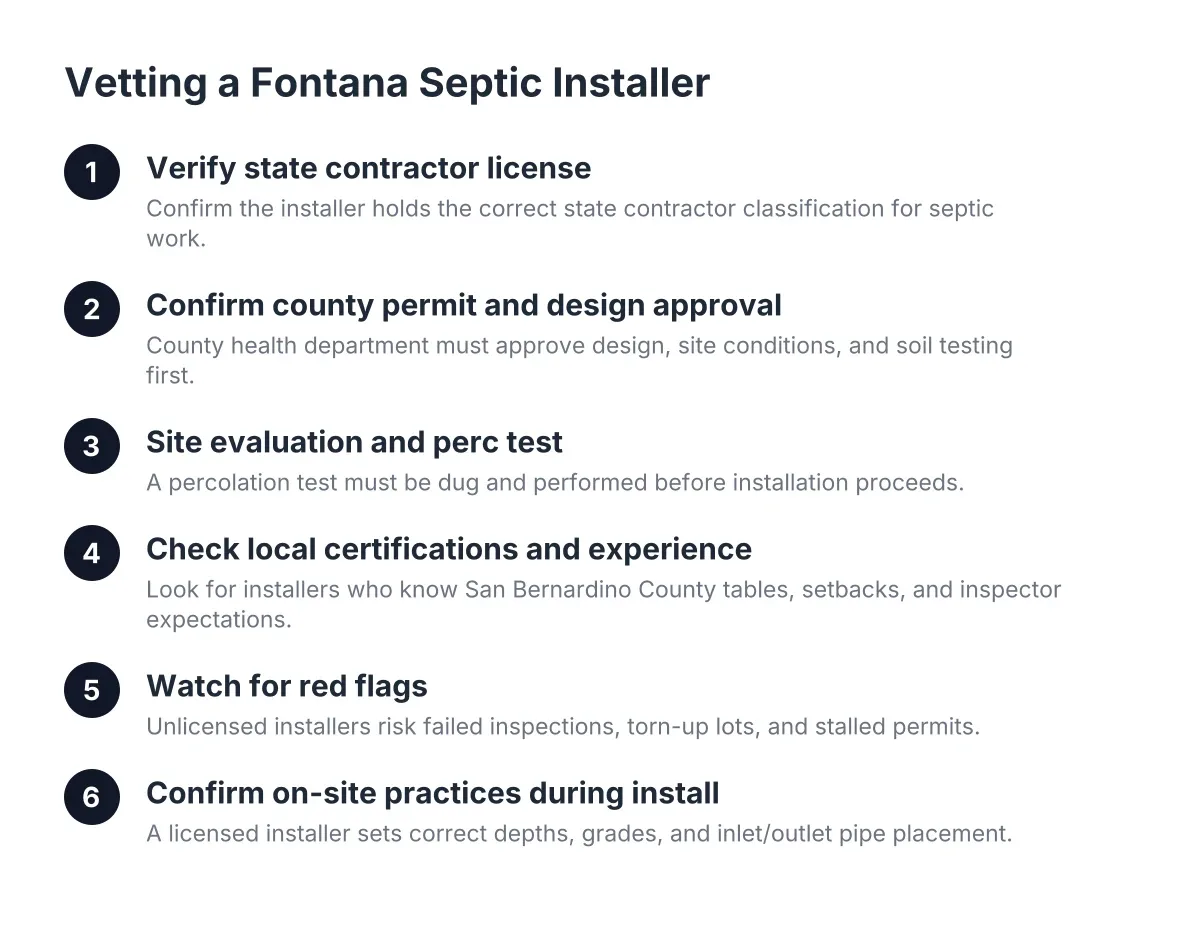
Checking septic system installer licensing is step one, but a license alone does not tell you the contractor knows this county, this soil, or this inspector's expectations. Suppose you just bought a three-bedroom home on a half-acre in north Fontana, the home inspection flagged the septic tank, and a deeper look shows the drain field is failing and the system needs full replacement. You search septic tank installers near me and get a mix of local crews, out-of-town operators, and lead-generation sites that sell your number to whoever pays. Here is how to sort them.
Ask every candidate these questions before you talk price:
- What is your state contractor license number, and what classification is it? Then verify it yourself on the state license board's lookup. Takes five minutes. A legitimate installer expects this question.
- How many systems have you permitted through San Bernardino County, and how recently? You want someone who has been through the current process, not someone describing how it worked years ago.
- Who pulls the health department permit, you or me? The right answer from a full-service installer is that they manage the permit and design submittal. If they push that back on you, expect to manage the county yourself.
- Will you be on site for the open-trench inspection? The installer should meet the county inspector at the hole. If corrections are needed, the person who dug it should be standing there.
- Can you give me addresses or references from recent installs nearby? Then call them. Ask whether the project passed inspection the first time and whether the final price matched the bid.
- What happens if the system fails inspection? Listen for a specific answer about corrections and re-inspection, not a shrug.
In addition, get at least two or three bids from licensed installers with real septic experience before choosing. Comparing bids is not just about price. It shows you who understood the site, who asked about the perc results, and who quoted a tank size that matches the county's capacity table for your bedroom count. A bid for a 1,000-gallon tank on a five-bedroom house tells you the bidder never opened the county standards.
Red Flags That Should End the Conversation
Some warning signs are worth walking away from, no matter how good the price looks. Watch for these:
- No license number on the bid, the truck, or the website, or a number that does not check out on the state lookup.
- A cash discount offered to skip the permit. An unpermitted system can block a future sale, and the county can require you to dig it up.
- A quote given over the phone without a site visit or any questions about soil, slope, or bedroom count.
- Pressure to sign today because the price expires. Legitimate septic work is scheduled around county review, not artificial urgency.
- No mention of the perc test or county inspection anywhere in the proposal.
A fly-by-night operator costs you twice: once for the bad install, and again when a licensed crew has to fix it under the county's eye.
What a Licensed Installer Does Differently on Site
The difference between a licensed, experienced installer and a general dig-and-dump crew shows up in details you would never think to check yourself. A conventional system has two main components, the septic tank and the drain field, according to the U.S. Environmental Protection Agency, and both have failure points that only show up years later if the install was sloppy.
For example, after the tank is set, the fill around the spots where pipe penetrates the tank should be compacted thoroughly to prevent settling or damage at that connection, according to Onsite Installer. Skip that compaction and the pipe can shear or sag as the soil settles, causing a slow leak you will not notice until sewage surfaces in the yard. On the drain field side, construction means laying a thick layer of gravel, placing perforated drain pipes on top, covering the pipes with more gravel, and burying the assembly with soil, according to the US EPA. Grade and depth matter at every layer. An installer who rushes the gravel bed builds a field that channels effluent to one spot instead of spreading it.
However, even the best installer cannot overcome a bad site. If your parcel fails its perc test, or the lot is too small to meet setbacks for a replacement drain field, you will need an engineered alternative design, and that calls for a qualified designer or engineer working with the county, not just an installer with a backhoe. Complicated sites are the clearest case for bringing in professional help early rather than hoping a standard design squeaks through.
For Builders: Keeping Multi-Lot Projects on the County's Good Side
Developers working 5 to 20 lots in unsewered areas like Glen Avon, Grand Terrace, or the county pockets around Fontana face a different version of the same licensing question. One bad installer does not just stall a house; it stalls a phase. County health department septic approval sits in the critical path before construction can proceed, so the installer's familiarity with the current submittal process directly controls your schedule.
Therefore, vet installers on throughput, not just competence. Ask how many county design approvals they have shepherded in the past year, what the current review timeline looks like, and whether they can run perc testing and design submittals for multiple lots in parallel. An installer who batches submittals and shows up prepared for every open-trench inspection is worth a premium over a cheaper crew that fails one inspection per lot and pushes your certificate of occupancy dates. Across a 10-lot project with installs commonly running in the $10,000 to $30,000 range per system as a rough planning figure, a single month of permit slippage can cost more than the spread between the low bid and the right bid.
One more scheduling note: coordinate your trades around the inspection sequence. The plumber's connection to the house and any pump wiring cannot be finaled until the septic system passes, so sequence those subs after the county's open-trench visit, not before.
After the Install: Set Up the System to Last
Once the county signs off, the installer's job ends and yours begins. For a first-time septic owner, three habits protect the investment.
First, get the system on a pump-out schedule. A new tank does not need pumping right away, but a septic system inspection every few years and a pump-out when the solids build up is the whole maintenance plan for most homes. EPA guidance states regular septic maintenance costs $250 to $500 every three to five years, versus $5,000 to $15,000 to repair or replace a failed conventional system, according to the U.S. Environmental Protection Agency. That is the cheapest insurance in homeownership.
Next, keep your records. Save the approved design, the permit, the as-built drawing showing where the tank and leach field sit, and the final inspection sign-off. When you call a local septic pumper for the first pump-out, that paperwork tells the crew exactly where to dig and saves you an hour of probing the yard. It also matters when you sell.
Finally, watch the water going in. A single leaky or running toilet can waste as much as 200 gallons of water per day, according to the U.S. Environmental Protection Agency, and all of that water lands on your drain field. Fix running toilets fast, spread laundry loads through the week, and skip the additives. On the common question of whether to use products like Ridex, the honest answer is that a healthy tank does not need them; routine pumping does more than any bottle poured down the drain.
The Short Version
Licensing is the filter, local experience is the test. Verify the state contractor license yourself, confirm the installer has recent San Bernardino County septic approvals, and make them walk you through the permit sequence from perc test to final inspection before you sign. Get multiple bids from licensed installers, and treat anyone who offers to skip the permit as a liability, not a bargain. Whether you are a first-time owner replacing a failed drain field or a builder with a dozen lots waiting on health department approval, the installer who knows this county's process is the one who gets you to a passed inspection the first time.
If you need septic tank pumping, Fontana Septic can help.
Prefer to talk it through? Call (909) 316-2368 — a quick call is usually the fastest way to get a straight answer for your situation.