
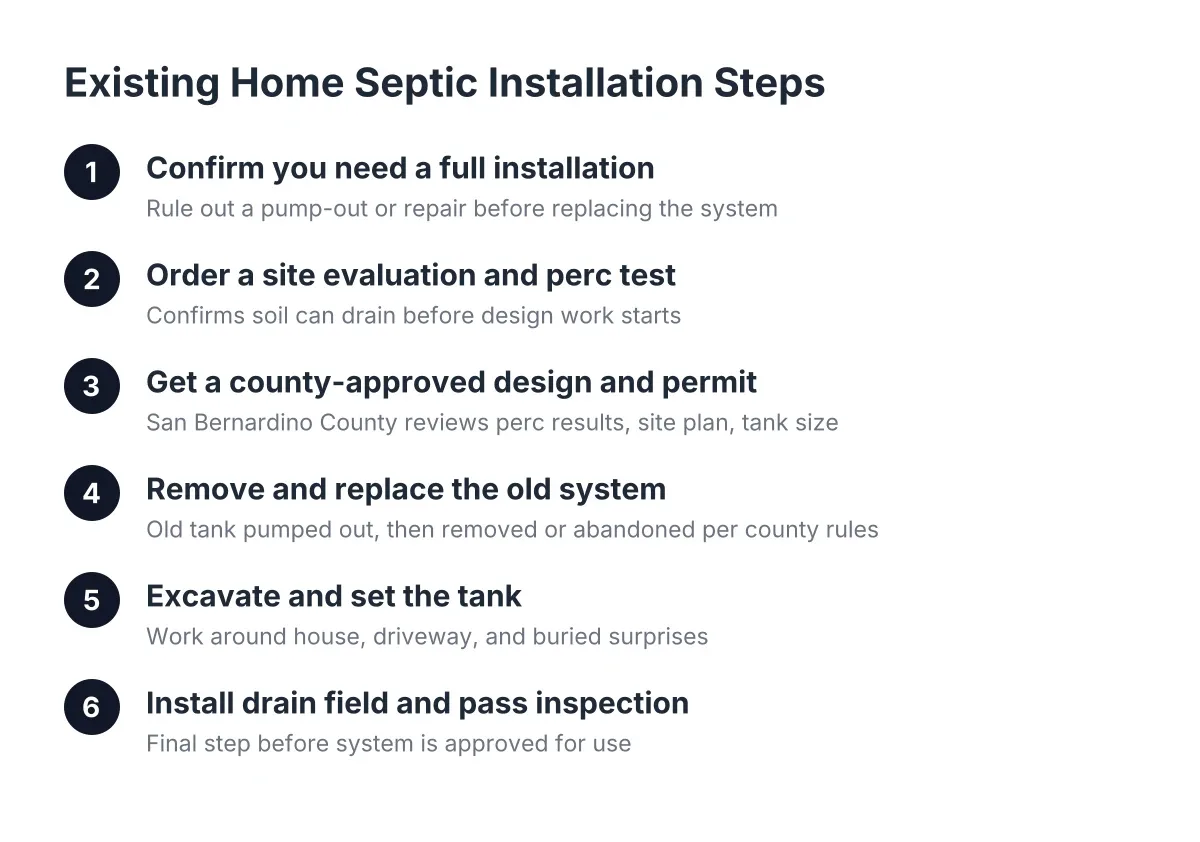
Existing Home Septic Installation in Fontana: A Step-by-Step Homeowner Guide
Adding a septic system to an older property is different from putting one in on bare land. An existing home septic installation in Fontana has to work around your house, your driveway, your landscaping, and decades of buried surprises like old cesspools or abandoned lines. It also has to clear San Bernardino County permitting before anyone digs. This guide walks through the process step by step so the job stays on schedule and passes inspection the first time, whether you own the home or manage a handful of rental units on septic.
One note before we start: this is not a do-it-yourself project. Counties treat septic work as a public health matter because a bad install can contaminate wells and neighboring property. The work requires a licensed contractor and permits, and a full job typically involves three trades: a septic installer for the tank and drain field, a plumber to tie in the house, and an electrician if a pump is needed.
Step 1: Confirm You Actually Need a Full Installation
Start by finding out whether the problem is the whole system or just part of it. Backups, slow drains, and sewage smell in the yard feel like the end of the system, but they often trace back to a full tank or a clogged line. A pump-out and a septic system inspection cost far less than a new system, so rule them out first.
According to the U.S. Environmental Protection Agency, regular septic maintenance runs about $250 to $500 every three to five years, while repairing or replacing a failed conventional system runs $5,000 to $15,000. That gap is why the first call should be for an inspection, not an excavator.
A full existing home septic installation usually makes sense in a few situations:
- The home has an original tank or cesspool that has reached the end of its useful life
- The drain field has failed and the soil will no longer accept water
- A remodel or addition sits on top of the current system, forcing a relocation
- You added bedrooms, and the county now requires more tank capacity than the old system provides
- The property never had a proper permitted system in the first place
If you are buying an older Fontana-area home, factor a likely system replacement into the purchase price. A tank from the 1960s may work today and fail next year.
Step 2: Order a Site Evaluation and Perc Test
Before any design work, the soil has to prove it can drain. A percolation test, or perc test, measures how fast water soaks into the ground at the planned drain field location. According to University of Nebraska-Lincoln Extension, this test must be dug and performed before installing a septic system to confirm the system will function properly.
On an existing lot, the perc test is where older properties get complicated. The evaluator has to find usable soil that is not already occupied by the house, the old system, a well, a pool, or a neighbor's setbacks. Most local rules require at least 10 feet between the septic system and the building it serves, according to the Minnesota Pollution Control Agency, and county setbacks from wells and property lines add more constraints.
Therefore, walk the property with the evaluator and bring everything you know: where the old tank sits, where lines run, and where you plan future work. If the only soil that passes is uphill from the house, the design will need a pump, which changes cost and adds an electrical hookup.
Step 3: Get a County-Approved Design and Permit
You cannot dig until San Bernardino County approves a septic design for the property. The county reviews the perc test results, the site plan, the tank size, and the drain field layout before issuing a permit. Submitting a complete, accurate plan the first time is the single biggest factor in keeping the schedule.
Tank size is driven by bedroom count, not by how many people live there today. San Bernardino County's minimum capacity table requires a 1,000-gallon tank for a 3-bedroom home and 1,500 gallons for a 5-6 bedroom home, according to the San Bernardino County Department of Public Health. If you plan to add a bedroom later, size for it now; upgrading a tank after the fact means digging twice.
This is also where a local contractor earns their keep. An installer who works Riverside and San Bernardino county permits regularly knows what each reviewer wants on the plan, which cuts the back-and-forth that stalls out-of-area crews. As of 2026, plan on the design and permit phase taking weeks, not days, so start the paperwork before the old system fails completely if you can.
Can I Install My Own Septic System in California?
In practice, no. California counties, including San Bernardino, require permitted septic work to be designed and installed under licensed professionals because failures create public health risks. Becoming a licensed installer requires certification beyond a pumping operation, including exams on soil types, percolation rates, system design, and local regulations, according to the New Hampshire Department of Environmental Services. Homeowners who dig first and ask later often end up paying twice: once to remove unpermitted work, and again to do it right.
Step 4: Remove and Replace the Existing Home Septic Installation
An existing home septic installation means dealing with what is already in the ground. The old tank must be pumped out and either removed or properly abandoned, usually by crushing or filling it per county rules. Any septage pumped from the tank is trucked to a sewage treatment plant for disposal; it is never handled on site, according to the New Hampshire Department of Environmental Services.
Next, mark utilities and map the excavation path. On an older Fontana lot, the crew has to route an excavator past mature trees, block walls, and sometimes through a narrow side yard. Suppose a landlord owns a duplex in the area with a shared 1970s tank between the buildings; in that scenario, the crew may need to stage the dig so at least one unit keeps working plumbing during the job, and tenants get notice about water use restrictions on excavation days.
For landlords with several septic-served units, this planning step protects rent. A day of coordinated downtime beats a week of surprise backups and vacancy risk at lease turnover.
Step 5: Excavate and Set the Tank
With the permit in hand, the crew excavates a pit for the new tank and a trench connecting it to the house sewer line. A conventional system has two main components, the septic tank and the drain field, according to the U.S. Environmental Protection Agency, and the tank goes in first.
Setting the tank is precision work, not just a hole and a drop. The tank must sit level on a stable base, at the right depth for gravity flow from the house. Where the inlet and outlet pipes penetrate the tank, the fill material around those connections should be compacted thoroughly to prevent settling that cracks the pipe, a point emphasized by Onsite Installer. A cracked inlet on a new tank is the kind of failure that shows up as a slow drain six months later.
Step 6: Install the Drain Field and Pass Inspection
The drain field, also called a leach field, is where treated water returns to the soil, and it is the part the county watches closest. The crew digs trenches per the approved design, lays the distribution pipe and media, and then stops. Before backfilling, a county inspector typically must approve the open installation; crews may partially backfill only enough to hold components in place.
In addition, systems with pumps or aerobic treatment usually need multiple inspection visits: one to approve tank placement, and a final check of alarms, sprayers, and electrical hookups before the county signs off. Do not let anyone bury work the inspector has not seen. An unapproved backfill can force the crew to re-excavate the whole field, which blows the schedule and the budget.
Only after final approval does the plumber make the house connection live and the crew finish grading. Then the system goes into service.
Step 7: Set Up a Maintenance Routine From Day One
A new system fails early for the same reasons an old one did: too much water, grease, and neglect. Protect the investment from the first month.
- Schedule septic tank pumping on a regular cycle, typically every three to five years for a household, sooner for rentals with heavy use
- Fix running toilets fast; a single leaky toilet can waste as much as 200 gallons of water per day, according to the U.S. Environmental Protection Agency, and all of it lands in your new tank
- Keep grease out of the drains; EPA's report to Congress found grease is the most common cause of reported sewer blockages at 47%
- Keep vehicles and structures off the drain field
- Keep a copy of the as-built plan so the next septic pumper or inspector knows exactly where everything sits
Skip the additive shortcuts. Products like Rid-X are not a substitute for pump-outs; a septic system runs on regular pumping and sane water use, not a monthly powder.
How Long Does an Existing Home Septic Installation Take?
For an occupied older home, plan on several weeks to a few months from first site evaluation to final county approval. The physical septic system installation, excavation through backfill, often takes only days once permits are issued. The perc test, county plan review, and inspection scheduling consume most of the calendar. Homes with tight lots, failed soil in the obvious locations, or unpermitted old systems take longer because the design has to solve problems bare land does not have.
When to Bring in a Local Pro Before You Commit
Every older property is different, and this guide cannot substitute for eyes on your lot. If your system is backing up right now, start with an emergency pump-out and a septic system inspection; that stabilizes the house and tells you whether you are facing a repair, a leach field fix, or a full replacement. Septic systems are less common in California than in most states, about 10% of homes according to the U.S. Environmental Protection Agency, so local knowledge of unsewered Fontana-area lots matters more here than in septic-heavy regions.
A straightforward local crew that handles pumping, inspection, and system work in Fontana can tell you which path you are on before anyone quotes a five-figure job. Get that answer first. Then, if a new system is truly the fix, you will walk into the permit process with a clear scope, a realistic timeline, and no surprises under the dirt.
If you need septic tank pumping, Fontana Septic can help.
Prefer to talk it through? Call (909) 316-2368 — a quick call is usually the fastest way to get a straight answer for your situation.