
What a Septic Maintenance Contract Covers: Services, Schedule, and Fine Print
If you just bought your first home on septic in Fontana, someone has probably already mentioned a service agreement to you. Maybe your home inspector flagged the tank. Maybe your realtor said it has not been pumped in years. Before you sign anything, you should know exactly what a septic contract coverage explained means, what it does not, and whether you need one at all. This guide walks through the services, the frequency, and the exclusions in plain language, so you can make the call without getting talked into something you do not need.
Why New Septic Owners End Up Confused About Contracts
Here is the situation most first-time septic owners land in. You closed on the house. The inspection report said something like "septic tank near capacity, recommend service." You searched "septic tank company near me," and now you are looking at options that range from a one-time pump-out to a multi-year agreement with monthly payments.
The confusion is understandable. Septic is not common in this part of the country. According to U.S. Environmental Protection Agency data, California has one of the lowest rates of septic system use among states, at about 10 percent, compared to a high of 55 percent in Vermont. That means most of your friends, and honestly most plumbers, have never dealt with one. You are learning a system your neighbors on city sewer never think about.
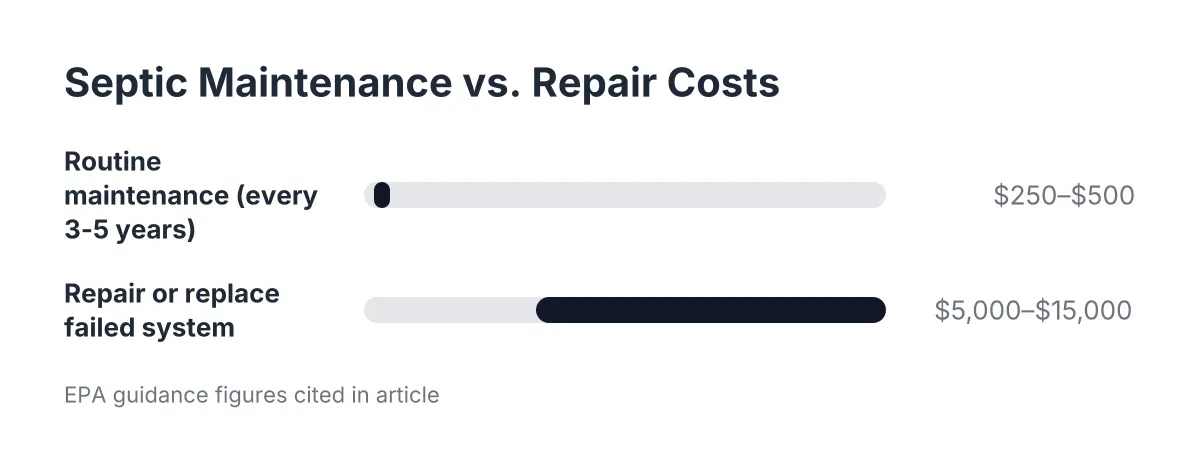
The stakes are real, though. EPA guidance puts regular septic maintenance at $250 to $500 every three to five years, versus $5,000 to $15,000 to repair or replace a failed conventional system. That gap is the whole reason maintenance contracts exist. The question is whether a contract is the right way to buy that maintenance, and that starts with knowing what is actually inside one.
What Is a Septic Maintenance Contract?
A septic maintenance contract is a written agreement where a septic company handles routine service for your system on a set schedule, usually for a flat annual or monthly fee. Instead of calling for a pump-out when you remember, the company tracks your tank, comes out on schedule, and documents each visit. It turns septic care from a thing you forget into a thing that happens automatically.
That is the honest version. Contracts vary a lot from one company to the next, which is exactly why you need to read the service list line by line. Two agreements with the same price can cover different work. One might include annual septic system inspection and a pump-out every few years. Another might be little more than a reminder call and a discount coupon.
For a first-time owner, the appeal is obvious. You do not know how often to pump a septic tank, you do not know what a failing leach field looks like, and you do not want to learn the expensive way. A good contract puts those decisions in the hands of a local septic pumper who sees tanks like yours every week.
It is worth saying that a contract is not the only path. Plenty of Fontana homeowners simply schedule a pump-out every three to five years and an inspection in between, with no agreement at all. Septic maintenance contracts earn their keep when you want the schedule, the records, and the single point of contact handled for you, or when you own more than one property on septic and cannot track it all in your head.
What a Septic Contract Covers for Maintenance
A typical septic maintenance contract covers scheduled inspections, pump-outs at set intervals, basic component checks, and written service records. Some add filter cleaning, minor adjustments, and priority scheduling for problems. The exact list depends on the company and on your system type, so treat the following as the standard menu, not a promise every contract keeps.
Scheduled Septic Tank Pumping
Pumping is the anchor service. The tank collects solids that never break down completely, and those solids have to come out before they flow into the leach field. Once solids reach the drain field, the damage is usually the expensive kind.
Most contracts set a pump-out interval based on tank size and household use. A three-bedroom home with a couple of occupants might go four or five years between pump-outs. A five-bedroom house full of teenagers might need service every two to three years. Tank size matters here; San Bernardino County's minimum capacity table requires a 1,000-gallon tank for a 3-bedroom home and 1,500 gallons for a 5-6 bedroom home. A smaller tank with heavy use fills faster, and a good contract adjusts the schedule to match.
Watch for one detail in the fine print: does the contract include the pump-out itself, or only the scheduling of it? Some agreements bundle the septic system pumping cost into the fee. Others charge the pump-out separately at each visit and the contract only covers inspections and reminders. Neither structure is wrong, but you should know which one you are signing.
Regular Septic System Inspection
Between pump-outs, an inspection is how problems get caught early. A septic tank inspector checks sludge and scum levels, looks at the inlet and outlet baffles, checks the tank walls for cracks, and walks the drain field looking for soggy spots or odors. On systems with an effluent filter, the visit usually includes cleaning it.
This is the part of the agreement that pays for itself quietly. A cracked baffle found during a routine inspection is a small repair. The same crack found two years later, after solids have been washing into the leach field, can mean digging up the yard. If your home inspection report said the tank "needs attention," a proper septic system inspection is the step that tells you what that actually means.
Records, Reminders, and a Single Point of Contact
Do not underrate the paperwork. A contract should produce a dated record of every pump-out and inspection, with tank condition notes. Those records matter when you sell the house, when the county asks, or when a future problem needs a history to diagnose.
For landlords, this is often the main reason to sign. Say a property owner has three rentals in the Fontana and Bloomington area, all on septic, all on different pump-out timelines. Without an agreement, that owner is tracking three tanks in a spreadsheet and hoping a tenant reports a slow drain before it becomes a backup. With recurring septic service under one contract, one local company holds the schedule, calls before each visit, and keeps the records for all three addresses. One point of contact, predictable line items in the budget, and no surprise calls from tenants at 9 p.m.
Extras That Vary by Company and System
Beyond the core services, some agreements include:
- Effluent filter cleaning at each visit
- Drain cleaning for slow drains connected to the system
- Priority scheduling if a backup or emergency comes up
- Grease trap cleaning for properties that have one
- Riser and lid checks so the tank stays accessible
- Discounted rates on repairs the inspection uncovers
None of these are standard everywhere. If a service matters to you, confirm it is written into the agreement, not just mentioned on the phone.
A Note on Aerobic Systems
If your property has an aerobic septic system, the contract question changes. Aerobic systems use mechanical parts, air pumps, and sometimes chlorinators, and they need more frequent checks than a conventional tank. In many areas, ongoing service on aerobic systems is not optional; it is expected as part of owning one. If your inspection report mentions an aerobic system, plan on scheduled service from the start and confirm the company you call actually works on them.
What the Contract Usually Does Not Cover
Knowing what a septic maintenance contract covers is only half the job. The exclusions are where new owners get surprised, so read this section as closely as the service list.
First, repairs are almost never included in the base fee. If the inspection finds a broken baffle, a failed pump, root intrusion, or a saturated drain field, fixing it is a separate charge. The contract found the problem; it did not prepay the solution. Some agreements offer a discount on repair work, which helps, but budget for repairs as their own category.
Second, damage from misuse is on you. Wipes labeled "flushable," grease down the kitchen drain, paint, and harsh chemicals all shorten a tank's life, and no agreement covers the consequences. Grease deserves special mention. Research published in the International Journal of Environmental Science and Technology estimates that 30 to 40 percent of sewer clogs come from fat, oil, and grease deposits in pipes. What clogs a city sewer main will clog your line to the tank just as well.
Third, plumbing inside the house is typically outside the agreement. A running toilet is a good example, and it matters more on septic than on city sewer. According to the U.S. Environmental Protection Agency, a single leaky or running toilet can waste as much as 200 gallons of water per day. On septic, that water does not just show up on a bill; it floods your tank and pushes water into the leach field faster than the soil can absorb it. Fixing the toilet is your plumber's job, but the contract's inspection notes might be what tips you off.
Common exclusions to check for in writing:
- System repairs and part replacement, including pumps and baffles
- Leach field or drain field repair and replacement
- Tank replacement
- Damage from roots, vehicles driving over the field, or construction
- Problems caused by flushing wipes, grease, or chemicals
- Interior plumbing, fixtures, and supply-side leaks
- Emergency visits, unless the agreement specifically includes them
If a company will not put its exclusions in writing, that tells you something about the company.
How Often Do Septic Tanks Need Servicing?
Most conventional septic tanks need pumping every three to five years, with an inspection at least every one to three years in between. Household size, tank capacity, and water habits move that number in both directions. Aerobic septic systems need more frequent checks because they have mechanical parts that can fail without warning.
That three-to-five-year figure lines up with EPA guidance, and it is the baseline most maintenance contracts are built around. However, the right interval for your house is not a rule of thumb; it is a measurement. A septic pumper who opens your tank can see how fast solids are building and tell you whether you are a three-year house or a five-year house. That first pump-out and inspection is where your real schedule gets set.
For a first-time owner, here is a practical way to start. Suppose you just closed on a home in Fontana and the seller could not tell you when the tank was last pumped. In that scenario, the smart first move is a pump-out with an inspection at the same time. The crew empties the tank, looks at the baffles and walls while it is open, checks the drain field, and gives you a baseline. From there, whether you sign an agreement or just put a reminder on your calendar, you are working from facts instead of guesses.
Some warning signs mean you should not wait for the schedule. Slow drains throughout the house, sewage odor in the yard, gurgling fixtures, and soggy green patches over the drain field all call for a service visit now, contract or not.
Reading the Agreement Before You Sign
A septic maintenance contract covers what its pages say, not what the salesperson implied. Before you sign, sit down with the document and answer these questions:
- Which services are included in the fee, and which are billed separately?
- Is the pump-out itself covered, or only scheduled?
- How often will inspections happen, and what does the inspector actually check?
- What records will you receive after each visit?
- What are the written exclusions?
- How long is the term, and how do you cancel?
- Does the price change if the inspection finds heavy use or a larger tank?
Then look at the company behind the paper. A contract is only worth as much as the crew that shows up. Favor a local operator who answers the phone directly, works on septic systems as their main trade rather than a sideline to drain cleaning, and can explain their recommendations in plain terms. A company that pushes additives, insists every tank needs annual pumping regardless of condition, or dodges questions about exclusions is showing you how the whole relationship will go.
One honest trade-off: if your tank is in good shape, your household is small, and you are organized enough to book a pump-out every few years on your own, a contract may cost more than paying per visit. The agreement buys you the schedule, the records, and someone else remembering, and that is worth more to some owners than others. When the inspection turns up anything beyond routine wear, such as a compromised drain field or a failing pump, bring in septic system repair contractors to assess it before you commit to any long-term agreement on a system that may need real work first.
The Short Version for a First-Time Septic Owner
You do not need to become a septic expert. You need three things: a baseline pump-out and inspection so you know what you own, a realistic service interval based on your tank and household, and a local company you trust to keep to it.
A maintenance contract is one way to package those three things. It works well if you want the schedule handled, you own rental property on septic, or your system is aerobic and needs regular attention anyway. It matters less if you have a healthy conventional tank and the discipline to book service yourself.
Either way, the math has not changed since you closed escrow. A few hundred dollars of routine care every few years, or five figures for a failed system. As of 2026, that is still the cheapest insurance a Fontana homeowner on septic can buy, whether it comes with a contract or a calendar reminder.
If you need septic tank pumping, Fontana Septic can help.
Prefer to talk it through? Call (909) 316-2368 — a quick call is usually the fastest way to get a straight answer for your situation.