
What’s Included in Septic Maintenance Contracts: Pumping, Inspection, and Repair
If you own rental property on septic in Fontana, or you just finished a new build on land without sewer hookup, you have probably asked what's included in septic maintenance contracts before signing one. The short answer: most agreements bundle scheduled pump-outs, a septic system inspection at each visit, and a written record of what the crew found. Some add repair coverage or discounted repair rates. Understanding what belongs in septic contract inclusions helps you know exactly what you are paying for, what stays outside the contract, and how to set one up across one address or several.
The goal here is not to talk you into a contract. You have already decided scheduled service beats waiting for a backup call from a tenant. The goal is to help you get the agreement set up right the first time, so pumping happens on schedule, records stay in one place, and nobody has to shop for a septic pumper in a panic.
What Is a Septic Maintenance Contract?
A septic maintenance contract is a standing agreement with a local septic service company to pump, inspect, and monitor your septic system on a set schedule, usually for a flat annual or per-visit price. Instead of calling a septic pumper every few years when you remember, the schedule runs itself. The company tracks when each tank is due, shows up, does the work, and leaves you a written report.
For a single homeowner, that means one less thing to track. For a landlord with three or four rentals spread across Fontana, Bloomington, and Jurupa Valley, it means one point of contact instead of a folder of receipts from whoever answered the phone last time. Each property gets its own service record, and you get one person to call when a tenant reports a slow drain.
New construction owners run into contracts from a different direction. If your new system uses an advanced or aerobic treatment design, the county often requires a service agreement as a condition of the permit. Those systems have pumps, filters, and moving parts that a conventional tank does not, and the agreement is not optional paperwork. It is part of keeping the system legal and running.
What's Included in Septic Maintenance: The Core Services
Most agreements cover three things: scheduled septic tank pumping, a system inspection at each visit, and documented records. Repair coverage varies by contract and is worth reading closely. Here is what each piece looks like in practice, so you can compare what a company offers against what your properties actually need. Knowing the exact septic contract inclusions for your property ensures you get the right coverage and avoid surprise charges.
Scheduled Septic Tank Pumping
Pumping is the backbone of any agreement. A conventional septic system has two main parts, a tank that settles out solids and a drain field that disperses the clarified liquid into the soil, according to the U.S. Environmental Protection Agency. Solids build up in the tank over time. If nobody removes them, they push into the drain field and wreck it, which is the expensive failure everyone is trying to avoid.
Under a contract, the pump-out happens on a set interval matched to the tank size and the household using it. For an active family of four, pumping every two to three years is generally advisable because of the higher solids and water load, according to Penn State Extension. A retired couple on the same tank might stretch to four or five years. A good agreement sets the interval per property, not one blanket schedule for everything you own.
The waste itself does not stay on site. Pumped septage gets hauled by truck to a sewage treatment plant for disposal, according to the New Hampshire Department of Environmental Services. That hauling and disposal cost should be built into the contract price, not tacked on later. Ask before you sign.
Septic System Inspection at Every Visit
The inspection is where a contract earns its keep. Any septic pumper can empty a tank. A septic tank inspector who opens the lid, checks the baffles and tees, measures the scum and sludge layers, and looks at the tank walls is doing something different: catching a $300 fix before it becomes a $10,000 drain field replacement.
A standard inspection during a contract visit covers:
- Sludge and scum levels, to confirm the pumping interval still fits the household
- Inlet and outlet baffles or tees, checking for clogs, damage, or missing parts
- Tank integrity, looking for cracks, corrosion, or root intrusion in a concrete tank
- Water level, since a tank sitting too high or too low points to a drain field or inlet problem
- Effluent filter cleaning, if the tank has one
- A quick look at the drain field area for soggy spots, odors, or unusually green grass
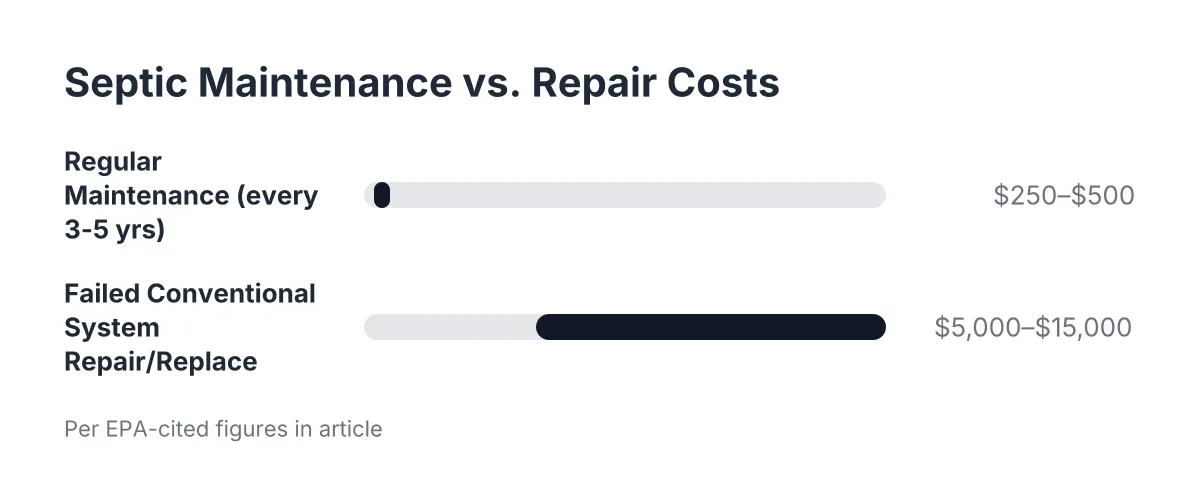
The stakes justify the checkup. Regular maintenance runs $250 to $500 every three to five years, while repairing or replacing a failed conventional system runs $5,000 to $15,000, according to the U.S. Environmental Protection Agency. The inspection is how the contract keeps you on the cheap side of that gap.
Written Records for Every Property
Each visit should end with a written report: property address, date of service, work performed, tank material and condition, whether the crew found problems, and whether the tank showed signs of having been full. This sounds like clerical detail until you need it.
Landlords need these records when a tenant disputes a backup, when an insurance question comes up, or when it is time to sell. Buyers and their inspectors ask for septic service history, and a clean stack of dated reports moves a sale along. New construction owners need records too; some counties want proof of ongoing service for advanced systems, and a documented history protects your warranty conversation if a component fails early.
If the company keeps those records and can pull the history for any address on request, tracking septic maintenance across properties stops being your job. That is most of the point.
Beyond the Core: Additional Septic Contract Inclusions and Add-Ons
Beyond the pump-out and inspection, contracts differ most in what else they fold in. This is where you compare agreements line by line rather than by price alone. Common add-ons include priority scheduling, repair discounts, and coverage for related services like drain cleaning or grease trap cleaning. Many providers use septic contract inclusions and exclusions to spell out which services are built into your fee and which ones cost extra.
Repair Coverage: What Contracts Usually Do and Do Not Cover
Most septic maintenance contracts do not cover major repairs outright. Instead, they typically include minor fixes found during a visit, such as replacing a broken baffle or cleaning a clogged tee, and offer contract holders a discounted rate or priority scheduling on bigger work like leach field repair.
Read the repair language before signing. Some questions to ask:
- Are minor parts found during a visit, like baffles, lids, or filters, included or billed separately?
- Does the contract include a set number of emergency or backup calls per year?
- Do contract holders get priority when a backup happens, ahead of one-time callers?
- Is leach field inspection included, or only the tank?
- For aerobic systems, does the agreement cover pump and aerator checks, and what happens if a pump fails?
That last one matters for new construction owners. Aerobic and advanced treatment systems need periodic full-service maintenance that can include cleaning filters, checking or replacing pumps, and servicing lines. That work costs more than a simple pump-out on a conventional tank, and the contract should say plainly which parts of it are included.
Drain Cleaning and Grease Traps
Some agreements bundle drain cleaning for slow drains between visits, which landlords appreciate because a slow drain is the most common tenant complaint on septic properties. If you own a rental with a commercial kitchen setup, or a small food business, grease trap cleaning may be part of the package too. Grease is not a small issue; research estimates 30 to 40 percent of sewer clogs come from fat, oil, and grease deposits in pipes, according to the International Journal of Environmental Science and Technology. Septic systems tolerate grease even worse than sewers do.
How Often Do Septic Tanks Need Servicing?
Most septic tanks need pumping every three to five years, with an inspection every two to three years or at each pump-out. Heavier use shortens the interval; an active family of four should pump every two to three years, according to Penn State Extension. Tank size, household size, and garbage disposal use all shift the schedule.
This is exactly the math a contract handles for you. Suppose a landlord owns three rentals in the Fontana area: a two-bedroom with a single tenant, a four-bedroom with a family of five, and a three-bedroom that turns over every year or two. Those three tanks should not be on the same schedule. In that scenario, a contract might put the two-bedroom on a five-year pump-out, the four-bedroom on a two-year cycle, and the three-bedroom on three years with an inspection at each tenant turnover.
Tank capacity plays into the interval too. San Bernardino County's minimum capacity table requires a 1,000-gallon tank for a three-bedroom home and 1,500 gallons for a five- or six-bedroom home, according to the San Bernardino County Department of Public Health. A tank sized at the county minimum for a full house fills faster than an oversized tank under a light load. A crew that has pumped the tank before knows how fast it actually fills, which beats guessing from a chart.
One more variable people miss: water load. A single leaky or running toilet can waste as much as 200 gallons of water per day, according to the U.S. Environmental Protection Agency. That water flushes through the tank faster than solids can settle, which pushes solids toward the drain field. If an inspection report shows a high water level, check the fixtures before assuming the tank is the problem.
Setting Up a Contract Across Multiple Properties
If you manage several septic-dependent rentals, the setup work happens once, up front. Do it thoroughly and the agreement runs itself for years.
First, gather what you know about each system: tank location, approximate size, last pump-out date, and any past problems like backups or soggy yard patches. If you do not know where a tank is, say so; locating and uncovering it is a normal part of a first visit, though some companies bill lid excavation separately.
Next, schedule a baseline visit for every address. The first pump-out and inspection establish the condition of each system. This is where surprises surface: a cracked lid, roots in an older concrete tank, a missing outlet baffle. Better to find those on a calm Tuesday than during a holiday weekend backup.
Then set the intervals per property based on what the baseline showed, and confirm how the company will remind you. A useful agreement means you never have to remember a date; the company tracks it and calls before the crew rolls.
Finally, decide who tenants call. Some landlords route everything through themselves; others authorize tenants to call the septic company directly for backups, with the landlord billed under the agreement. Either works, but write it down so a 9 p.m. slow drain call does not turn into confusion about who approved what.
What a Contract Cannot Do
Be clear-eyed about the limits. A maintenance agreement does not make an old drain field young again, and it does not override how tenants use the system. If a renter pours grease down the sink or flushes wipes, no pumping schedule fully protects the tank. Lease language about septic use, plus the inspection reports to back it up, does more than the contract alone.
A contract also does not replace permitted work. New system design, perc testing, and installation sit outside a maintenance agreement and involve the county directly. A percolation test must be performed before installing a septic system to confirm how the soil drains, according to the University of Nebraska-Lincoln Extension, and a local health department inspection typically follows as part of the installation process, according to the Caroline County Health Department. Installation work also requires licensing beyond what a pumping operation carries, according to the New Hampshire Department of Environmental Services. If your system failed and needs replacement, or you are building new, talk to a licensed installer and the county; the maintenance contract picks up after the system is in the ground and signed off.
Worth noting for California owners: septic is less common here than in much of the country. About 10 percent of California homes use septic systems, compared to a high of 55 percent in Vermont, according to the U.S. Environmental Protection Agency. That is part of why unincorporated Fontana-area properties benefit from a local company that works on septic all day, rather than a general outfit that sees a tank twice a month.
Questions to Settle Before You Sign in 2026
Before you sign an agreement this year, get plain answers on paper for each of these:
- Which properties and addresses does the agreement cover, and can you add one later?
- What is the pump-out interval for each tank, and who tracks it?
- Is the inspection a real checklist with a written report, or just a lid-off glance?
- Are disposal fees, lid excavation, and filter cleaning included in the price?
- What repairs are included, what is discounted, and what is billed at standard rates?
- Do contract holders get priority on emergency backup calls?
- For aerobic or advanced systems, does the agreement meet the county's service requirements?
- How do you cancel or transfer the agreement if you sell a property?
Knowing what's included in septic maintenance agreements, and just as important what is excluded, is the difference between a contract that saves you money and one that surprises you at repair time. The core is simple: scheduled pump-outs, a genuine inspection with a written report, and one local point of contact who knows your tanks. Get those three in writing, set the intervals to match each property, and the system that most owners forget about becomes the one thing on your list that handles itself.
If you need septic tank pumping, Fontana Septic can help.
Prefer to talk it through? Call (909) 316-2368 — a quick call is usually the fastest way to get a straight answer for your situation.