
Does a Septic Maintenance Contract Save Money or Cost More? A Landlord’s Math
If you own a handful of rental homes on septic around Fontana, CA, you have probably asked the question in plain terms: does a septic maintenance contract actually save money over the long run, or is it just another recurring bill eating into rent? Understanding the septic contract cost for landlords is essential to making that decision. It is a fair question. Pumping is not free, and a contract adds structure and paperwork to something you could handle one call at a time. This guide walks through the real math for a landlord managing two to ten units, what a contract does and does not cover, and where the savings actually come from.
The short version: for a single owner-occupied home, a contract is a convenience. For a landlord juggling multiple addresses, tenants, and pump-out schedules, the numbers usually tilt the other way. Here is why.
Why Landlords Face Tougher Septic System Challenges Than Homeowners
A homeowner who skips a pump-out risks a slow drain and a bad weekend. A landlord who skips a pump-out risks a tenant calling at 9 p.m. about a backup, a scramble to find a septic pumper who answers the phone, and, in the worst case, a habitability complaint that puts a lease at risk.
The stakes are different because the failure modes are different. When you own three or four rentals on septic, you are not managing one system. You are managing three or four systems on three or four different timelines, each with tenants who treat the plumbing differently than you would. One property might have a family of five loading the tank hard. Another might sit half-vacant. Tracking that from a spreadsheet, or worse, from memory, is where things slip.
That is the actual problem a septic maintenance contract solves. It is not a magic discount. It is a way to move septic from your reactive list to your scheduled list, with one local point of contact instead of a new search for "septic tank pumping companies near me" every time a tenant complains.
What Is a Septic Maintenance Contract and How Does It Affect Costs for Landlords?
A septic maintenance contract is a standing agreement with a septic company to service your system, or systems, on a set schedule for a set price. Typical terms include scheduled septic tank pumping, a periodic septic system inspection, and priority scheduling when something goes wrong between visits. The company tracks the calendar so you do not have to.
For a landlord, the useful version of a contract covers every property under one agreement. The company keeps a record for each address: tank location, last pump-out date, sludge levels at the last visit, and any notes on the leach field or drain field. You get one invoice trail for your accounting and one phone number for every septic issue across your portfolio.
Contracts vary in what they bundle. Some are pumping-only on a fixed cycle. Others add an annual inspection, filter cleaning, and a discounted rate on repairs. Advanced treatment systems, such as aerobic units, are a separate case; those systems are built with more moving parts and generally come with a required service agreement because they need regular professional attention to keep working. If any of your properties runs an aerobic system, a maintenance agreement is less a choice and more a condition of owning it.
The Core Math: Maintenance Cost vs. Failure Cost
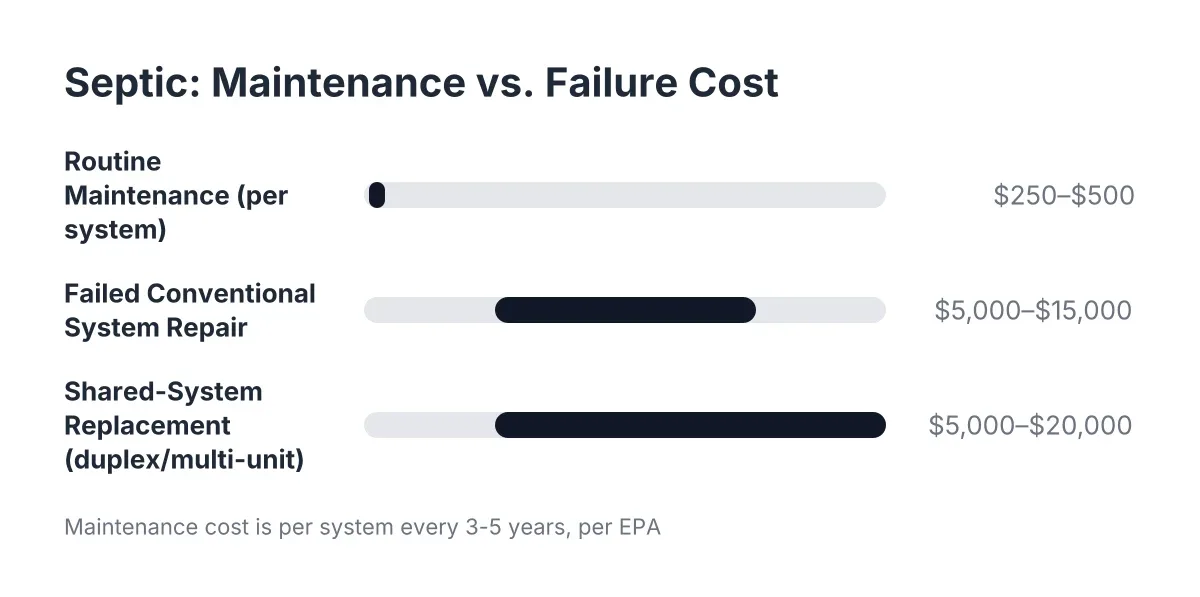
Regular septic maintenance costs $250 to $500 every three to five years per system, while repairing or replacing a failed conventional system runs $5,000 to $15,000, according to U.S. Environmental Protection Agency guidance. That single comparison does most of the work in this decision.
Run it against a small portfolio. Suppose you own four rental homes on septic near Fontana. On a maintenance schedule, you might spend $400 per tank every three years, or about $530 per year across all four properties. That is a predictable line item you can build into rents and reserves.
Now suppose one of those four systems fails because it went eight years without a pump-out and solids pushed into the drain field. In that scenario you are looking at a five-figure repair or replacement, plus excavation of the yard, plus a tenant who cannot use the plumbing while the work happens. A shared-system replacement on a duplex or small multi-unit lot can land in the $5,000 to $20,000 range, which is the kind of capital hit most small landlords have to amortize rather than absorb.
The math does not require every neglected system to fail. It only requires that skipping maintenance raises the odds enough that, across several properties and a decade of ownership, you eventually eat one failure you could have prevented. One avoided drain field replacement pays for decades of scheduled pump-outs across your whole portfolio.
There is a second, quieter cost curve too. A neglected system does not just fail or not fail. It degrades. Tanks that go too long between pump-outs need service more often afterward, clog filters faster, and wear out pumps sooner. Deferred maintenance does not save the money; it moves the bill later and makes it bigger.
Where a Contract Actually Saves Money, and Where It Does Not
Honesty helps here. A septic maintenance contract does not make the pump-out itself cheaper in most cases. Pumping is a competitive, low-margin service, and the per-visit price on a contract is often close to what you would pay calling around. If you expected a contract to cut the sticker price in half, that is not where the value lives.
The savings show up in five other places:
- Avoided emergency premiums. A scheduled pump-out during business hours costs less than an urgent call after a backup, and it never involves a tenant standing in a wet bathroom while you search for help.
- Caught-early repairs. A septic tank inspector checking baffles, filters, and sludge levels on a routine visit finds a $300 problem before it becomes a $6,000 leach field problem.
- Longer system life. Keeping a conventional gravity system pumped and inspected helps it last for decades. Letting it fail can force you into a more complex replacement system that costs more to install and more to maintain every year after.
- Zero missed schedules. The company tracks each address. You stop being the person who has to remember whether the Rialto duplex was pumped in 2022 or 2024.
- Clean documentation. Every visit generates a dated service record per property. That paper trail matters for your accounting, for a future sale, and if a tenant or code enforcement ever questions the condition of the system.
Where a contract costs more: if you own a single unit with light occupancy, a young system, and a good calendar habit, you can likely manage on-call service and pay the same or less. The contract's value scales with the number of systems, the number of tenants, and how much your time is worth. At one property, it is a preference. At five, it is the cheaper option once you count your own hours and the risk you are carrying.
How Often Do Septic Tanks Need Servicing on Rentals?
Most residential septic tanks need pumping every three to five years, and rentals with full households often need it more often. For an active family of four, pumping every two to three years is generally advisable because of higher solids and water use, according to Penn State Extension. Tenant-occupied homes tend to sit at the heavy end of that range.
The reason is behavior. Tenants did not buy the septic system and usually were not told how to live on one. Grease down the kitchen drain, wipes down the toilet, and heavy laundry days all load the tank faster than a careful owner would. Fat, oil, and grease alone cause an estimated 30 to 40 percent of sewer line clogs, according to research in the International Journal of Environmental Science and Technology, and rental kitchens are where that grease comes from.
Water waste compounds it. A single leaky or running toilet can waste as much as 200 gallons of water per day, according to the U.S. Environmental Protection Agency, and every gallon of that runs through the septic tank and out to the drain field. A tenant may never report a running toilet. A technician on a scheduled inspection visit will notice a tank that is processing far more water than the household size explains, which is often the first sign of a fixture problem you can fix for the cost of a flapper valve.
Tank size relative to occupancy matters too. San Bernardino County's minimum capacity table calls for a 1,000-gallon tank for a 3-bedroom home and 1,500 gallons for a 5-to-6-bedroom home, according to the San Bernardino County Department of Public Health. Older rentals in the Fontana area sometimes carry tanks sized for fewer occupants than the home now holds. If a 3-bedroom rental houses six people on a 1,000-gallon tank, that system needs a shorter pump-out cycle, and a contract lets you set that cycle per property instead of guessing.
Does a Septic Maintenance Contract Cover Repairs and Emergencies?
A standard septic maintenance contract covers scheduled pumping and inspection; it does not usually include the cost of major repairs. What it typically does include is diagnosis, priority scheduling for repair work, and sometimes a preferred rate on labor. Read the terms before you sign so the repair question never surprises you.
Here is the practical breakdown of what falls where on most agreements:
- Covered by the contract: routine pump-outs on the agreed cycle, a septic system inspection at each visit, filter cleaning, and record-keeping per address.
- Discounted or prioritized, but billed separately: baffle replacement, riser installation, drain cleaning, leach field inspection and repair, and emergency septic service between scheduled visits.
- Never covered: full system replacement, major excavation, or damage caused by tenant abuse or unpermitted changes to the property.
For a landlord, the priority scheduling clause matters as much as the coverage list. When a tenant reports a slow drain or a backup, the difference between same-week service and "we can get to you in three weeks" is the difference between a maintenance ticket and an escalating habitability complaint. A contract puts your properties at the front of the line with a crew that already knows where every tank sits and what its history looks like.
One more note on scope. In California, septic is less common than in much of the country; EPA data shows about 10 percent of California homes use septic systems, compared to a high of 55 percent in Vermont. That means fewer local companies do this work full time, and the ones that do carry the area's institutional knowledge. A contract with a Fontana-focused septic pumper keeps you connected to that knowledge instead of starting from zero with each call.
What a Multi-Property Agreement Looks Like in Practice
The mechanics are simple. You give the company a list of addresses. A technician visits each property, locates and measures each tank, checks the drain field area, and records a baseline: tank size, condition, sludge and scum levels, and access notes. From that baseline, each property gets its own pump-out interval, because a duplex with six tenants and a single-family home with two do not belong on the same cycle.
After that, the schedule runs itself. The company reminds you before each visit, coordinates access if a tenant needs notice, does the work, and sends a service record you can drop straight into that property's file. When something urgent comes up between visits, you call one number, name the address, and the crew already has the history in front of them.
For example, say a landlord owns a triplex in the Fontana area plus two single-family rentals nearby. The septic contract cost for landlords managing multiple properties might run somewhere around $500 to $900 per year across all three properties, spread predictably instead of arriving as surprise invoices. Under one agreement, the triplex tank might go on a two-year pump-out cycle because of occupancy, while the single-family homes sit at three to four years. Those figures are illustrative estimates, not a quote; actual pricing depends on tank size, access, and condition, which is exactly what the baseline visit establishes.
Compare that to the alternative most landlords know from experience: a previous septic company stops answering calls, a tenant reports a backup on a Friday, and you spend the afternoon calling every "septic tank pumping companies near me" result hoping someone picks up. The contract exists to make sure that afternoon never happens again.
What a Contract Cannot Do
A contract is not a shield against everything. It cannot stop a tenant from pouring fryer grease down the sink for two years, and it cannot revive a drain field that was undersized or badly installed decades ago. Commercial septic additives marketed to dissolve sludge lack strong scientific backing, according to Washington State University Extension, so no contract that leans on additives instead of pumping is worth signing.
The system itself sets some limits too. A conventional septic system has two main components, the tank and the drain field, according to the U.S. Environmental Protection Agency, and the drain field is the expensive half. If an inspection finds a drain field already in decline, a maintenance contract will slow the damage and document the timeline, but it cannot rewind it. In that case, get a full leach field inspection and a professional assessment before committing to any long-term plan; the right move might be repair, partial replacement, or budgeting for a new field, and that is a judgment call for someone standing on your property, not an article.
There is also the honest trade-off at the small end. If you own one rental with a young system and reliable tenants, the annual contract cost may exceed what on-call service would run you. The break-even point arrives when tracking schedules across addresses starts costing you missed pump-outs, emergency premiums, or sleep.
The Bottom Line for Fontana Landlords
So, does a septic maintenance contract save money long-term? For a landlord with two or more septic-served rentals, yes, and the mechanism is risk and time rather than per-visit discounts. You trade a predictable few hundred dollars a year per system for a sharply lower chance of a five-figure failure, faster response when tenants call, and a documented service history for every address you own.
The comparison worth writing down is the EPA's: $250 to $500 in maintenance every few years against $5,000 to $15,000 for a failed system. Multiply the downside by the number of properties you own and the decision gets easier. For landlords managing multiple properties, understanding the septic contract cost for landlords and their rental property obligations helps clarify when preventive service is a business necessity rather than an optional expense. Septic maintenance contracts work for landlords the same way any preventive schedule works: not by making each visit cheaper, but by making the expensive day never come.
If you are weighing it in 2026, start with a baseline inspection across your properties. Learn what each tank holds, when each was last pumped, and what shape each drain field is in. Whether or not you sign an agreement afterward, you will be managing your portfolio with facts instead of guesses, and that alone is worth the visit.
If you need septic tank pumping, Fontana Septic can help.
Prefer to talk it through? Call (909) 316-2368 — a quick call is usually the fastest way to get a straight answer for your situation.