
Septic Maintenance Contract Pay vs. Pay-Per-Service: The Real Cost Math for Landlords
If you own rental homes on septic in Fontana, you have two ways to handle the tanks: sign a service agreement and pay a set amount on a schedule, or call a septic pumper when a tenant complains. The question of septic contract cost comparison comes down to this: is a predictable recurring cost cheaper over time than paying per service when something goes wrong? For a landlord juggling three or four addresses, the answer depends on how much a surprise backup actually costs you, not just the pump-out invoice. This guide walks through both models, the real numbers behind each, and how to decide which fits your properties.
Why This Question Hits Landlords Harder Than Homeowners
A single homeowner on septic can afford to be reactive. They live in the house. They notice the slow drain, the gurgle, the wet patch over the leach field, and they call someone before it turns into sewage in the shower.
A landlord does not have that early warning. Your tenant notices the slow drain on Tuesday, ignores it until Friday, and calls you Saturday night when the tub backs up. Now you are searching "septic tank pumping companies near me" from your kitchen while a tenant texts you photos. If it drags on, a septic problem can escalate into a habitability complaint, and that costs more than any pump-out.
Multiply that by three or four rental homes, each with a different tank size, a different last-pumped date, and a different tenant load, and the tracking problem gets real. Most landlords cannot say off the top of their head when each tank was last pumped. That is the gap a maintenance contract exists to close.
What a Septic Maintenance Contract Actually Is
A septic maintenance contract is a standing agreement with one septic company to service your system on a set schedule for a set price. Instead of calling around each time, you pay a recurring amount and the company shows up when the schedule says the tank is due, whether or not anyone has noticed a problem yet.
For a rental property, a typical agreement covers some mix of the following:
- Scheduled septic tank pumping on a fixed interval, usually every two to five years per tank
- A septic system inspection during each visit, checking baffles, tank condition, and liquid levels
- A look at the leach field or drain field for soggy spots, odors, or standing water
- Reminders when a property is coming due, so nothing falls through the cracks
- Priority scheduling when a tenant reports a backup or slow drain between visits
- Service records for each address, which matter at tax time and at sale time
What usually costs extra: septic system repair, leach field repair, replacing a damaged lid or riser, drain cleaning inside the house, and grease trap cleaning if a property has one. A contract keeps the routine work predictable; it does not make repairs free. Read the coverage terms before you sign, because agreements vary widely on what counts as included.
One more note. Advanced or aerobic systems are a different case. These systems often require a service agreement because they have pumps, filters, and moving parts that need regular attention. If one of your rentals has an aerobic unit, a maintenance agreement is less a choice and more a standing requirement of owning that system.
Understanding the Septic Contract Cost and Service Comparison
Septic maintenance contract pay generally runs close to what you would spend on the same pump-outs booked one at a time, sometimes with a modest discount for committing to the schedule. The financial case for a contract is not a cheaper pump-out. It is avoiding the expensive failures that happen when routine service gets skipped.
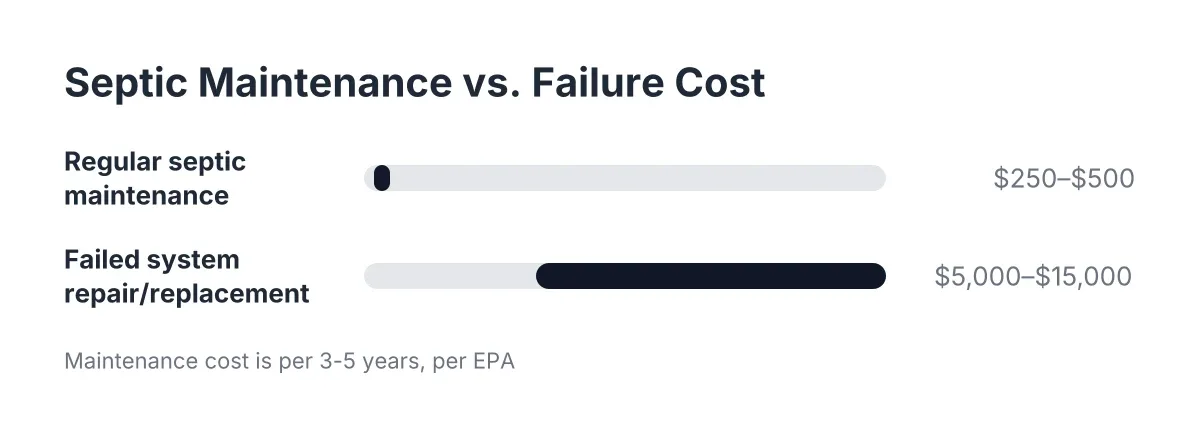
Here is the baseline. According to the U.S. Environmental Protection Agency, regular septic maintenance costs about $250 to $500 every three to five years, while repairing or replacing a failed conventional system runs $5,000 to $15,000. That spread is the whole argument. Pumping is a low-cost, competitive service. Failure is not.
The pay-per-service model
Paying per service means you call a septic pumper when a tank is due or when a tenant complains, and you pay that visit's price. The upside is flexibility. You are not locked in, you can shop each job, and if a property sells, you owe nothing going forward.
The downsides show up over time. First, nobody is tracking your schedule but you. A tank that should be pumped every three years quietly goes six, solids carry over into the drain field, and the drain field is the expensive part to fix. Second, reactive calls tend to happen at the worst times, and emergency septic service on a weekend costs more than a scheduled weekday pump-out. Third, every skipped year raises the odds of the $5,000-to-$15,000 failure instead of the few-hundred-dollar pump-out.
There is also a hidden cost specific to landlords: your time. Every reactive call means finding a company, confirming they actually serve Fontana rather than routing you through a distant dispatch, coordinating tenant access, and following up. Do that across several properties and the hours add up.
The contract model
Under a contract, the company tracks the schedule and the septic maintenance contract pay structure spreads the cost into predictable amounts you can budget against rent. For a landlord, three benefits stand out.
Predictability. You know what septic costs each property this year, which makes your per-door expense math honest instead of hopeful.
Documentation. Each visit produces a record for that address. If a tenant ever raises a habitability question, or a buyer's inspector asks for maintenance history, you have dated service records instead of a shrug.
Early detection. A septic tank inspector who sees the same tank every visit catches a sagging baffle or a rising liquid level before it becomes a backup. Regular pumping paired with periodic inspection prevents more problems than any additive or shortcut, and it does so at pump-out prices instead of repair prices.
The trade-off is commitment. You are paying on a schedule even in years when a lightly used tank might have stretched another year. For a single low-occupancy home, that can mean paying for a visit sooner than strictly necessary. Across a portfolio, that cost is usually smaller than one missed tank.
A Side-by-Side Example: Septic Contract Cost and Service Outcomes Across Three Rentals
Suppose a landlord owns three rental houses in the Fontana area, each on a conventional septic system, each with a family of four as tenants. Per Penn State Extension, an active family of four generally needs the tank pumped every two to three years because of higher solids and water use. This scenario is illustrative, and your numbers will differ by tank size and tenant habits.
Pay-per-service, in the realistic version: House one gets pumped on time because that tenant reports problems early. House two goes five years because nobody complained. House three backs up on a holiday weekend, needs an emergency pump-out at a premium, and the follow-up inspection finds solids pushed into the leach field. Now you are pricing leach field repair in the thousands, plus a tenant who wants a rent concession for the days the bathroom was unusable.
Under a contract, in that same scenario: all three tanks get pumped on their intervals, the company flags the early drain field saturation at house three during a routine visit, and you fix a small problem at a small price. The total spent on routine service might be similar or slightly higher across the good years. The total spent overall is far lower, because the failure never matured.
That is the honest framing of the cost of a septic maintenance contract. You pay a modest, planned amount to convert an unpredictable four-figure or five-figure risk into a predictable line item.
How Often Do Septic Tanks Need Servicing?
Most septic tanks need pumping every three to five years, and heavily used tanks need it every two to three. According to Penn State Extension, an active family of four should plan on a two-to-three-year interval because the household produces more solids and wastewater. Tank size, occupancy, and habits move the number in either direction.
For rentals, plan toward the shorter end. Tenants did not buy the system and rarely baby it. Grease down the kitchen drain, wipes flushed, and long showers all load the tank faster. Grease matters more than most owners think; research published in the International Journal of Environmental Science and Technology estimates that 30 to 40 percent of sewer clogs trace back to fat, oil, and grease deposits.
Tank capacity also sets the pace. In this county, the San Bernardino County Department of Public Health requires a minimum 1,000-gallon tank for a 3-bedroom home and 1,500 gallons for a 5-to-6-bedroom home. A 3-bedroom rental with five occupants on a 1,000-gallon tank fills faster than the same house with two occupants. If you do not know a property's tank size, a septic system inspection can establish it, and that number should anchor the pumping interval in any agreement you sign.
One quiet drain on any system is water waste. Per the U.S. Environmental Protection Agency, a single running toilet can waste up to 200 gallons of water per day, all of it flowing into the tank and out to the drain field. Fixing tenant-reported plumbing leaks fast is septic maintenance too.
What You Can Handle Yourself, and When to Call a Pro
A landlord or a handy tenant can manage the light-duty side of septic care. Keep records of pump-out dates. Tell tenants what not to flush and keep grease out of the kitchen sink. Fix running toilets and dripping faucets quickly. Keep vehicles and heavy storage off the leach field, and walk the yard during property visits looking for soggy patches or odors.
Everything below the lid belongs to a professional. Pumping requires a vacuum truck, and by law the waste goes to a treatment facility, not anywhere on site; the New Hampshire Department of Environmental Services notes that pumped septic waste is trucked to a sewage treatment plant for disposal. Opening a tank is genuinely dangerous because of gases and collapse risk. Diagnosing a failing drain field, replacing a baffle, or assessing tank condition all call for a septic tank inspector, not a guess.
Call a professional now, not next week, if a tenant reports any of these:
- Sewage backing up into tubs, showers, or floor drains
- Multiple slow drains at once, especially in the lowest fixtures
- Sewage odor inside the house or over the tank and drain field
- Wet, spongy, or unusually green patches over the leach field
- Gurgling from drains or toilets after flushing
Any one of these can mean a full tank; several together can mean a drain field problem. Waiting turns a pump-out into a repair estimate.
Fontana-Specific Factors Worth Knowing
Septic is the minority setup in California. According to the U.S. Environmental Protection Agency, only about 10 percent of California homes rely on septic systems, one of the lowest rates in the country. In the Fontana area, that means septic homes cluster in the semi-rural and unincorporated pockets, often on half-acre-plus lots, while newer subdivisions sit on municipal sewer. The Environmental Finance Center Network notes that city homes typically connect to municipal sewage treatment, while septic serves areas without centralized sewer.
Two local implications follow. First, national plumbing brands and call-center dispatch outfits see less septic work here, so septic is often an afterthought for them. A local crew that does only septic system services knows the tanks, soils, and county rules on these streets. Second, county requirements matter. San Bernardino County sets minimum tank capacities by bedroom count, and any new system or major repair involves the health department. A percolation test, which measures how well soil drains, must be performed before installing a system, per the University of Nebraska-Lincoln Extension, and local health department inspection typically follows as part of installation.
Soil in this area varies lot to lot, from sandy fast-draining ground to tighter soils that stress a drain field sooner. That variability is one more reason a standing relationship with one local company pays off; the crew that pumped the tank last cycle already knows how that specific system behaves.
Choosing a Provider for a Contract Across Multiple Properties
Not every septic company handles multi-property agreements well, so ask direct questions before you commit. Three matter most.
First, ask how they track schedules across addresses. You want one point of contact who can tell you, on one call, when each of your properties was last pumped and when each comes due. If the answer involves you keeping your own spreadsheet, the contract is not doing its main job.
Second, ask exactly what each scheduled visit includes and what triggers an extra charge. A fair agreement spells out the pump-out, the inspection points, and the per-visit or annual price in writing. Vague coverage language is where disputes start. One practical note: since an inspection-only visit often costs nearly as much as a pump-out, agreements that pump and inspect in the same visit usually deliver more value per dollar.
Third, ask how they handle tenant calls between scheduled visits. Backups do not wait for the calendar. You want a company that will take a slow-drain report from your tenant, coordinate access, and bill you directly, so you are not the middleman on every septic system pumping call.
A fair quote for a multi-property agreement should itemize each address, state the pumping interval per tank, list what the inspection covers, and separate routine service from repair pricing. Be cautious with any quote that names one flat price without asking about tank sizes, bedroom counts, or occupancy, because those variables drive the real workload. If a property has an advanced or aerobic system, confirm the agreement covers its specific service requirements, or have a professional evaluate it first; that is a case where general advice is not enough and a site visit is the right move.
The Bottom Line on Contract vs. Per-Service
For a single lightly used home, paying per service can work if the owner is disciplined about the schedule. For a landlord with several septic-dependent rentals, the math tilts toward a contract. Septic maintenance contracts trade a small, planned recurring cost for tracking, documentation, early detection, and one number to call, and they sharply cut the odds of the $5,000-to-$15,000 failure the EPA warns about.
The deciding question is not which option has the lower invoice this year. It is which option keeps every tank on schedule when you are not thinking about septic at all, because that is most of the time.
If your rentals sit in Fontana or the surrounding area and you want one local point of contact for scheduled pumping, inspection, and the occasional tenant emergency, reach out for an estimate. A short call about your addresses, tank sizes, and last pump-out dates is enough to put a schedule and a price in front of you for 2026.
If you need septic tank pumping, Fontana Septic can help.
Prefer to talk it through? Call (909) 316-2368 — a quick call is usually the fastest way to get a straight answer for your situation.