
Septic Maintenance Contract Local Crew vs. Franchise: What Landlords Get
You manage three or four rental homes on septic, and you already know the pattern. A tenant texts about a slow drain on Friday afternoon, you call the number you used last time, and you get a dispatch center two states away that reads your address off a script. If you have decided to put your rentals on a recurring pumping schedule, the next decision matters just as much as the first one: whether to use a septic contract for landlords through a local operator or a franchise agreement routed through a national call center. This guide walks through those differences, then shows you how to set up a contract that actually keeps tenant complaints off your phone.
Why the Response Difference Matters More for Landlords
For a homeowner, a slow response to a septic problem is an inconvenience. For a landlord, it is a habitability issue. A backup in a rental home does not wait politely while a dispatch queue works through tickets in three time zones. Sewage on a bathroom floor can turn into a tenant complaint to the county, a rent withholding claim, or a vacancy.
That is why the structure behind your service agreement matters as much as the price on it. Two contracts can list the same services, pump-out every three years, annual septic system inspection, priority scheduling for backups, and still perform completely differently when a tenant calls at 4 p.m. on a Thursday.
The difference usually comes down to one question: when something goes wrong at one of your properties, who picks up the phone, and how many layers sit between that person and the truck?
What Is a Septic Maintenance Contract?
A septic maintenance contract is a standing agreement with a septic company to service your system on a set schedule, usually covering routine pump-outs, inspections, and sometimes priority response for problems like backups or slow drains. Instead of calling around each time a tank needs pumping, you pay a set rate and the schedule runs itself.
For a landlord, the contract does three jobs at once. It puts every property on a known pump-out schedule so nothing gets forgotten. It creates a paper trail of service records for your accounting and for any dispute with a tenant or the county. Additionally, it also gives you one number to call when something breaks, instead of starting a new search for a septic tank service near me every time a tenant complains.
The financial logic is simple. According to U.S. Environmental Protection Agency guidance, regular septic maintenance costs $250 to $500 every three to five years, while repairing or replacing a failed conventional system runs $5,000 to $15,000. Across four rental properties, one skipped pump-out that kills a leach field can wipe out years of margin on that unit.
Choosing a Septic Contract for Landlords: Local vs. National Franchise
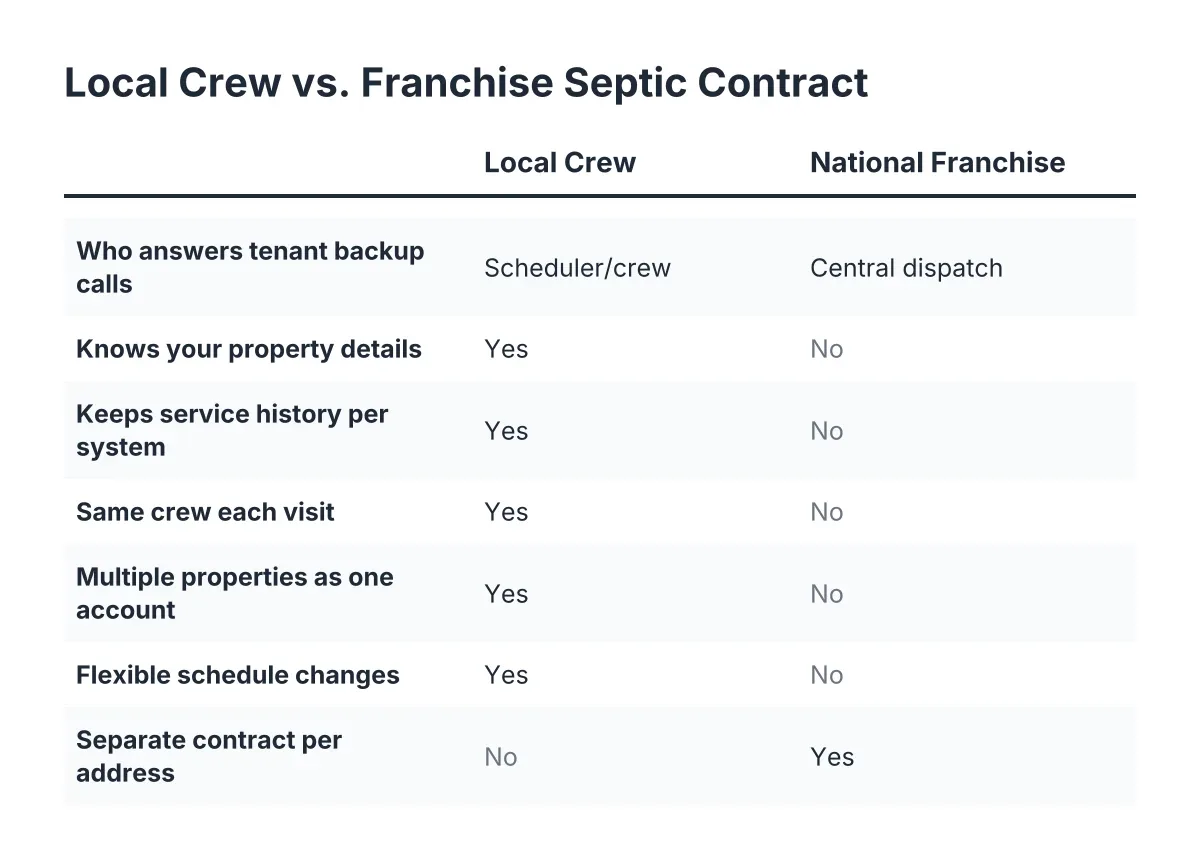
On paper, a franchise contract and a local contract look similar. Both promise scheduled pumping, both offer some form of inspection, and both quote an annual or per-visit rate. The differences show up in how the work actually gets done. Here is where they diverge for someone managing multiple addresses.
Who answers when a tenant reports a backup
With a national franchise or directory brand, your call typically routes to a central dispatch center. The person answering has never seen your properties. They log a ticket, assign it to whichever affiliated crew covers your zip code, and the crew calls you back when the ticket reaches them. Every handoff adds time, and every handoff loses detail. The dispatcher does not know that the tank at your Sierra Avenue rental sits under the side yard behind the gate, or that the tenant works nights and needs a morning appointment.
With a local septic pumper, the person who answers is usually the person who schedules the truck, and often the person who was on your property last time. That matters for landlords specifically, because half of your calls involve coordinating access with a tenant. Fewer layers means fewer dropped details, fewer missed appointments, and fewer follow-up calls from you playing telephone between a tenant and a dispatcher.
Who holds the history on your systems
Septic work rewards memory. A crew that pumped your tank two years ago knows the sludge level they found, whether the baffles looked worn, and whether the drain field showed early signs of trouble. A franchise model can send a different subcontracted crew each visit, which means each visit starts from zero.
For a landlord, that history is not a nice extra. It is how you catch a failing leach field at the inspection stage instead of the emergency stage. It is also the documentation you want on file if a tenant ever claims you neglected the system. A local septic tank inspector who keeps records on each of your addresses gives you both.
How multiple properties get handled
Franchise systems generally treat each address as a separate account with its own ticket stream. If you own rentals in Fontana and nearby unincorporated San Bernardino County parcels, you may end up managing four separate contract renewals and four separate scheduling threads.
A local septic contract for landlords with multiple properties can treat you as one customer with four tanks. Pump-outs can be grouped by area and timing, so the crew handles two of your properties in one trip instead of two truck rolls a month apart. That grouping is often where the real savings hide, more than in the headline per-visit price.
Flexibility when a property changes
Rentals turn over. A three-bedroom house that held two quiet retirees now holds a family of five, and water use doubles. A rigid national contract locks the pump-out interval at signing. Furthermore, a local operator can adjust the schedule when you mention the turnover, because you are talking to the person who sets the schedule, not a customer service tier reading policy.
Setting Up a Septic Maintenance Contract Local Landlords Can Actually Run
You have chosen to put your rentals on recurring septic service. Here is how to set the agreement up so it works across multiple addresses without you becoming the coordinator.
Step 1: Get a baseline inspection on every property
Before signing anything, have a septic system inspection done on each rental. You need to know the tank size, location, condition, and last pump-out date for every address. Many landlords inherit properties with no septic records at all, and guessing at intervals is how surprise backups happen.
Tank size drives everything downstream. For reference, San Bernardino County's minimum capacity table requires a 1,000-gallon tank for a 3-bedroom home and 1,500 gallons for a 5-6 bedroom home, according to the San Bernardino County Department of Public Health. If a prior owner squeezed a large household onto an undersized tank, your pump-out interval needs to shrink to match.
Step 2: Set a per-property pump-out schedule, not a blanket one
Resist the urge to put every property on the same interval because it is easier to remember. A two-person household on a 1,500-gallon tank and a five-person household on a 1,000-gallon tank need different schedules. Ask the crew to recommend an interval per address based on the baseline inspection, then let the contract carry those dates so you do not have to.
Step 3: Put these items in writing
A useful agreement for a multi-property landlord should spell out:
- Every covered address, with tank location notes and access instructions for each
- The pump-out interval per property and who initiates scheduling, you or the company
- What the annual inspection covers: tank, baffles, leach field condition, and drain lines
- How tenant-reported problems get handled, including whether tenants can call directly
- What counts as covered maintenance versus billable septic system repair
- The paper trail: a service record after every visit, sent to you, itemized per address
That last item earns its place at tax time and during any habitability dispute. Documented, dated service records show you maintained the system on schedule.
Step 4: Decide how tenant calls flow
Some landlords want every tenant complaint routed through them. Others authorize the septic company to take calls from tenants directly for covered issues, with the landlord copied on everything. Either works, but decide up front and write it into the agreement. The worst version is the undefined one, where a tenant calls the company, the company calls you, you call the tenant, and a slow drain sits for three days while everyone waits on someone else.
Step 5: Review the plan once a year
Occupancy changes, and so does the system's condition. A yearly review takes fifteen minutes: confirm household sizes at each address, review the inspection findings, and adjust intervals. This is also when you catch small repairs, a worn baffle, a root intrusion at a drain line, while they are still small.
How Often Do Septic Tanks Need Servicing?
Most septic tanks need pumping every three to five years, though the right interval for any specific tank depends on tank size, household size, and water use. A rental with a large family on a smaller tank may need a pump-out every two to three years, while a lightly used property can stretch toward five.
EPA guidance frames the three-to-five-year window as the norm for routine maintenance. Treat that as a starting range, not a rule. The baseline inspection tells you where each of your properties actually falls, and the annual inspection confirms whether the interval still fits.
Water waste inside the home shortens the interval more than most landlords expect. According to the U.S. Environmental Protection Agency, a single leaky or running toilet can waste as much as 200 gallons of water per day, all of it flowing into the tank and out to the drain field. If a tenant mentions a running toilet, fix it fast; it is quietly loading your septic system every hour it runs.
One more note on scope. Septic systems are less common in California than in most states, about 10% of homes according to EPA data, which means fewer tenants arrive knowing how to live on one. A one-page septic guide in your lease packet, covering what not to flush and why grease down the drain matters, costs nothing and prevents calls.
A Hypothetical Tuesday: One Backup, Two Contracts
Suppose you own three rentals in Fontana and one in Sunnyslope, all on septic. On a Tuesday morning, the Fontana tenant on the north side texts you a photo of a backed-up shower drain.
Under a franchise-style agreement, you call the national line. Dispatch logs the ticket and tells you a technician will call to schedule. The callback comes Wednesday, the crew that arrives Thursday has never seen the property, and they spend the first forty minutes locating the tank lid. The tenant has now lived with a sewage smell for two days and is drafting a complaint.
Under a local septic contract for landlords, you call the crew that pumped that tank last spring. They know the lid sits behind the side gate, they have the tenant's number on file because your contract authorizes direct contact, and they can tell you from their records that the tank was pumped recently, which points to a line clog rather than a full tank. The diagnosis starts before the truck does. Neither version is a promise about response times; it is a picture of how information flow changes the job.
Questions to Ask Before You Sign
Whether you are comparing a franchise agreement or a local one, put these questions to whoever you are about to sign with. The answers reveal the structure behind the contract faster than the contract itself does.
- Who answers the phone when I call, and is that person in Fontana or at a call center?
- Will the same crew service my properties visit to visit?
- Can you group my properties into shared trips, and does that change my per-visit cost?
- What records do I get after each pump-out and inspection, and how are they delivered?
- Can my tenants call you directly for covered issues, with me copied?
- How do we adjust the schedule when occupancy at a property changes?
- What happens if you find a repair need during a routine visit; do I approve it before work starts?
A local operator should answer all seven without checking with anyone. If the answers require a callback from a regional office, you have learned what you needed to know.
Where a Contract Ends and a Bigger Decision Begins
A maintenance agreement handles pumping, inspection, and small repairs. It does not fix a leach field at the end of its life, and no contract should pretend otherwise. If an inspection finds a drain field in decline, you are into a repair-or-replace decision that deserves its own evaluation, including whether the county requires an engineered fix. That is the point to bring in a septic professional for a full assessment rather than leaning on the routine agreement, and it is worth getting the finding in writing either way.
Grease is the other boundary worth naming. If any of your properties has a shared kitchen setup or a tenant running a home food business, grease buildup can clog lines well before the tank fills. Research published in the International Journal of Environmental Science and Technology estimates that 30-40% of sewer clogs come from fat, oil, and grease deposits. Ask whether drain cleaning or grease trap cleaning can fold into the agreement for those properties.
The Bottom Line for Multi-Property Landlords in 2026
The search that brought you here probably looked like "septic tank pumping companies near me" or "septic tank near me," and the listings that come back mix local crews with national brands wearing local names. As of 2026, the practical test for septic maintenance contracts is not the logo or the price sheet. It is whether one person, close to your properties, holds the schedule, the history, and the phone.
Choose the agreement where the person scheduling the truck knows your addresses. Set per-property intervals from a real baseline inspection. Put access notes, tenant call flow, and per-address records in writing. Review it once a year. Do those four things, and the septic side of your rental business turns into a line item you budget for instead of a Friday afternoon emergency you scramble through.
If you need septic tank pumping, Fontana Septic can help.
Prefer to talk it through? Call (909) 316-2368 — a quick call is usually the fastest way to get a straight answer for your situation.