
DIY Septic Emergency Fixes That Work vs. Mistakes That Cost Thousands
When sewage backs up into your tub or your yard turns swampy, you need to know which diy septic emergency fixes actually help and which ones make the bill bigger. This guide walks you through the steps in order: what to do in the first ten minutes, what you can safely handle yourself, and where the line sits between a smart stopgap and a dangerous mistake. It is written for Fontana homeowners, especially if this is your first house on a septic system and you have never dealt with a backup before.
Here is the honest frame up front. Some diy septic emergency fixes buy you hours or days at no cost. Others, like digging into the tank or dumping chemicals down the drain, can turn a pump-out call into a full drain field repair. According to U.S. Environmental Protection Agency guidance, regular maintenance runs $250 to $500 every three to five years, while repairing or replacing a failed conventional system runs $5,000 to $15,000. The steps below are ordered to keep you on the cheap side of that gap.
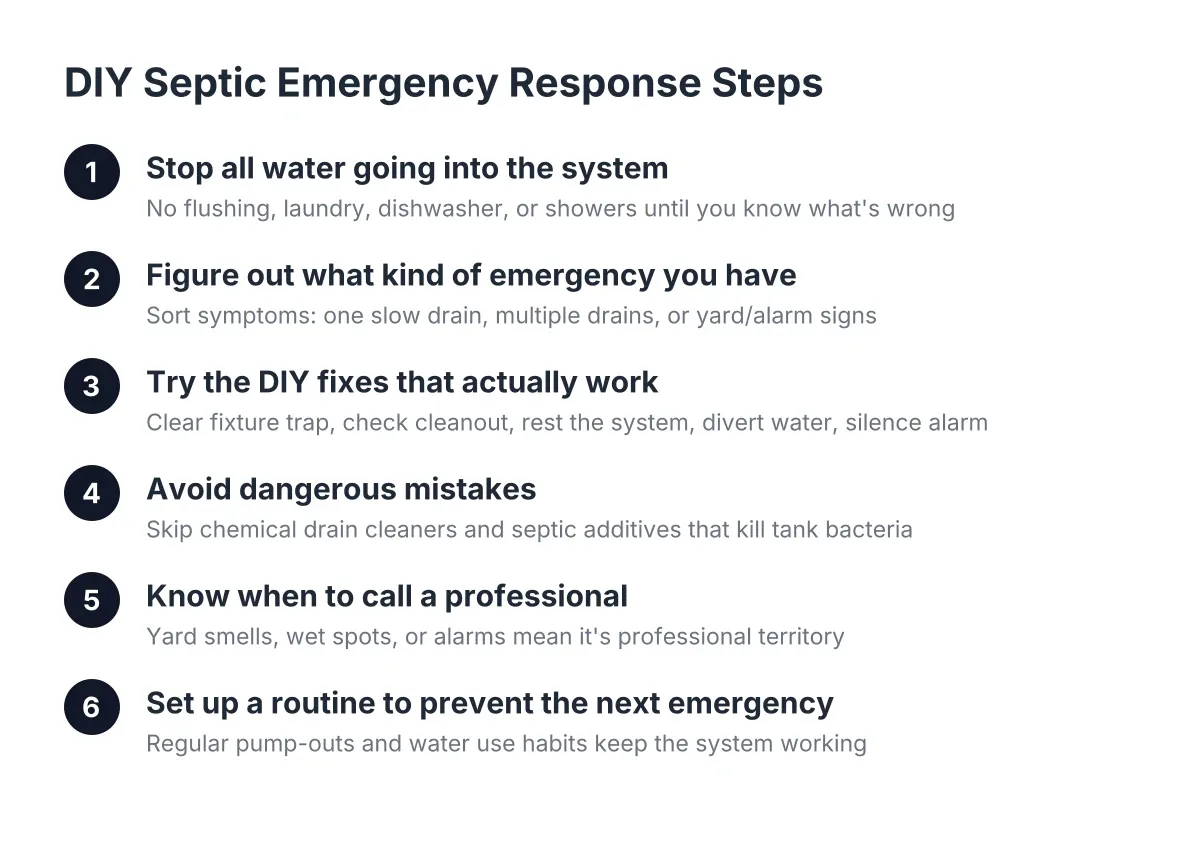
Step 1: Stop All Water Going Into the System
The first move in any septic backup is simple: stop adding water. Every gallon you send down a drain right now has nowhere to go except back up into your house or out onto your lawn.
That means no flushing, no laundry, no dishwasher, and no showers until you know what is wrong. If the backup is severe, shut off water at the fixtures or at the main supply valve. Tell everyone in the house, because one forgotten flush can push sewage back into a tub.
In addition, check for hidden water loads. A single running toilet can waste as much as 200 gallons of water per day, according to the U.S. Environmental Protection Agency. That alone can overwhelm a tank that is already full. Jiggle the handle, lift the tank lid, and make sure the flapper seals.
Step 2: Figure Out What Kind of Emergency You Have
Not every slow drain is a septic emergency, and the fix depends on the symptom. Take five minutes to read the signs before you touch anything.
Signs of a Septic Emergency and How to Respond
The signs of a septic emergency in Fontana are sewage backing up into the lowest drains in the house, standing water or a strong sewage smell over the tank or drain field, gurgling from multiple fixtures at once, and a septic alarm sounding on systems that have a pump. Any one of these means the system cannot move wastewater, and continued use will push sewage backward.
Sort your symptoms into three buckets:
- One slow drain, everything else fine. Likely a clog in that fixture's line, not the septic system. This is the safest DIY territory.
- Multiple drains slow, gurgling toilets, sewage at the lowest drain. The main line or the tank is the problem. Limited DIY options here.
- Sewage smell in the yard, wet spots over the drain field, or an alarm. The tank is full or the leach field is failing. This is professional territory, and fast.
Why do septic systems fail and what causes emergencies?
Septic systems fail most often because the tank went too long between pump-outs, solids escaped into the drain field, grease built up in the lines, or water use spiked past what the system can absorb. Tree roots, crushed pipes, and failed pumps cause the rest. Grease is a bigger factor than most first-time owners expect; EPA's report to Congress found grease is the most common cause of reported sewer blockages, at 47%.
For context, septic is less common in California than in most states, about 10% of homes according to the U.S. Environmental Protection Agency. So if you just bought your first rural property around Fontana, you are not alone in learning this from scratch. Most neighbors with city sewer cannot tell you what to do either.
Step 3: Try the DIY Septic Emergency Fixes That Actually Work
A few fixes are safe, cheap, and genuinely effective. Work through them in this order.
Check and clear the fixture trap first. If only one sink or tub is slow, remove and clean the P-trap under it, or use a hand auger on that line. This solves the problem in the first bucket above without touching the septic system at all.
Find your septic cleanout and check for a house-line clog. Most homes have a cleanout pipe between the house and the tank, usually a capped white pipe near the foundation. Open it carefully. If wastewater is standing in the cleanout, the clog is between the cleanout and the tank, or the tank is full. If the cleanout is dry while drains back up, the clog is inside the house plumbing, and a hand auger through the cleanout may clear it.
Rest the system. If drains are sluggish after heavy use, say a weekend with guests and back-to-back laundry loads, stop all water for 8 to 12 hours. A saturated drain field often recovers on its own once you stop feeding it. This is the single most underrated of all diy septic emergency fixes, and it costs nothing.
Divert water away from the drain field. If a wet winter storm has soaked the yard, make sure gutters and downspouts drain away from the tank and leach field. Do not park or drive on the field. Compacted, waterlogged soil cannot absorb anything.
Silence the alarm, then reduce water use. On a pumped system, the alarm means the pump chamber is high. Press the silence button, cut water use to near zero, and see if the level drops over a few hours. If the alarm returns, the pump or float has likely failed and needs a service call.
Step 4: Avoid the Dangerous Mistakes That Turn a Pump-Out Into a Replacement
This is where first-time septic owners lose money. Every item below looks like a fix and acts like a wrecking ball.
- Do not pour chemical drain cleaner or "septic treatment" additives down the drain during a backup. Caustic chemicals kill the bacteria your tank depends on and can damage older pipes. No additive empties a full tank.
- Do not open the tank lid yourself. Septic tanks release gases that can knock a person unconscious in seconds, and people have died falling into open tanks. Locating the lid is fine. Opening it is not a DIY job.
- Do not pump the tank into your yard or a ditch. Beyond the health hazard, discharging sewage is illegal in San Bernardino County and can bring fines that dwarf the cost of a pump-out.
- Do not run a rented power auger blindly into the main line. Older clay or Orangeburg pipe, common on rural parcels, can shatter. A broken main line turns a $400 problem into an excavation.
- Do not "just add water" to a full tank to push things through. This forces solids into the drain field, and a clogged leach field is the $5,000 to $15,000 failure the EPA figure describes.
- Do not ignore it and hope. Sewage standing in the yard contaminates soil and can reach groundwater, and the drain field damage compounds every day the tank stays over-full.
When You Can Handle an Emergency Yourself Versus Need a Professional
You can fix a septic emergency yourself when the problem is a single clogged fixture, a house-line clog reachable from the cleanout, or a saturated system that recovers with rest. You need a professional when sewage backs up at multiple drains, the tank needs a pump-out, the alarm stays on, or the yard smells like sewage. DIY covers the plumbing side; anything inside the tank or drain field needs a septic pumper with a truck.
Here is the honest trade-off: the fixes in Step 3 buy time, but none of them empties a tank or repairs a leach field. If the inspection report on your new house said the tank "needs attention," that usually means it needs a pump-out and a proper septic system inspection, not an additive from the hardware store.
Step 5: Know What Happens on the Emergency Call, and What Fair Pricing Looks Like
Suppose a first-time owner in north Fontana wakes up to sewage in the hall bathroom on a Saturday. In that scenario, a straightforward local emergency septic service visit typically runs like this: the crew locates and opens the tank, checks the liquid level, pumps the tank, and inspects the inlet and outlet baffles. If the backup was a full tank, drains clear as soon as the pump-out finishes. If the tank was fine, the crew moves to the line between house and tank, or flags a drain field problem.
For pricing, a fair operator tells you the pump-out price before the truck leaves the yard, plus any after-hours difference, and does not invent charges once the lid is open. As an illustrative estimate only, a routine pump-out often lands in the few-hundred-dollar range, while emergency timing adds a premium; the exact number depends on tank size and access. For reference, San Bernardino County's minimum capacity table requires a 1,000-gallon tank for a 3-bedroom home and 1,500 gallons for a 5-6 bedroom home, according to the San Bernardino County Department of Public Health, so most Fontana pump-outs fall in that range. Searching "septic pumping near me" or "emergency plumbing near me" will surface both local crews and national dispatch lines; ask whoever answers whether the truck is local to Fontana and whether they will quote the pump-out before arrival.
One caution on limits: if sewage has flooded living space, or if anyone in the house is immunocompromised, treat cleanup as a health matter and get professional remediation advice rather than mopping it up yourself.
Step 6: Set Up the Routine That Prevents the Next Emergency
Once the crisis is over, put your system on a schedule so you never repeat it. This is where first-time septic owners get ahead.
- Get a baseline septic system inspection. Have a septic tank inspector measure sludge levels, check the baffles, and walk the drain field. Now you know what you own.
- Put the next pump-out on the calendar. Most households need a pump-out every three to five years. Your inspection sets the real interval for your tank size and household.
- Fix water waste in 2026, not someday. Repair running toilets and dripping fixtures now; that 200-gallon-a-day leak is a silent tank filler.
- Keep grease and wipes out of the drains. Scrape pans into the trash, and flush nothing but waste and toilet paper. Homes with heavy kitchen use may benefit from grease trap cleaning.
- Map your system. Mark the tank lid, cleanout, and drain field edges. In the next emergency, you will save an hour of searching.
The pattern behind every step in this guide is the same. Smart diy septic emergency fixes are the ones that remove load from the system: stop the water, clear the house-side clog, rest the drain field. The dangerous ones are the ones that force the system to take more, chemicals, extra water, or blind pressure. Handle the house side yourself, leave the tank and leach field to a local crew, and keep a Fontana septic number saved in your phone before you need it at 2 a.m.
If you need septic tank pumping, Fontana Septic can help.
Prefer to talk it through? Call (909) 316-2368 — a quick call is usually the fastest way to get a straight answer for your situation.