
Finding Emergency Septic Service Open Now: 24/7 Help for Fontana, CA Homes
When sewage backs up into your tub at 9 p.m., you do not want a call center reading a script from three states away. You want a local crew that answers, tells you what to do right now, and shows up with a pump truck. This guide covers finding emergency septic service in the Fontana, CA area and handling a septic backup after hours: what counts as a true emergency, what to do while help is on the way, what a fair after-hours call should cost, and how to tell a straightforward local septic pumper from a dispatch brand that treats septic work as an afterthought.
If you just bought your first home on septic, this matters twice over. You are learning how the system works at the same time you may be dealing with its worst day. The good news is that septic emergencies follow predictable patterns, and the right response is usually simple. Here is how it all works.
What Counts as a Septic Emergency in Fontana?
A septic emergency is any situation where wastewater is going somewhere it should not: backing up into the house, pooling in the yard, or overflowing the tank. It also includes a red alarm light on systems that have a pump. Slow drains alone are a warning; sewage in your shower is an emergency.
The line between "call this week" and "call tonight" matters because after-hours service costs more. Knowing the difference protects both your house and your wallet.
Call for emergency septic service right away if you see any of these:
- Sewage backing up into tubs, showers, or floor drains, especially on the lowest level of the house
- Wastewater surfacing or pooling over the septic tank or drain field
- A strong sewage smell inside the house that gets worse when water runs
- A red septic alarm light or audible alarm on a pump system
- Every drain in the house slow or gurgling at the same time
That last one is the tell most first-time septic owners miss. If one sink drains slowly, you likely have a clog in that line, which is a drain cleaning job. If every fixture in the house struggles at once, the problem sits past the house, in the tank or the leach field. That is septic territory, and a septic crew should look at it first. A plumber only enters the picture if the tank checks out and the blockage turns out to be inside the household plumbing.
What does a septic backup after hours mean for your response time?
A red septic alarm light means the water level inside your pump tank is higher than it should be, and the system is close to backing up. Treat it as an emergency. Stop running water immediately, and call a septic technician the same day. The alarm is a warning stage, not the failure itself, so acting fast usually prevents sewage from reaching the house.
Many Fontana properties have gravity systems with no alarm at all. If yours has an alarm box on the wall or a post near the tank, you have a pump system. Find that box now, before there is a problem, so you know what the light and silence-switch look like.
What Should I Do If My Septic Tank Backs Up?
If your septic tank backs up, stop all water use in the house first. Every flush, load of laundry, and shower adds gallons to a tank that has nowhere to send them. Then keep people and pets away from any sewage, open windows near affected drains, and call a local septic service to diagnose the problem before you call anyone else.
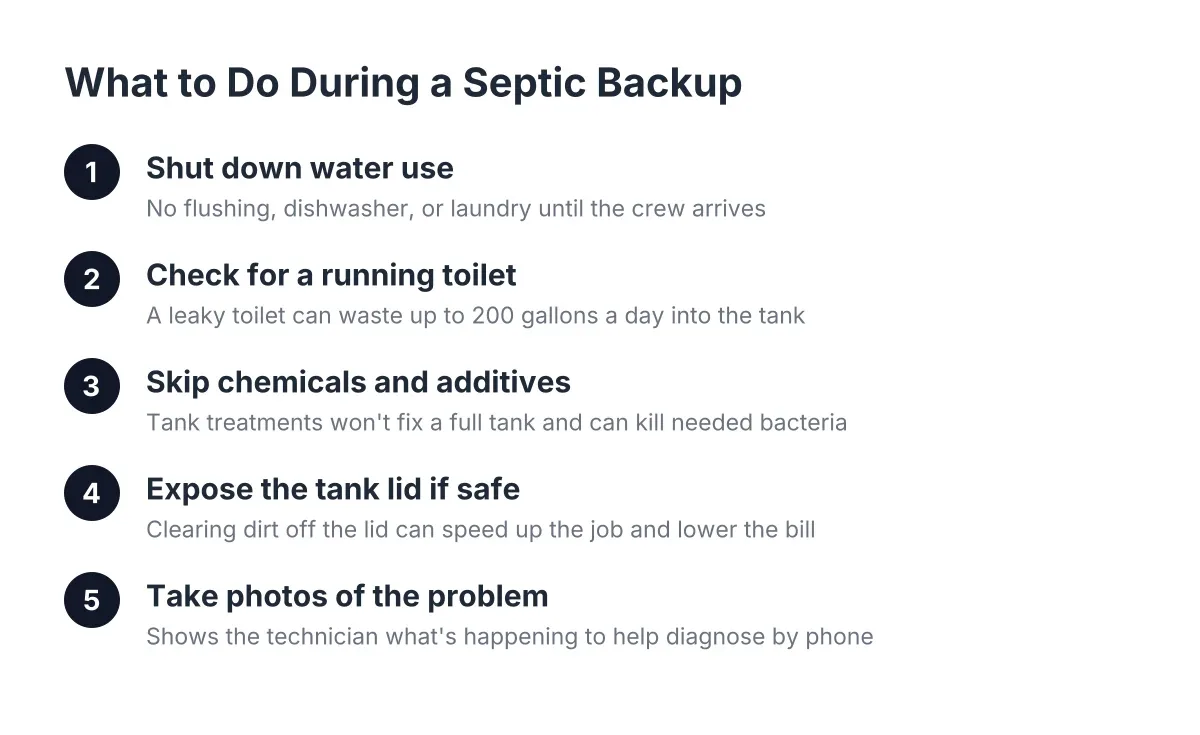
Here is the order of operations while you wait for the crew:
- Shut down water use. No flushing, no dishwasher, no laundry. If you must, use a neighbor's bathroom.
- Check for a running toilet. According to the U.S. Environmental Protection Agency, a single leaky or running toilet can waste as much as 200 gallons of water per day, and every one of those gallons lands in your tank.
- Do not add chemicals or additives. Drain cleaner and "tank treatment" products will not fix a full tank or a saturated leach field, and harsh chemicals can kill the bacteria your system needs.
- Find and expose the tank lid if you safely can. Crews charge extra for digging, and locating a buried lid takes time. If you know where it is, clearing the dirt off it before the truck arrives speeds up the job and can lower your bill.
- Take photos of what you are seeing. Sewage in the tub, wet spots in the yard, the alarm panel. It helps the technician diagnose over the phone.
Do not open the tank yourself beyond exposing the lid. Septic tanks hold gases that can knock a person out, and an open tank is a fall hazard. Exposing the access lid is homeowner work; everything below it belongs to a professional.
Can I fix a septic emergency myself?
Most septic emergencies need a professional because the fix involves pumping the tank, clearing the main line, or repairing the leach field, none of which a homeowner can do safely. What you can do yourself is limited but valuable: stop water use, expose the tank lid, and rule out a simple single-fixture clog before you pay for an emergency call.
There is one honest exception. If only one toilet or sink is backed up and everything else drains fine, a plunger or a household drain snake may solve it. That is a clog, not a septic failure. But if plunging one fixture pushes water up through another, stop. You are moving sewage around a blocked system, and it is time to call for assistance when your septic backs up after hours.
Finding Emergency Septic Service That Actually Answers in Fontana, CA
Finding emergency septic service that picks up the phone comes down to one filter: is this an actual local operator, or a marketing site routing your call to a dispatch center? In a backup, that difference decides whether the person you reach can tell you what to do right now or just takes your zip code and puts you in a queue.
Search results make this harder than it should be. Type "septic tank emergency near me" or "septic tank pumping near me within 20 mi" and you will see national directories, franchise brands, and thin one-page sites that list a phone number and nothing else. Some of those numbers ring in another state. The truck that eventually shows up may be subcontracted, and the price may be whatever the dispatcher's screen says.
Therefore, ask three questions before you commit, even in a hurry:
- Where is your crew based, and do you serve my part of Fontana directly? A local outfit can answer in one sentence. A call center will stall or ask for your zip code again.
- Can you give me a price range for the pump-out before you roll a truck? A fair operator quotes a range up front and explains what could move it, such as tank size, digging for the lid, or a second compartment. A vague "the tech will quote you on site" is how crisis markup happens.
- Do you do septic work as your main trade? Some drain companies do septic pumping on the side. You want a septic pumper who can also read what the tank is telling them: whether this is a one-time clog, a tank overdue for pumping, or the early sign of a leach field problem.
A good emergency crew also acts as a diagnostician, not just a vacuum truck. When the tank is open, the technician should tell you the sludge level, whether the baffles are intact, and whether water is flowing back from the drain field. That last observation matters most; backflow from the field points to a bigger problem than a full tank.
What a fair septic backup after hours visit includes
A standard emergency pump-out visit should cover locating the tank, opening the access, pumping out the contents, a basic look at the tank's condition and baffles, and a plain-language explanation of what caused the backup. The waste itself gets hauled away; pumped septic waste is trucked to a sewage treatment plant for disposal rather than handled on site, per the New Hampshire Department of Environmental Services.
Things that are usually extra, and should be quoted before the work starts:
- Digging to locate and expose a buried lid
- Using a camera and locator to find a tank nobody can locate by normal means
- Clearing the line between the house and the tank
- Any repair work, such as replacing a baffle or a broken lid
- A full septic system inspection with a written report, which is a separate service
How Much Does Emergency Septic Service Cost in Fontana, CA?
Emergency septic service in Fontana typically costs more than a scheduled pump-out because of after-hours labor and same-day dispatch. For context, routine septic tank pumping generally runs a few hundred dollars; the EPA puts regular septic maintenance at $250 to $500 every three to five years. Emergency calls add a premium on top of that baseline, and any repairs found are priced separately.
Nobody can quote your exact bill without knowing your tank and your situation, and this article will not invent a number. What you can do is understand the variables that move the price, so a quote makes sense when you hear it:
- Tank size. San Bernardino County's capacity table requires a 1,000-gallon tank for a 3-bedroom home and 1,500 gallons for a 5-6 bedroom home, according to the San Bernardino County Department of Public Health. A bigger tank means more gallons to pump and haul.
- Access. An exposed lid at grade is fast. A lid buried under two feet of compacted Fontana soil is digging time, billed accordingly.
- Timing. Nights, weekends, and holidays carry after-hours rates. If the situation can safely wait until morning, ask; a straight answer to that question is itself a trust signal.
- What the crew finds. A tank that simply has not been pumped in eight years is a pump-out. A tank flooded by a failing leach field is the start of a repair conversation.
That last variable is the expensive one, and it is why deferring maintenance is a bad bet. The EPA estimates that repairing or replacing a failed conventional system costs $5,000 to $15,000, versus a few hundred dollars for routine pumping. For a first-time septic owner on a typical Fontana lot, that gap is the whole argument for getting on a pumping schedule.
When you compare septic services near me prices, compare like with like. A low headline price that excludes digging, extra gallons, and disposal is not lower once the truck leaves. Ask what the quoted price includes, in writing or by text if you can get it.
An illustrative Fontana scenario
Suppose a family of four closes on a half-acre property near north Fontana in early 2026. The home inspection noted "septic tank, service history unknown," the realtor shrugged, and three months later every drain in the house gurgles on laundry day. By Saturday morning there is gray water in the hall shower.
In that scenario, the right sequence looks like this. The homeowners stop all water use and skip the drain chemicals. They call a local septic crew, describe the symptoms, and get a price range for a weekend pump-out plus a per-foot estimate if digging is needed. Because the previous owner left a sketch showing the tank ten feet off the back porch, which lines up with the common code minimum of 10 feet between a septic system and the building it serves noted by the Minnesota Pollution Control Agency, they expose the lid themselves with a shovel before the truck arrives. The crew pumps the tank, finds heavy sludge but intact baffles and a healthy drain field, and the family walks away with a working system and a pumping reminder set for two to three years out. Penn State Extension notes that an active family of four generally needs pumping on that two-to-three-year cycle.
Same emergency, handled two different ways, can end in a modest weekend bill or in a diagnostic mess with a subcontracted truck and a surprise invoice. The difference was thirty minutes of preparation and one good phone call.
Why Septic Systems Fail and What Causes Emergencies
Septic systems fail for a handful of predictable reasons: a tank that was never pumped, grease and non-flushables clogging the works, too much water hitting the system at once, or a leach field at the end of its life. Almost every emergency call traces back to one of these, and most were preventable months earlier.
A conventional system has two main parts, the septic tank and the drain field, per the U.S. Environmental Protection Agency. The tank separates solids; the field absorbs the treated water. When either part gets overwhelmed, wastewater has nowhere to go but backward.
Grease deserves its own warning. The EPA's report to Congress found grease is the most common cause of reported sewer blockages, at 47 percent. In a septic home, bacon fat down the sink hardens in the tank and the lines the same way. If you run a home business with a commercial kitchen setup, grease trap cleaning belongs on your maintenance list alongside the tank.
Ignoring the warning signs makes everything worse. A failing system does not heal; sewage keeps saturating the leach field until the soil can no longer absorb it, and a repairable problem becomes a replacement. California homes on septic are a minority, about 10 percent of the state per EPA data, so many buyers arrive with no septic experience at all. That is fine. What matters is acting on the first slow drain instead of the third backup.
One honest caveat: pumping does not fix everything. If your drain field is saturated or collapsed, a pump-out buys you days, not years, and the right move is a leach field inspection and a repair plan. A trustworthy crew will tell you that at the tank, not after three more emergency visits.
Set Yourself Up Before the Next Emergency
The best time for finding emergency septic service is before you need it. Line up a local septic company now, while your drains still work, and half the stress of a future backup disappears.
For a first-time septic owner in Fontana, that looks like a short checklist:
- Book a baseline pump-out and inspection if the tank's service history is unknown. You will learn your tank size, its condition, and its location.
- Mark the tank lid and keep access clear. Do not park, build, or plant over the tank or the drain field.
- Put the pumping schedule on your calendar; every two to three years for an active family of four is a sound starting point.
- Keep grease, wipes, and heavy chemical cleaners out of the drains.
- Save the number of a local crew that answers its own phone, so a 9 p.m. backup is a call, not a search.
People often search for 24 hour emergency plumbing when the real problem is the septic system, then lose an evening to a company that cannot pump a tank. Knowing that your home runs on septic, and knowing who services it, is the single biggest upgrade a new rural homeowner can make.
If you are in Fontana or the immediate surrounding area and your tank is overdue, backing up, or a complete unknown, reach out to a local septic crew for a straight answer and a plain quote. Whether it is a routine pump-out, a septic system inspection, or a backup that cannot wait until Monday, the right call is the local one.
If you need septic tank pumping, Fontana Septic can help.
Prefer to talk it through? Call (909) 316-2368 — a quick call is usually the fastest way to get a straight answer for your situation.