
DIY Drain Field Maintenance vs. Hiring a Local Septic Pro: A Step-by-Step Guide
A struggling leach field does not always mean a full replacement. Before you spend $5,000 or more digging up trenches, work through the basics of DIY drain field maintenance and figure out which problems you can handle yourself and which ones call for a local septic pro. This guide walks you through the process step by step, from spotting the warning signs to knowing exactly when to pick up the phone. It is written for Fontana homeowners and small landlords on septic, and it applies whether your system is 30 years old or freshly permitted.
Most septic companies focus on the tank and skip past the field. That is a mistake, because the drain field is the part that fails expensively. According to the U.S. Environmental Protection Agency, regular septic maintenance runs $250 to $500 every three to five years, while repairing or replacing a failed conventional system runs $5,000 to $15,000. The steps below are ordered the way an experienced septic tank inspector would actually work the problem.
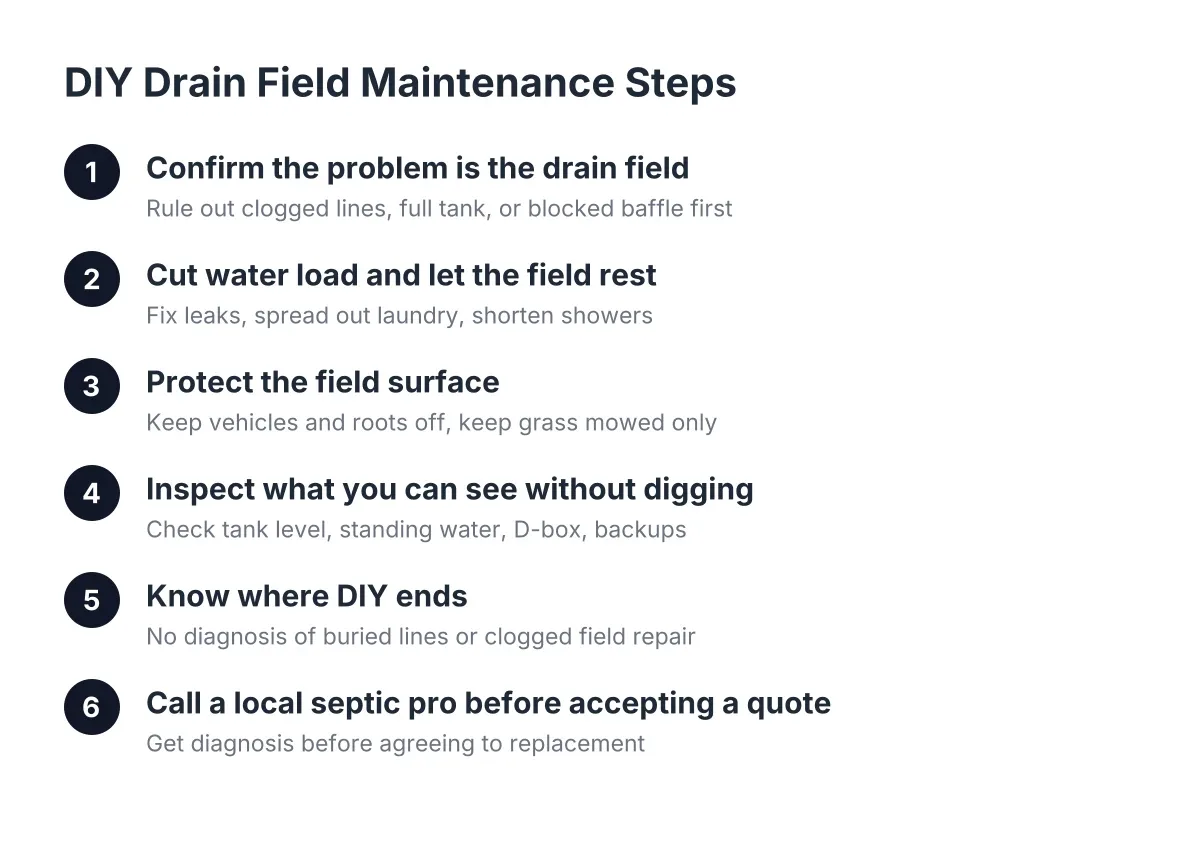
Step 1: Confirm the Problem Is Actually the Drain Field
First, rule out the cheaper culprits. A slow drain or a backup inside the house can come from a clogged house line, a full tank, or a blocked outlet baffle. None of those mean your leach field is failing.
A conventional septic system has two main components, the septic tank and the drain field, according to the U.S. Environmental Protection Agency. The tank settles out solids; the field disperses the clarified liquid into the soil. If the tank has not been pumped in five or more years, schedule a pump-out before you blame the field. A tank packed with solids pushes sludge into the field lines, and that alone can mimic field failure.
Signs that point to the field itself rather than the tank:
- Soggy or spongy ground over the trench lines, even in dry weather
- Bright green grass stripes over the field while the rest of the yard is dull
- Sewage odor outdoors near the field, not just at the tank lid
- Backups that return within days or weeks of a fresh pump-out
- Gurgling in multiple fixtures at once, not just one drain
However, one soggy spot after a wet winter is not a verdict. Watch it for a week of dry weather before deciding.
Step 2: Cut the Water Load and Let the Field Rest
Next, give the soil a chance to recover. A saturated field cannot absorb more water, and every gallon you send it makes things worse. This is the single most effective piece of DIY drain field upkeep, and it costs nothing.
For a few days to a few weeks, do the following:
- Fix every leak. According to the U.S. Environmental Protection Agency, a single running toilet can waste as much as 200 gallons of water per day, which is more than many households send to the tank in total.
- Spread out laundry. One load per day instead of five on Saturday.
- Shorten showers and skip baths.
- Redirect roof gutters, sprinklers, and surface runoff away from the field. Outside water saturates the soil just as fast as inside water.
For a small landlord with a duplex on a shared system, this step means talking to tenants. Suppose you own a two-unit rental where both households do laundry on the same day; staggering wash days alone can dry out a marginal field enough to buy you months of planning time instead of an emergency call.
Step 3: Protect the Field Surface with DIY Drain Field Maintenance
In addition to cutting water, protect the ground above the trenches. A drain field is built by laying gravel, placing perforated drain pipes on top, adding more gravel, and burying the assembly with soil, according to the US EPA. That structure is tough against water and fragile against weight and roots.
Maintenance practices for DIY drain field care at the surface look like this:
- Keep vehicles, trailers, and equipment off the field. Compacted soil stops absorbing.
- Remove trees and deep-rooted shrubs within about 20 to 30 feet of the lines. Roots find perforated septic drain field pipe and clog it.
- Keep grass over the field, mowed, and nothing more. No patios, no sheds, no gravel parking pads.
- Never route a water softener discharge or sump pump into the septic system.
These habits will not fix a failed field, but they prevent most of the damage that kills one early. A well-built field on decent soil can last decades; a field that gets driven over and flooded with grease can fail in ten years.
Step 4: Inspect What You Can See Without Digging
Then walk the system with a checklist. You do not need a backhoe to learn a lot.
- Open the tank access lids, if you can do so safely, and check liquid level. Water above the outlet pipe suggests the field is not taking flow.
- Look for standing water or gray staining at the end of the field, the low side.
- Note which fixtures back up and when. Backups only during heavy use point to an overloaded but living field. Constant backups point to a dead one.
- Check for a distribution box if your system has one. A tilted or clogged D-box sends all the flow to one trench and drowns it while the others sit dry. Resetting a D-box is one of the few genuine repairs a careful owner can handle.
Never enter a septic tank or lean into one. The gases inside can knock a person out in seconds. Looking from above with the lid open is the limit of safe DIY inspection.
Step 5: Know Where DIY Ends
Here is the honest line. DIY drain field maintenance covers water reduction, surface protection, leak repair, and basic observation. It does not cover diagnosis of buried lines, and it does not cover repair of a clogged field.
The key diagnostic step for a failing field is exposing the leach lines away from the tank and checking whether they hold standing water or run dry, and whether roots have invaded. That finding determines the repair path, and it requires digging in the right spots, which requires knowing the septic drain field design, the layout, and the depth. Guessing wrong means trenching up a working line for nothing.
Additive treatments deserve a word here. Bacterial and enzyme treatments are sometimes used as a remedial step on a sluggish field before anyone talks about replacement, and on a marginal field they can help. However, no treatment restores a system that has stopped flowing entirely. If nothing drains, the problem is structural, and pouring product into the tank wastes money and time.
Step 6: Call a Local Septic Pro for Diagnosis Before You Accept a Replacement Quote
A proper leach field inspection tells you whether the field can be saved, and that answer is worth paying for. If a company diagnosed your field as failed after one look at a backup, get a second opinion focused on the field. Many outfits treat the field as an afterthought to tank pumping, and "replace it all" is the easy answer, not always the right one.
A thorough septic system inspection of the field should include locating the lines, checking the D-box, probing or exposing a section of trench, and testing whether the soil still accepts water. Options short of full replacement can include root removal, D-box repair, replacing a crushed section of pipe, or targeted leach field repair on one failed trench while the others keep working. Modern septic drain field chambers can also replace a failed gravel trench in less space than the original design needed, where soil and county rules allow it.
Be realistic about the hard cases. Once a field is clogged with non-degradable waste through its full length, the fix is excavating and replacing the leach lines, not another pump-out. In San Bernardino County, a full replacement typically means a new percolation test and engineering evaluation, and a perc test must be performed before installing a septic system to confirm the soil drains properly, according to University of Nebraska-Lincoln Extension. Some counties also require an upgrade to a more expensive system type if a conventional gravel-and-pipe field fails, so the permit path matters as much as the digging.
Step 7: Set a Maintenance Schedule So You Never Do This Again
Finally, put the system on a calendar. For most Fontana households, that means a pump-out every three to five years, sized to your tank and your usage. San Bernardino County's minimum tank capacity table requires a 1,000-gallon tank for a 3-bedroom home and 1,500 gallons for a 5-6 bedroom home, according to the San Bernardino County Department of Public Health, and smaller tanks serving full houses need pumping on the shorter end of that range.
For landlords, tie the pump-out to lease turnover so a backup never costs you a vacancy. For a new construction owner, start the schedule the day the county signs off; a new field lasts longest when the tank never overfills. Routine pumping and the maintenance habits above are what keep a field alive for decades instead of forcing a five-figure replacement.
Quick Answers on Drain Field Repair and Maintenance
Can I repair my leach field myself or do I need a professional?
You can maintain a leach field yourself, but you cannot reliably repair one. DIY work covers reducing water load, fixing leaks, protecting the surface, and resetting a distribution box. Diagnosing buried lines, replacing pipe or gravel, and anything touching county permits calls for a local septic pro with the equipment and code knowledge.
What happens if you don't repair a failing leach field?
An unrepaired failing leach field sends untreated wastewater to the surface or backs it into the house. Sewage on the ground is a health hazard and can draw code enforcement, especially on rental property. The soil damage also spreads; a field caught early might need one trench repaired, while a neglected one needs full replacement.
How often does DIY drain field upkeep matter for field care in Fontana?
A leach field in Fontana needs no scheduled service of its own, but the tank feeding it needs a pump-out every three to five years. As of 2026, that remains the standard interval for typical households. Skip the pump-outs and solids carry over into the field, which is the most common preventable cause of field failure.
If you need septic tank pumping, Fontana Septic can help.
Prefer to talk it through? Call (909) 316-2368 — a quick call is usually the fastest way to get a straight answer for your situation.