
Septic Tank Pumping in Fontana: What a Local Crew Does That Dispatch Can’t
When your toilets stop flushing and the yard smells like sewage, you do not have time to sit on hold with a national dispatch line. You need septic tank pumping in Fontana from a local septic pumping crew that answers the phone, tells you what the job costs, and shows up with a truck. This guide walks through what a pump-out includes, what drives the price, the signs that mean call now, and how to tell a local septic pumper from a franchise that treats septic work as a side job.
Why the Company You Call Matters More Than the Search Result
Search "septic pumper near me" from Fontana and you get a wall of listings. Some are local crews. Many are national brands and directories that route your call to a dispatch center two time zones away. The person answering has never seen a septic tank, cannot tell you if your problem is a full tank or a failed leach field, and cannot quote the job until "a technician reviews it."
That distinction matters most in an emergency. Suppose your drains back up on a Saturday morning with family arriving that evening. A dispatch center logs a ticket. A local operator asks the questions that actually shorten the visit: When was the tank last pumped? Do you know where the lids are? Is the backup at one fixture or every drain in the house? Those three answers tell an experienced septic pumper whether you need a pump-out, a drain cleaning, or a look at the drain field before the truck ever leaves the yard.
There is a second difference. For many franchise brands, septic is an add-on to drain cleaning. For a local septic company, septic system services are the whole business: pumping, septic system inspection, leach field repair, grease trap cleaning, and emergency backups. When one trade is the entire operation, the crew has seen your exact problem before.
What Septic Tank Pumping Actually Includes
A proper pump-out is more than sticking a hose in a hole. Here is the scope of work a good provider delivers on a standard residential visit:
- Locating and opening the tank. The crew finds the tank and exposes the access lids. If the lids are buried under lawn or hardscape, digging them out may be part of the visit or an added charge, depending on depth.
- Pumping the full tank. That means removing liquids, the floating scum layer, and the settled sludge at the bottom, not just the easy liquid on top. A pump-out that leaves the sludge behind buys you months, not years.
- A basic condition check. While the tank is open, the operator looks at the inlet and outlet baffles, the liquid level before pumping, and signs of backflow from the drain field. This is the free diagnostic value of a pump-out; it tells you whether the tank was the problem or a symptom.
- Legal disposal. Waste pumped from residential tanks is hauled by truck to a treatment plant for disposal rather than processed on-site, according to the New Hampshire Department of Environmental Services. A legitimate hauler carries the waste to an approved facility; that disposal cost is built into the price.
What is usually extra: heavy lid excavation, hydro-jetting clogged lines, baffle or lid replacement, riser installation, and any leach field inspection and repair work. A straight answer on the phone should separate the base pump-out price from those add-ons before anyone starts digging.
People sometimes ask about septic pumping versus cleaning. In practice, a thorough pump-out that removes sludge and scum is the cleaning. If a company quotes a low "pumping" price and then upsells "cleaning" on site, that is a pricing game, not two services.
How Much Does It Cost for a Local Septic Pumping Crew to Pump Out a Tank?
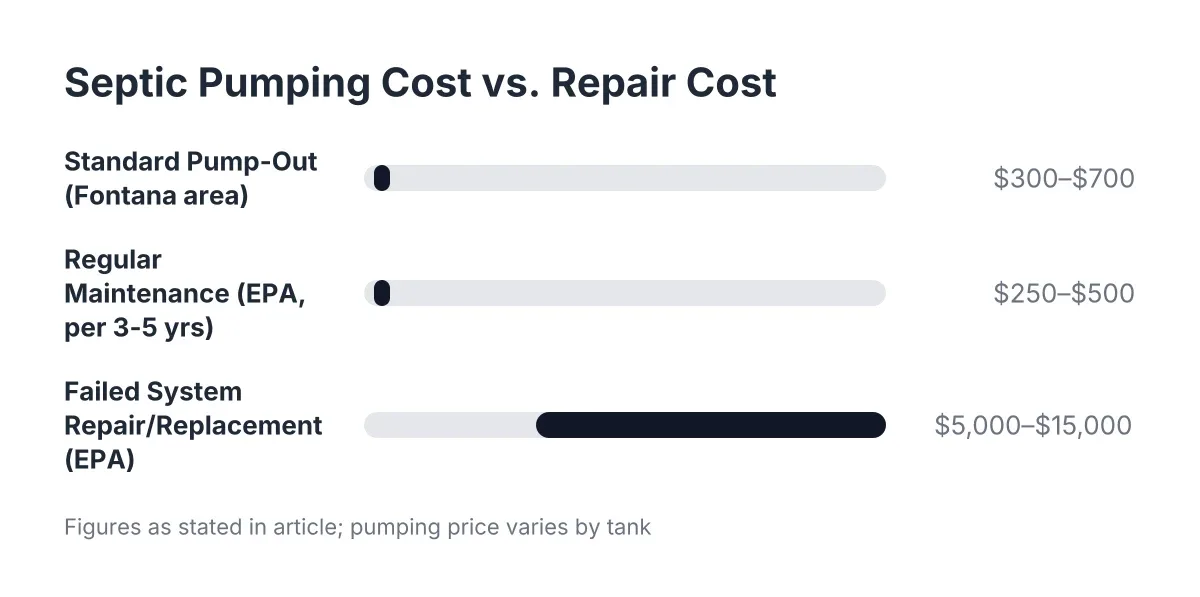
Pumping a residential septic tank in the Fontana area generally runs a few hundred dollars for a standard tank with accessible lids; think of a range in the neighborhood of $300 to $700 as a realistic estimate, not a quote. Tank size, lid access, sludge buildup, and disposal distance all move the number. Emergency and after-hours calls cost more.
The honest answer is that costs vary by job, and any company quoting one flat number sight unseen is guessing. What you can pin down on the phone in 2026:
- The base price for pumping a typical residential tank.
- What counts as an extra charge: buried lids, an overfull tank, a second trip.
- Whether an emergency or weekend visit changes the rate, and by how much.
Tank size matters because it sets how much waste the truck hauls away. San Bernardino County's minimum capacity table requires a 1,000-gallon tank for a 3-bedroom home and 1,500 gallons for a 5-6 bedroom home, according to the San Bernardino County Department of Public Health. Most Fontana-area homes fall in that range, so a company that works here daily can price your job within a tight band once they know your bedroom count and last pump date.
For perspective on why the price is worth paying: EPA guidance puts regular septic maintenance at $250 to $500 every three to five years, versus $5,000 to $15,000 to repair or replace a failed conventional system, according to the U.S. Environmental Protection Agency. A skipped pump-out is the most expensive money a septic owner ever saves.
One caution for the emergency caller. If your tank is backing up because the drain field has failed, pumping buys you days, not a fix. A straight operator will tell you that at the tank, not after three repeat pump-outs.
How Often Should a Fontana Septic Tank Be Pumped?
Most household septic tanks need pumping every three to five years, and busy households need it sooner. For an active family of four, pumping every two to three years is generally advisable because of higher solids and water use, according to Penn State Extension. Usage, tank size, and garbage disposal habits move the interval more than the calendar does.
How long before a septic tank needs to be pumped depends on three things: how many people live in the house, how big the tank is, and what goes down the drains. A retired couple on a 1,500-gallon tank might stretch past five years. A family of six on a 1,000-gallon tank with a garbage disposal will not.
Water leaks shorten the interval too. A single leaky or running toilet can waste as much as 200 gallons of water per day, according to the U.S. Environmental Protection Agency. All of that water pushes through your tank and drain field, stirring solids toward the outlet and soaking the soil. Fixing a running toilet is one of the cheapest septic protections there is.
Septic homes are the exception in California, not the rule. EPA data shows about 10% of California homes use septic systems, one of the lowest rates among states. In Fontana that means septic parcels sit in specific pockets, often older lots and unincorporated edges. If you just bought one of these homes and have no pump-out records, treat that as due now and start your own log from the first visit.
Signs Your Septic Tank Needs Pumping Now
Some signs mean schedule service this month. Others mean stop running water and call today.
- Slow drains throughout the house, not just one fixture
- Gurgling from toilets or drains when the washer or shower runs
- Sewage smell in the yard, near the tank, or over the drain field
- Wet, soggy, or unusually green patches over the leach field
- Sewage backing up into tubs or floor drains, the call-now sign
- An alarm sounding on a pumped or aerobic system
A single slow drain is usually a plumbing clog, and a homeowner can try a plunger or drain snake. However, when every drain slows at once, the problem is downstream of the house, in the tank or the field, and no amount of drain cleaner will fix it. Never open a septic tank yourself or lean over an open lid; the gases inside can knock a person out in seconds. Locating lids and checking sludge depth is work for a crew with the right equipment.
What Happens During a Local Septic Tank Pumping Crew Visit in Fontana
Here is an illustrative visit, so you know what to expect and how long to block out. Say a homeowner near Sierra and Baseline calls about slow drains and a smell near the back fence. The crew arrives, confirms the tank location, and opens the lids. If the lids sit a few inches down, that is a few minutes of digging; if they are two feet under a decade of soil, expect extra time and possibly an added charge.
Next, the operator notes the liquid level before pumping starts. A level above the outlet pipe suggests the drain field is not taking water. A level below normal can mean a leaking tank. This one observation is why an experienced septic tank inspector wants to see the tank before it is emptied, not after.
Then the truck pumps the tank: liquids first, then the operator breaks up and removes the sludge and scum. How long it takes to pump out a septic tank depends on size and buildup; for a typical residential tank with clear access, plan on roughly one to two hours on site as an estimate, longer if lids need excavation or the sludge has hardened after years without service.
Finally, the operator checks the baffles and gives you the verdict: healthy tank, pump again in a few years; or a warning sign, such as water flowing back from the drain field, that points to a bigger issue. Because a stand-alone inspection often costs nearly as much as a pump-out, having the tank pumped and inspected in one visit is usually the better value than paying for a diagnosis alone.
Keep the paperwork. Note the date, tank size if known, and anything the crew flagged. That record sets your next interval and matters at resale.
Should I Use Rid-X or Additives in My Septic?
Additives are not a substitute for pumping, and a healthy septic tank does not need them. The bacteria that digest waste arrive free with every flush. No additive removes the settled sludge that fills your tank over time; only a pump truck does that. Most septic professionals will tell you to save the monthly additive money toward the next pump-out.
The reasoning is simple once you know how the system works. According to the U.S. Environmental Protection Agency, a conventional system has two main parts: the tank, where solids settle out, and the drain field, where clarified liquid disperses through perforated pipes, gravel, and soil. Sludge is inert settled material. Bacteria, boosted or not, do not make it disappear; it accumulates until it is pumped out.
What actually protects the system costs nothing: keep grease, wipes, coffee grounds, and harsh chemicals out of the drains, spread laundry loads across the week, and fix leaks fast. If a home has a heavy grease problem, the fix is a grease trap and regular grease trap cleaning, not an additive.
Fontana-Area Details That Change the Job
Local conditions shape septic work here in ways a national dispatcher never mentions. First, San Bernardino County sets the rules for septic systems in this area, including minimum tank sizes tied to bedroom count. If you are repairing or replacing a system, county health department approval is part of the process, and design work requires licensed expertise beyond what a pumping crew carries. Becoming a licensed septic installer requires certification covering soil types, percolation rates, and system design, according to the New Hampshire Department of Environmental Services; the same principle applies here, so replacement is a permitted project, not a weekend job.
Second, septic in this area clusters in older neighborhoods and unincorporated pockets around Fontana. Homes inside newer city sewer zones connect to municipal treatment and have no tank at all; septic serves the areas without centralized sewer, as the Environmental Finance Center Network notes. If you are unsure which you have, a home with no sewer charge on the water bill and a cleanout or lids in the yard is likely septic.
Third, builders and developers working unincorporated parcels around the Fontana area face the county process on every lot: percolation testing, engineered design, and health department sign-off before construction proceeds. A local septic contact who handles inspection and pumping on existing systems can also flag site conditions early, which beats discovering a failed perc area after grading.
Dry Southern California soil adds one more wrinkle. Long dry spells followed by heavy winter rain can mask a struggling drain field for months, then flood it in a week. If your system only backs up during wet weeks, tell the crew; that pattern points at the field, not the tank.
Choosing a Local Septic Pumping Crew in Fontana
You do not need ten questions. Three separate a real local septic pumper from a dispatch brand or a thin listing:
- Where is the truck based, and do you service my address? A local operator knows Fontana streets and the unincorporated pockets around them. A call center will say yes to anything and figure it out later.
- What does the base pump-out include, and what costs extra? A fair quote names the base price, then lists the add-ons: buried lids, extra pumping volume, hydro-jetting, or repairs. Vague answers on the phone become surprise charges in the driveway.
- Will you tell me if pumping won't fix it? The right answer is yes, with an explanation of what they check at the tank. A crew that only sells pump-outs will pump a failing system three times before mentioning the leach field.
Emergency callers should ask one more: what does after-hours service cost compared to a scheduled visit? Getting that number before the truck rolls is your protection against the crazy-price emergency quote that burned you last time.
The pattern behind all three questions is the same. Local crews doing septic work in Fontana every week can answer specifically, because they priced the same job yesterday. Dispatch centers answer in generalities, because the person on the phone has never opened a tank.
The Bottom Line for Fontana Septic Owners
Pump on schedule, watch for the whole-house warning signs, skip the additives, and keep records. When you need service, call a local operation that will quote the job plainly and tell you the truth at the tank, even when the truth is that the drain field, not the tank, is the problem. Routine septic tank pumping is cheap insurance against a five-figure system failure, and the right local crew makes it a one-hour errand instead of an all-day emergency.
If your system is due, or your drains are already telling you it is overdue, reach out to a local Fontana septic crew for a straight estimate and a scheduled pump-out. One phone call with real answers beats a weekend of backed-up drains.
If you need septic tank pumping, Fontana Septic can help.
Prefer to talk it through? Call (909) 316-2368 — a quick call is usually the fastest way to get a straight answer for your situation.