
Emergency Leach Field Failure: 8 Steps to Take While You Wait for Service
Sewage in the yard, toilets that won't flush, and a smell you can't ignore. An emergency leach field failure hits fast, and most of the damage happens in the hours before a crew arrives. The good news: what you do while you wait matters, and in many cases the field itself can still be saved. Most companies skip past the drain field and jump straight to "replace everything." This guide does the opposite. Here are eight steps—the core leach field emergency steps—in order, that protect your house, your yard, and your wallet until a local septic pro gets there.
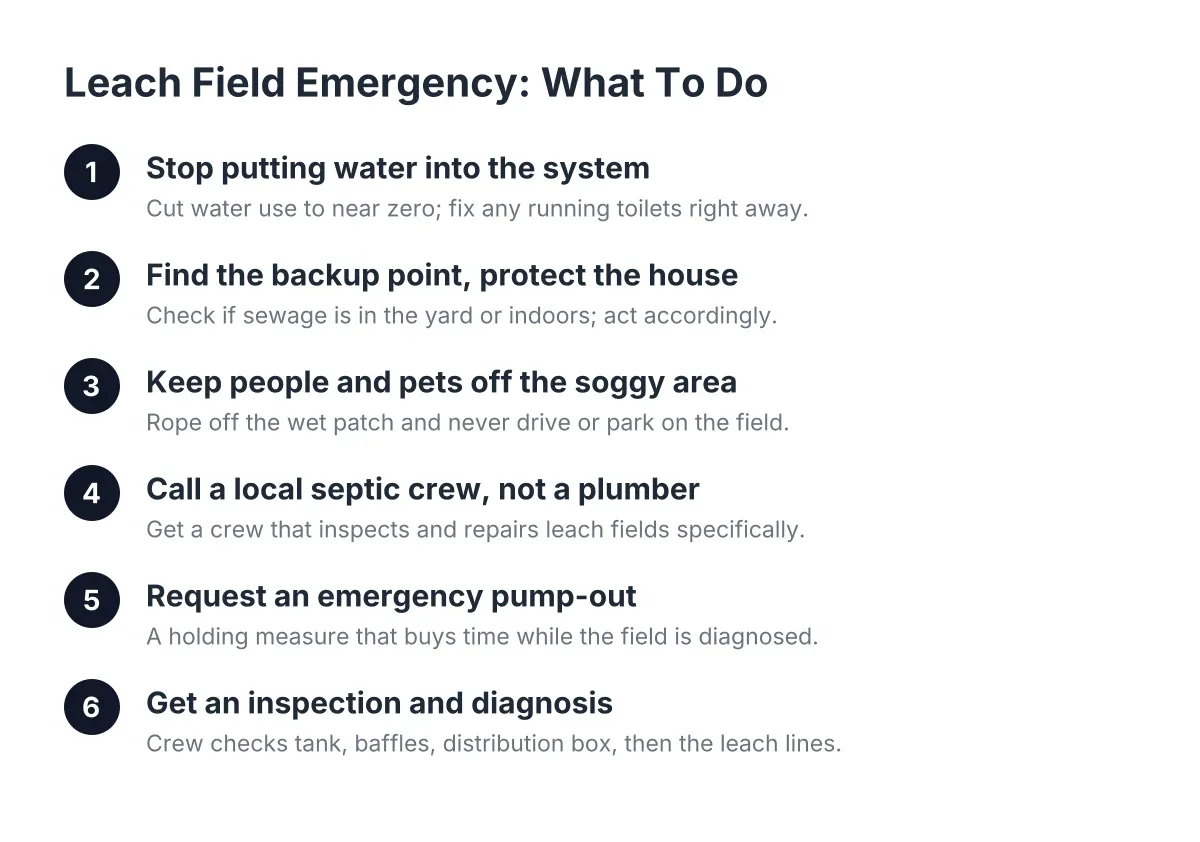
1. Stop Putting Water Into the System Right Now
The single most important move during an emergency leach field failure is cutting water use to near zero. Every gallon you send down a drain has nowhere to go except back up into your tub, your lowest toilet, or your yard. Stop laundry mid-cycle if you have to, skip the dishwasher, and hold off on showers.
Think of your septic tank as a bucket that is already full. San Bernardino County's minimum tank sizing table calls for a 1,000-gallon tank for a 3-bedroom home, according to San Bernardino County Department of Public Health. When the leach field stops absorbing, that tank fills in a day or less under normal household use.
In addition, check for hidden water loads. A single leaky or running toilet can waste as much as 200 gallons of water per day, according to U.S. Environmental Protection Agency. That one fixture alone can keep a struggling drain field underwater.
2. Find the Backup Point and Protect the House First
Figure out where the sewage is going before you do anything else. If it is pooling in the yard over the drain field, the house is still draining and you have some time. If it is coming up in a tub or floor drain inside, the house is the priority.
For an indoor backup, close toilet lids, block floor drains with a towel-wrapped plug or sandbag, and move rugs and furniture away from the lowest drains. Shut off water to any fixture that runs on its own, like an ice maker or a water softener that regenerates on a timer.
However, do not open the septic tank lid yourself to "relieve pressure." An open tank is a fall hazard and a gas hazard, and it will not fix a field that cannot absorb water.
3. Keep People and Pets Off the Soggy Area
Standing water or a soggy, sewage-smelling patch over the leach field is untreated effluent. Keep kids and pets away from it, and do not walk through it and track it indoors. Rope off the wet area with stakes and string if you have them, or just a couple of lawn chairs.
Also, do not drive or park on the drain field, today or ever. A soggy field is at its weakest, and vehicle weight can crush perforated lateral pipes that might otherwise have been repairable. Protecting those lines now keeps the cheaper repair options on the table.
4. Call a Local Septic Crew, Not a General Plumber
A leach field problem is septic work, not drain work. A general plumber can snake a clogged line inside the house, but a failed or saturated drain field needs someone who pumps tanks, inspects fields, and knows San Bernardino County's rules for onsite systems. When you search "septic tank emergency near me," look for a local Fontana operation that lists leach field inspection and repair as its own service, not a footnote under drain cleaning.
When you call, have three things ready: where the sewage is showing up, when you last had a pump-out, and whether anything changed recently, like extra guests, new landscaping, or heavy irrigation. A straightforward crew can often tell you from those answers whether this looks like a full tank, a clogged line, or a true field failure.
Ask what the trip and pump-out will cost before they roll. A legitimate local septic pumper will tell you. Emergency pricing fear is real, and the way to beat it is to get numbers stated plainly on the phone before anyone starts digging.
5. Request an Emergency Pump-Out as a Holding Measure
Ask the crew to pump the tank even if the field is the real problem. A pump-out does not fix a failed leach field, but it buys you a working house. With the tank empty and your water use cut back, most households can flush and run short showers for several days while the field gets diagnosed.
For example, suppose a homeowner in Fontana has effluent surfacing over the field on a Friday afternoon. In that scenario, a same-week pump-out plus strict water limits usually carries the house through to a proper leach field inspection the following week, instead of forcing a rushed replacement decision over a weekend.
Treat this as a bridge, not a cure. If the field cannot absorb water, the tank will fill again. Periodic pump-outs with tight water conservation is a known short-term strategy while you plan the real repair, but it gets expensive if it becomes the plan.
6. Emergency Leach Field Inspection and Diagnosis Steps
A proper diagnosis of an emergency leach field failure starts at the tank and works outward. The crew checks tank levels, then the baffles, then the distribution box, and finally exposes a leach line away from the tank to see what is inside it. That last step is the one that tells you whether the field can be saved.
First, the inlet side. A clogged inlet baffle is a common cause of septic backups and should be one of the first things checked when a line into the tank is blocked, according to Washington State Department of Health. If the baffle is the problem, you may not have a field failure at all.
Next, the lines themselves. Here is roughly what each finding means:
- Dry lines with root debris: Good news. Roots can be cut out and the lines restored. This is the most repairable finding.
- Standing water in the lines, soil still absorbing slowly: The field is overloaded but may respond to rest, reduced water use, or septic drain field rehab measures.
- Fully saturated soil around the lines: The soil itself has stopped accepting effluent. This points toward partial or full replacement.
Understanding this helps you ask the right question when the crew climbs out of the trench: "Did you find roots, standing water, or saturated soil?" The answer drives everything that follows.
7. Know Your Repair Options Before Anyone Says "Replace"
Can a leach field be repaired instead of replaced? Often, yes. Root removal, repairing a crushed or settled line, fixing a tilted distribution box, and resting an overloaded field are all legitimate fixes that cost a fraction of a new system. Leach field repair should always be evaluated before full replacement, because replacement is the most expensive path and sometimes the wrong one.
The stakes are significant. According to U.S. Environmental Protection Agency, repairing or replacing a failed conventional system runs $5,000 to $15,000, while routine maintenance costs $250 to $500 every three to five years. That gap is exactly why saving the existing field is worth a careful look.
However, be honest about the limits. Most field failures trace back to hydraulic overload, too much water, or biological overload, too much organic material, and a field clogged with non-degradable waste often needs its lines excavated and replaced rather than treated. Bacterial and enzyme treatments are sometimes used as a remedial step on a flagged field, but results vary, and they are not a substitute for a professional septic system inspection. If the soil is saturated, no additive will un-saturate it.
In addition, know what full replacement involves so nobody can rush you into it. Replacing a leach field in San Bernardino County generally means treating it as a new system: a new percolation test, engineered design, and county health department review. A percolation test must be performed before installing a septic system to confirm the soil drains properly, according to University of Nebraska-Lincoln Extension. If a builder or developer is reading this for a new parcel in an unsewered zone, that perc-and-design sequence is the same gate your project permits run through.
8. Set Up the Habits That Prevent the Next Emergency
Once the crisis passes, change what fed it. Most septic drain field repair jobs trace back to the same handful of habits: too much water too fast, grease down the kitchen drain, and a tank that went years past its pump-out. Fix those and a repaired field can serve for many more years.
Keep it simple:
- Spread out laundry across the week instead of stacking loads on one day.
- Keep grease out of the drain. Grease is the most common cause of reported sewer blockages at 47%, according to U.S. Environmental Protection Agency, and it clogs septic lines the same way.
- Fix running toilets and dripping fixtures the week you notice them.
- Put septic tank pumping on a regular schedule based on household size and tank capacity, not on symptoms.
- Keep vehicles, sheds, and deep-rooted trees off the drain field.
A yearly septic system inspection catches a tilted distribution box or a rising sludge layer long before sewage reaches the lawn. For a Fontana household on a standard tank, that is a short visit, not a project.
Quick Answers for the Worst Day
What happens if you don't act on a failing leach field?
Ignoring a failing leach field turns a repairable problem into a replacement problem. Untreated effluent keeps surfacing in the yard, backups move indoors, and saturated soil loses its ability to recover. Delay also creates a health risk for your family and neighbors, which is why symptoms should be addressed as soon as they appear.
Can I fix a soggy leach field myself?
Fixing a soggy leach field yourself requires following leach field emergency steps within your limits: water conservation and keeping load off the area, while the diagnosis and repair need a professional. You can cut water use, divert downspouts and irrigation away from the field, and schedule a pump-out. Digging into lines, moving a distribution box, or dosing chemicals without a diagnosis usually makes the repair bigger.
How long does leach field repair take?
Leach field repair time depends entirely on what the inspection finds. Clearing roots or fixing a single crushed line is often a one-day job once the trench is open. Full septic tank drain field repair that requires a new perc test, engineered design, and county approval runs weeks, mostly in the permitting stage rather than the digging.
An emergency leach field failure feels like the whole system is gone. Often it is not. Cut the water, protect the house, keep everyone off the wet ground, and get a local crew to open a line and tell you what is actually down there. Roots and clogs get fixed. Saturated soil gets replaced. Either way, you make the decision with facts from a trench, not fear from a phone call.
If you need septic tank pumping, Fontana Septic can help.
Prefer to talk it through? Call (909) 316-2368 — a quick call is usually the fastest way to get a straight answer for your situation.