
Leach Field Repair vs. Septic System Replacement Cost: Save the Field First
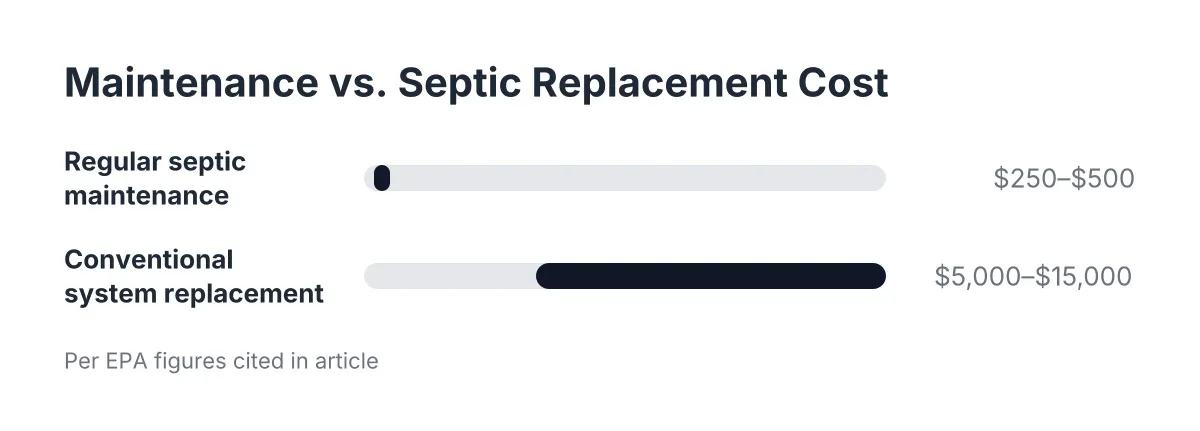
If your drain field is soggy, slow, or backing up, the first question that matters is whether the field can be saved. The full septic system replacement cost runs $5,000 to $15,000 for a conventional system, according to U.S. Environmental Protection Agency figures, and in San Bernardino County the real number often lands higher once you add engineering, permits, and excavation. Most companies skip past the leach field and jump straight to a replacement quote. This guide does the opposite. It walks through how a leach field actually fails, which failures can be repaired, which ones can't, and how catching the problem early keeps you out of the replacement conversation entirely.
We service septic systems in Fontana and the surrounding unincorporated areas every week, and the pattern is consistent. The tank gets attention because pump-outs are visible and routine. The leach field gets ignored until water surfaces in the yard. By then, some options are gone. If you're building on unsewered land or managing lots in Sunnyslope, Glen Avon, or Jurupa Valley, the same logic applies to the systems you're installing now: the decisions you make in year one decide whether that field lasts 30 years or fails in 12.
Why the Leach Field Decides Your Septic System Replacement Cost
The leach field is the expensive half of the system, and it is the half that usually fails first. A concrete tank can last 40 years or more. The field around it depends on soil, water load, and maintenance, and it is where most replacement money goes. When a company quotes you a full system replacement, the field is typically 60 to 70 percent of that number: the trenching, the leach field pipe, the gravel or chamber media, and the engineered design the county requires.
Here is the part most homeowners never hear. A leach field rarely dies all at once. It degrades in stages, and each stage has a different fix at a different price. Catch it at stage one, and you might be looking at a pump-out and a habit change. Catch it at stage three, and you're pricing a new field. The gap between those two outcomes is most of your septic system replacement cost.
That is why a proper leach field inspection matters more than any cost calculator you'll find online. Calculators tell you what a new system costs. An inspection tells you whether you need one.
How a Leach Field Fails, Stage by Stage
A drain field takes the liquid that leaves your tank and lets it soak into the soil. Failure happens when that soil stops accepting water. There are four common paths to that point, and each one looks different in the yard.
Stage 1: Solids carryover from a neglected tank
When a tank goes too long between pump-outs, the sludge layer rises until solids flow out with the liquid. Those solids coat the leach field pipe and the gravel around it. Early on, this shows up as slow drains inside the house and gurgling after heavy water use. The field itself may look fine.
This stage is recoverable. A pump-out, a baffle check, and a return to a normal pumping schedule can stop the damage before the soil clogs. EPA guidance puts regular septic maintenance at $250 to $500 every three to five years, versus $5,000 to $15,000 to repair or replace a failed conventional system. That ratio is the whole argument for staying on schedule.
Stage 2: Biomat buildup
Every working field grows a biological layer, called a biomat, where the effluent meets the soil. A healthy biomat filters water. An overloaded one seals the trench like a liner. At this stage you'll see wet spots over the field after laundry days, grass that stays greener over the trenches, and drains that slow down when the household water use spikes.
Stage 2 is where repair options still exist but the window is closing. Reducing water load, resting sections of the field, or mechanical remediation can restore soil absorption. This is the stage where a specific diagnosis pays for itself.
Stage 3: Saturated or compacted soil
Once the soil around the trenches is fully saturated, water has nowhere to go. Sewage surfaces in the yard, odors are constant, and backups happen even with light water use. Compaction from vehicles parked over the field causes the same result faster; crushed leach field pipe can't distribute anything.
At stage 3, partial fixes still exist in some cases: replacing a crushed section of pipe, adding trench length if the lot has room and the county approves, or rehabilitating soil in a limited area. But full field replacement is now on the table.
Stage 4: End of soil life
Soil has a working lifespan. After decades of accepting wastewater, the receiving layer can become permanently sealed. No amount of pumping or resting brings it back. A field at this stage needs replacement, and often in a new location on the parcel, which is why lot size and reserve area matter so much on new builds.
Can a Leach Field Be Repaired or Does It Need Replacing?
A leach field can be repaired when the failure comes from solids carryover, a damaged pipe section, a failed distribution box, or early biomat buildup. It needs replacing when the soil itself has permanently sealed or the field is undersized for the home's actual water use. An inspection that checks the tank, the distribution box, and the trenches tells you which situation you have.
The honest answer requires digging into specifics, sometimes literally. Here is what separates a repairable field from a dead one:
- Repairable: high tank sludge levels with a still-absorbing field, a broken or tilted distribution box sending all the water to one trench, a crushed or root-blocked run of leach field pipe, biomat clogging that responds to load reduction or remediation.
- Borderline: partial soil saturation where resting one section while using another can extend life, or fields that can be expanded because the lot has approved reserve area.
- Replacement territory: effluent surfacing across the whole field even after a pump-out, soil that fails a current perc evaluation, or a field built for a 2-bedroom load now serving a 5-bedroom house.
You can often tell which side you are on by where the symptoms show up. Wet spots over one section, with drains inside the house still working, point to a partial problem. Standing water across the yard, sewage backup indoors, and every drain running slow point to full failure. Our page on signs your septic drain field is failing walks through what can still be saved.
That last point in the replacement list trips up a lot of buyers of older Fontana-area properties. San Bernardino County's minimum septic tank capacity table requires a 1,000-gallon tank for a 3-bedroom home and 1,500 gallons for a 5-6 bedroom home, according to the San Bernardino County Department of Public Health, and field sizing scales the same way. A system that was legal for the house as built can be undersized for the house as expanded. No repair fixes an undersized field; it just delays the replacement.
One caution worth stating plainly: diagnosing soil condition is not a DIY job. Probing trenches, checking effluent levels, and reading a distribution box takes someone who does this work regularly. Guessing wrong in either direction costs money, either on a replacement you didn't need or on repairs poured into a field that was already gone.
What Actually Moves the Price of Leach Field Work
Leach field work is not one job. It ranges from clearing a clogged line to digging up and rebuilding the whole field, and the same failure can cost very different amounts on two different properties. These are the factors that decide where your job lands:
| Factor | Pushes the price down when… | Pushes it up when… |
|---|---|---|
| Extent of failure | One line or section is clogged and the rest drains | The whole field is saturated and backing up |
| Soil condition | Soil still percolates and the field can be restored | Soil is sealed or failed and new trenches are needed |
| Access | Field sits under open, flat, clear yard | Field sits under hardscape, trees, or tight access |
| Tank condition | Tank is recently pumped and in good shape | Tank is overdue, damaged, or pushing solids into lines |
| Permits and scope | Minor repair with light paperwork | Full replacement requiring permits and a new design |
| Timing | Caught early at the slow-drain stage | Handled as an emergency with sewage in the yard |
Access deserves a hard look before anyone quotes you. Leach field repair means excavation, and a field in an open, flat yard with clear access for equipment costs less to dig up than one under a driveway, patio, mature trees, or landscaping you want to keep. Rocky or hard-packed ground slows the digging and adds hours. Walk your yard and look at what sits on top of the field; everything the crew has to work around, remove, or restore adds to the bill.
Tank condition matters too. If your tank is overdue, the job may include a pump-out, a tank inspection, and possibly baffle or line repairs before the field work even starts. If your pumping records are current and the tank checks out, the scope stays smaller. This is also why the cost of septic tank pumping every few years is the cheapest line item in the whole septic budget. Pumping is routine service; leach field work is construction. A pump-out takes a crew and a truck for part of a day, while a field repair or replacement involves excavation, materials, possible permits, and yard restoration.
What a Real Leach Field Inspection Covers
Searching "septic repair near me" gets you a list of companies, but it doesn't tell you which ones will actually inspect the field before quoting. Many crews check the tank, see a problem, and quote a full system. A field-focused inspection goes further, and you should expect these steps:
- Tank assessment first. Sludge and scum levels, baffle condition, and signs of backflow from the field into the tank. Water flowing backward from the outlet is a field problem announcing itself.
- Distribution box check. The D-box splits flow between trenches. A cracked, settled, or root-invaded box overloads one trench while the others sit dry. This is one of the cheapest field repairs there is, and it mimics total field failure.
- Trench probing. Checking effluent levels in the trenches shows whether the soil is still accepting water or holding it.
- Surface survey. Wet spots, odor, unusually green strips, and settling over trench lines map where the field is struggling.
- Load review. Household size, fixture leaks, and water habits. According to the U.S. Environmental Protection Agency, a single leaky or running toilet can waste as much as 200 gallons of water per day. That volume alone can drown a marginal field, and fixing the toilet is a lot cheaper than fixing the soil.
An inspection like this ends with a specific answer: this component failed, this is the fix, and here is what happens if you wait. That is a different product than a replacement quote with a tank check behind it.
Repair Options That Keep You Out of Replacement Pricing
When the inspection shows the soil still works, several repairs can restore a struggling field. Each targets a different failure, so the diagnosis drives the choice.
Distribution box repair or replacement. If flow isn't splitting evenly, replacing the D-box and releveling the outlets can bring dry trenches back into service. For the cost of a small excavation and a new box, the field returns to full capacity.
Pipe section replacement. Roots, vehicle compaction, and age can block or crush individual runs of pipe. Replacing a damaged section restores that trench without touching the rest of the field.
Field resting and load management. Where a system has a diverter valve or room to add one, alternating between field sections lets the biomat in the resting section break down naturally. Combined with fixing leaks and spreading out laundry loads, this can add years.
Mechanical or biological remediation. Some clogged fields respond to soil fracturing or controlled treatment that restores absorption. Results depend heavily on soil type, and this is a case-by-case call, not a standard fix. Anyone promising it works everywhere is selling, not diagnosing.
Partial field expansion. If the parcel has approved space, adding trench length can relieve an overloaded field. This requires county sign-off, so it is more common on larger unincorporated lots than on tight Fontana infill parcels.
Timely leach field repair at any of these levels typically runs a fraction of what a new field costs. The trade-off is honesty about limits: repairs buy time and capacity, but they do not reset the clock on soil that is near the end of its life. A good contractor tells you which one you're paying for.
When Replacement Is the Right Call, and What Drives the Cost of a New Septic System
Sometimes replacement is the correct answer, and paying for repairs first just adds to the total. If the soil fails a current percolation evaluation, if effluent surfaces across the entire field, or if the system is undersized for the home, put the money into the new field.
For anyone building new or replacing a failed system in the Fontana area in 2026, the septic drain field replacement cost is driven by a handful of variables:
- Soil and perc results. Fast-draining soil means shorter trenches and lower cost. Tight soil means more trench length or an engineered alternative system, which changes the budget category entirely.
- System sizing. Bedroom count sets tank and field size under county tables. Design for the house you'll actually build, not the one on the first draft.
- Permits and design. County health department approval is required before construction proceeds. Design and permitting are real line items; make sure any quote states whether they're included or excluded. Permit costs and requirements come from the county, not the contractor, and they vary by scope: small repairs may need little paperwork, while a full drain field replacement can require permits, a site evaluation, and an approved design.
- Site access and grading. Sloped lots, existing structures, and utility conflicts add excavation cost.
- Reserve area. County requirements for a designated replacement area affect how the lot gets laid out. Protect that area from the start; it is your insurance against a future full septic system replacement cost with nowhere to put the new field.
For builders working lots in unincorporated San Bernardino County, this is where sequencing matters. A perc test that comes back tight after you've priced the project is a schedule killer. Get soil answers before you commit to a design, and confirm in writing whether your installer's quote covers permits and design or labor only. That single question prevents most of the "hidden cost" surprises developers complain about.
It is worth noting that septic is less common in California than in most states; EPA data puts California's septic use at about 10 percent of homes, compared to a high of 55 percent in Vermont. That means fewer local contractors know this work deeply, and more of the companies answering your call treat septic as a sideline to drain cleaning. Ask specifically about field experience before you hire.
How to Get an Accurate Estimate, Not a Phone Guess
No honest septic company can price a drain field over the phone, because the price depends on things nobody can see from the office: how far the failure has spread, what shape the soil is in, and what sits on top of the field. A phone quote is a guess, and a guess protects the company, not you. The real number comes from an on-site look. Here is how to make that visit count.
Have this information ready before anyone comes out:
- Where your tank and field are, if you know. A site plan or old permit record helps.
- When the tank was last pumped, and by whom.
- What symptoms you see: slow drains, wet spots, odors, backups, and when each started.
- Any past septic repairs on the property.
A good estimate should spell out the scope in plain terms: what gets dug, what gets repaired or replaced, whether pumping and inspection are included, who pulls permits, and how the yard gets restored afterward. If a quote is just one number on a text message, ask for the breakdown.
Estimates differ between providers for real reasons. One company may quote a partial repair while another quotes full replacement, so compare scopes, not just totals. Some include the pump-out and inspection in the price; others bill them separately. And a local Fontana crew that looks at your actual yard will price the job differently than a call center reading from a script. When two quotes are far apart, ask each company what the other one might have missed. The answers tell you a lot. Collect two or three written quotes covering the same scope; the goal is not the lowest number, it is the right scope at a fair price.
A Fontana Scenario: The $600 Fix That Was Quoted as a $14,000 Replacement
Here is a situation we see versions of regularly. A homeowner on a half-acre unincorporated parcel near Fontana notices sewage odor and a wet strip in the yard. The first company out looks at the surfacing water, declares the field failed, and quotes a full replacement in the low teens.
A second look tells a different story. The tank is overdue for a pump-out, and the distribution box has settled on one side. All the effluent has been running into a single trench for years, which is why that one strip is soggy while the rest of the field sits bone dry. The fix: a pump-out, a new D-box set level, and the field back on an even split. Total cost, a few hundred dollars plus the pump-out, not five figures.
Not every case ends that way. Sometimes the second look confirms the field is done, and the replacement quote was right. But the point stands: the difference between those two outcomes was a 20-minute check of a distribution box that the first crew never opened. Before you accept any full-replacement number, make sure someone actually diagnosed the field instead of pricing around it.
Protecting a Field So You Never Price a Replacement
Whether you just repaired a field or just installed one on a new build, the habits that follow decide its lifespan. A field that gets 30 years and a field that gets 12 usually differ in maintenance, not construction.
- Pump the tank on schedule, every three to five years for most households, so solids never reach the field.
- Fix running toilets and dripping fixtures fast; constant flow saturates soil that needs dry cycles to work.
- Keep vehicles, trailers, sheds, and heavy equipment off the field. Compaction crushes leach field pipe and seals soil.
- Send grease to the trash, not the drain. Fat, oil, and grease cause about 30 to 40 percent of sewer clogs, per research published in the International Journal of Environmental Science and Technology, and grease does the same damage inside a septic line. Send only wastewater into the system, no grease or wipes.
- Direct roof drains and irrigation away from the field so it only handles the water it was designed for.
- Get the field inspected when you see the first slow drain, not the first wet spot. A field that is struggling can often be repaired; a field that has fully failed usually gets replaced. The earlier you call, the more options stay on the table, and the cheaper the options are.
None of this is complicated. It is the difference between a maintenance line item and a replacement project, and in the Fontana area that difference is measured in thousands of dollars and weeks of excavation. The field can usually be saved if someone looks at it in time. Make sure someone does.
Cost Questions People Ask
Is septic tank repair cost separate from drain field repair cost?
Often, yes. The tank and the field are two parts of one system, and each can fail on its own. An inspection sorts out whether your problem lives in the tank, the field, or both, so your estimate covers what is actually broken and nothing more.
What does full septic system replacement cost depend on?
The size of the system your home needs, your soil's ability to absorb water, site access, and county permit requirements. Replacing the tank and installing a new leach field together is the most expensive septic job there is. That is why it should only happen after an inspection confirms the old field cannot be saved.
Why won't anyone give me a septic drain field repair price over the phone?
Because the price depends on things nobody can see from the office: how far the failure has spread, what shape the soil is in, and what sits on top of the field. A short site visit gets you a number you can plan around.
If you need septic tank pumping, Fontana Septic can help. And if your drain field is already showing symptoms, Fontana Septic's leach field inspection and repair can tell you whether it is a repair or a replacement before you spend a dollar on either.
Prefer to talk it through? Call (909) 316-2368 — a quick call is usually the fastest way to get a straight answer for your situation.