
Leach Field Replacement Cost in Fontana: When Repair Saves You Thousands
If you own a few rental properties on septic around Fontana, one soggy patch of grass can turn into the most expensive line item on your maintenance budget this year. The first question every landlord asks is the same: what is leach field replacement cost going to run, and do I even need a full replacement? The honest answer is that many failing fields can be repaired or rehabilitated for a fraction of replacement money, but only if someone actually inspects the field instead of quoting a new one over the phone. This guide walks through what fails, what repair costs compared to replacement, and how to tell which side of that line your property sits on.
Most septic companies treat the leach field as an afterthought. They pump the tank, note that the field "looks tired," and hand you a replacement bid. That skips the most important step. The field is where your money either gets saved or spent, so it deserves a real diagnosis before anyone opens a checkbook.
Why the Leach Field Is Where the Real Money Sits
The septic tank is the cheap part of your system. It holds solids, lets liquid settle, and sends the clarified water out to the leach field, sometimes called a drain field. The field is a network of buried pipes and gravel trenches that lets that water soak into the soil. It does the actual work of treating and dispersing wastewater.
Tanks rarely fail outright. Fields do. When a field stops absorbing water, wastewater has nowhere to go. It backs up into the house, or it surfaces in the yard. For a landlord, that means a tenant call at 9 p.m., a habitability complaint if it lingers, and a repair decision under pressure.
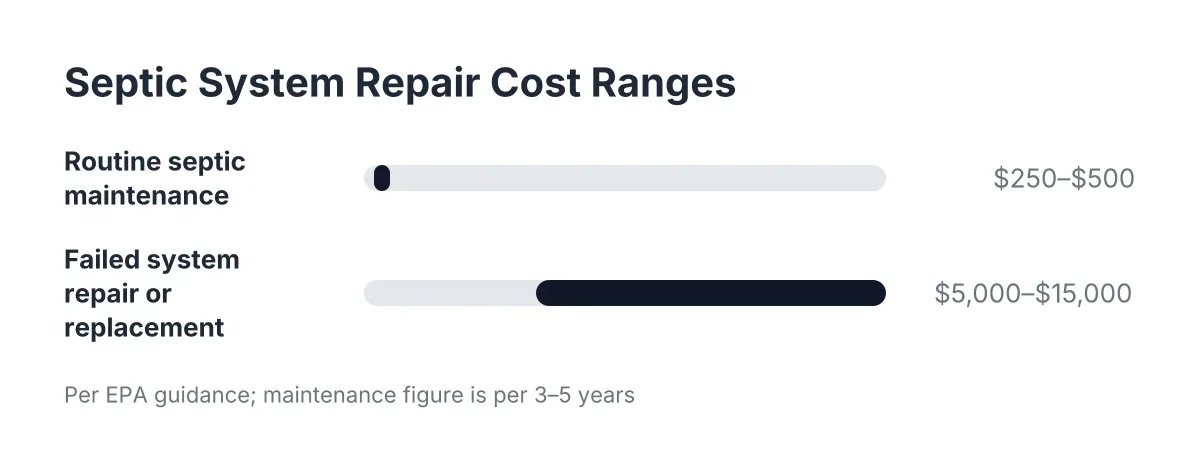
According to the U.S. Environmental Protection Agency, regular septic maintenance runs $250 to $500 every three to five years, while repairing or replacing a failed conventional system runs $5,000 to $15,000. That gap is the whole story. Routine pump-outs are pocket change next to a dead field. The goal of this article is to help you stay on the cheap side of that math, and to know what to expect when you cannot.
Signs of Leach Field Failure Landlords Should Not Ignore
Leach field failure shows up as sewage odors outside, wet or soggy ground over the field, unusually green grass in stripes over the trench lines, slow drains in every fixture at once, and gurgling in the plumbing. Any one of these at a rental property deserves an inspection within days, not months.
Tenants will not report these the way you would. They notice the slow drain in the tub and ignore the wet spot in the back yard. So the signals you get are filtered and late. Here is what to check yourself, or ask a tenant to photograph:
- Standing water or mushy soil over the field, especially in dry weather
- A sewage smell near the tank or field, strongest in the morning or evening
- Grass over the field that is greener and taller than the rest of the yard
- Slow drains in multiple fixtures, not just one sink
- Gurgling toilets or drains after laundry runs
- Backup into the lowest fixture in the house, often a shower or floor drain
One slow drain is usually a clog, and drain cleaning handles it. Every drain slow at once points past the pipes to the tank or field. That distinction matters, because a clog is a service call and a failed field is a capital expense.
Here is a scenario that will sound familiar. You own a duplex, both units on one shared septic system. The downstairs tenant reports a slow shower drain in March. You send a handyman, he snakes it, and it improves for two weeks. By May, both units have gurgling toilets, and there is a wet stripe across the back lawn. That progression, from one slow drain to system-wide symptoms plus surface water, is the classic arc of a field going down. The March call was the cheap moment to act.
Can a Leach Field Be Repaired, or Does It Need Replacing?
A leach field can often be repaired if the failure comes from a fixable cause: a crushed or root-blocked pipe, a failed distribution box, a neglected tank pushing solids into the lines, or hydraulic overload from leaks and overuse. Replacement becomes necessary when the soil itself is sealed with biomat or the field has simply reached the end of its lifespan.
That distinction is the single most useful thing to understand before you take bids. Fields fail for different reasons, and the reason determines the price.
Failures that repair can fix
First, mechanical damage. A vehicle parked over the field can crush a lateral line. Tree roots invade pipes and distribution boxes. A settled or tilted distribution box sends all the flow to one trench, drowning it while the others sit dry. These are targeted fixes, often a day or two of excavation and pipe work, and they cost a fraction of a new field.
Second, solids carryover. If a tank goes too long between pump-outs, solids flow into the field lines and clog them. Sometimes jetting the lines and getting the tank back on a pumping schedule restores the field. This is the failure mode landlords cause most often, because rentals get heavy use and pump-outs slip when no one is tracking them.
Third, hydraulic overload. The field is fine; it is just getting more water than it can absorb. The U.S. Environmental Protection Agency notes that a single leaky or running toilet can waste as much as 200 gallons of water per day. In a rental, a running toilet can go unreported for months. Fix the fixtures, and a saturated field often recovers on its own once it dries out.
Failures that mean replacement
Biomat is the field killer. Over years of use, a black, tar-like bacterial layer builds up on the trench walls and floor. Some biomat is normal and even helps treat wastewater. Too much seals the soil, and water can no longer soak away. Once the soil is sealed across the whole field, no amount of pipe work brings it back. Some fields respond to rest, meaning the system is diverted to a reserve area for a year or more, but most Fontana lots do not have a spare field sitting idle.
Age is the other. A conventional leach field lasts about 20 to 30 years with decent care. If your field is 35 years old and failing, spending repair money on it usually means paying twice. This is where an honest local inspection earns its fee: a septic tank inspector who probes the trenches and checks soil saturation can tell you whether you are buying five more years or throwing money into sealed ground.
What Leach Field Repair Costs Compared to Replacement
Leach field repair in the Fontana area typically runs from a few hundred dollars for jetting clogged lines up to a few thousand for replacing a distribution box or a damaged section of pipe. Full septic drain field replacement usually lands in the mid four figures to low five figures, depending on lot conditions, field size, and permitting.
No honest company quotes an exact number before seeing the property, and any figure you read online, whether it is a leach field replacement cost thread on Reddit or a national price table, reflects someone else's soil, lot, and county. Treat the ranges below as planning estimates for 2026, not quotes:
- Line jetting and tank pump-out: low hundreds. Worth trying first when solids carryover is the suspected cause.
- Distribution box repair or replacement: several hundred to around two thousand dollars. A common fix with a big payoff, since a bad box can mimic total field failure.
- Repairing a section of leach line: roughly one to five thousand, depending on depth, access, and how much trench has to be reopened.
- Adding trenches to an existing field: mid four figures, where the lot has room and the county approves.
- Full leach field replacement: for a single-family system, plan around the EPA's $5,000 to $15,000 range for a failed conventional system. Shared systems serving a duplex or several units can run past that, because required capacity scales with bedrooms.
That last point matters more for landlords than for homeowners. San Bernardino County's minimum septic tank capacity table requires a 1,000-gallon tank for a 3-bedroom home and 1,500 gallons for a 5-6 bedroom home, according to the San Bernardino County Department of Public Health. Field sizing scales the same way. A replacement field for a duplex is engineered for the combined bedroom count, not for one household, so a multi-unit replacement bid will read higher than what your single-family neighbors paid.
Percolation matters too. Parts of Fontana sit on soil that drains well, and parts do not. A perc test tells the county, and the contractor, how much trench the new field needs. Slow soil means more trench, and more trench means more money. This is why leach field replacement cost varies so much between two properties a mile apart.
What Drives Leach Field Replacement Cost Up or Down
Leach field replacement cost is driven by five things: soil percolation rate, system size based on bedroom count, site access for equipment, county permitting and testing requirements, and whether the old field must be abandoned in place or removed. Each one can swing the final number by thousands.
Soil comes first. Fast-draining soil needs less trench; tight soil needs more, or a different system design entirely. Bedroom count is second, because San Bernardino County sizes systems by bedrooms, not by how many people actually live there. A 4-bedroom rental gets a 4-bedroom system even if two tenants occupy it.
Access is the quiet cost multiplier. If an excavator can drive straight to the field, work goes fast. If the field sits behind a garage, under mature landscaping, or beside a fence line shared with a neighbor, expect hand work, smaller equipment, and more labor hours. On rental properties with carports and paved parking added over the years, the original field is sometimes partially under improvements, which complicates everything.
In addition, permits and testing add real money in San Bernardino County. Replacement fields need percolation testing, a design, and county sign-off. That is not a corner to cut. An unpermitted field replacement creates a disclosure problem when you sell the property and gives code enforcement something to cite if a tenant complains.
One trade-off worth naming: the cheapest bid is not always the cheapest field. A minimal repair on a field that is 90 percent sealed buys you months, not years, and you pay for the excavation twice. Conversely, replacing a field that only needed a new distribution box wastes five figures. The inspection is what protects you from both mistakes, and it is worth paying for even when a company offers a free replacement estimate instead.
How to Fix a Soggy Leach Field Before It Becomes a Replacement
Fixing a soggy leach field starts with cutting the water load: pump the tank, repair running toilets and leaky fixtures, spread out laundry loads, and keep irrigation and roof runoff off the field. If the soil is overloaded rather than sealed, the field often recovers as it dries out over several weeks.
Start with a pump-out and a septic system inspection. Pumping the tank gives the field immediate relief and lets an inspector see how the tank has been performing. High solids in the outlet zone suggest carryover into the lines. A tank inspection also catches a failed baffle, a cheap septic tank repair that stops solids from reaching the field at all.
Next, hunt down water waste in the units. Running toilets, dripping fixtures, and old washing machines all push extra gallons at the field every day. In a rental, ask tenants directly and check during turnover walkthroughs. This is the cheapest field repair that exists, because it costs a flapper valve and an hour of labor.
Then keep surface water off the field. Redirect downspouts, adjust sprinklers so they do not water the field area, and regrade low spots that pool. A field that has to absorb both wastewater and irrigation runoff fails years early. Also keep vehicles off it; tenant parking on the field compacts soil and crushes lines, and at multi-unit properties overflow parking tends to migrate onto whatever open ground exists.
However, know the limit of these steps. If the ground stays soggy after weeks of reduced load, or sewage surfaces during dry weather, the soil is likely sealed and you are in repair-or-replace territory. At that point, bring in a local crew that does leach field inspection and repair as its own line of work, not as a sideline to drain cleaning. In Fontana, that also means someone who knows how San Bernardino County handles perc tests and permits, because a contractor learning the county process on your job costs you time.
Worth knowing: California is not a heavy septic state overall. EPA data shows about 10 percent of California households use septic systems, compared to a high of 55 percent in Vermont. That is part of why general plumbing outfits here often lack deep field experience; septic is a small slice of their calls. The properties that do run on septic, including a lot of older rentals around Fontana, Rialto, and Colton, need companies that treat leach field repair as core work.
A Practical Plan for Landlords with Multiple Septic Properties
For a landlord with several septic-served rentals, the cheapest leach field strategy is a recurring pump-out schedule, a field inspection at every tank service, and documented records per property. That routine costs hundreds per year per property and is the main defense against a five-figure replacement arriving as a surprise.
You cannot manage what you are not tracking. If you own three or four rentals on septic across the Fontana area, build a simple one-page record for each: tank size, last pump-out date, field location sketch, known repairs, and symptoms reported by tenants. When a company inspects the field during a routine pump-out, have them note field condition on the invoice. Those notes become your early warning system, and they document maintenance if a habitability question ever comes up.
Put every property on a recurring pump-out schedule instead of waiting for tenant calls. Rentals typically need pumping more often than owner-occupied homes because usage is higher and nobody living there is watching what goes down the drain. Every three to five years is the standard EPA guidance; heavily used shared systems may need it more often, and your pumper's notes will tell you.
Budget the replacement before you need it. If a field at one of your properties is 25 years old, start reserving for it now, the same way you would for a roof. A planned septic drain field replacement scheduled between tenants costs the same in construction but far less in vacancy, tenant goodwill, and emergency premiums than one forced by a backup during a lease.
Finally, use one local company across all your properties. A crew that has pumped your tanks and seen your fields can tell you which failure is a distribution box and which is end-of-life soil, because they have the history. That knowledge is what separates a $1,500 repair from an unnecessary $12,000 replacement, and it only exists if someone has been paying attention to your systems over time.
The Bottom Line on Repair Versus Replacement
Do not let anyone quote you a new field without inspecting the old one. A large share of "failed" fields are actually failed distribution boxes, clogged lines from a neglected tank, or drowned soil that recovers when the water load drops. Those are repairs, and they cost a small fraction of leach field replacement cost.
At the same time, do not pour repair money into a field that is decades old with sealed soil. Pay for a real inspection, get a plain-spoken read on whether the field can be saved, and make the call with the property's remaining hold period in mind. For a Fontana landlord, that one inspection decision is the difference between a maintenance invoice and a capital project.
If you need septic tank pumping, Fontana Septic can help.
Prefer to talk it through? Call (909) 316-2368 — a quick call is usually the fastest way to get a straight answer for your situation.