
How Routine Septic Tank Cleaning Prevents System Failure and Big Repair Bills
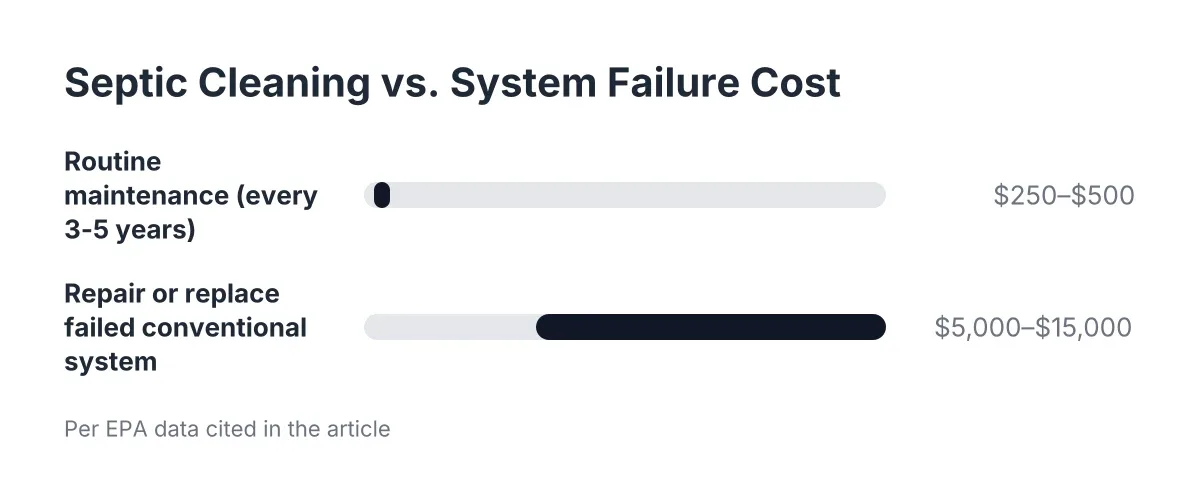
Most septic systems don't fail overnight. They fail slowly, over years, because the tank never got pumped and solids crept out into the leach field. Regular septic tank cleaning is the one habit that stops that slide. According to the U.S. Environmental Protection Agency, routine maintenance runs $250 to $500 every three to five years, while repairing or replacing a failed conventional system runs $5,000 to $15,000. That gap is the whole argument for this article.
Here in Fontana, most homes on the north end and in the surrounding unincorporated pockets sit on septic, not sewer. That's less common than people think. EPA data shows California has one of the lowest rates of septic use among states, about 10%, compared to 55% in Vermont. So if you're on septic here, you're in a minority, and a lot of the advice floating around online is written for other climates and other soil.
This guide walks through the steps that keep a tank from quietly wrecking your drain field. Follow them in order. None of them require special tools, just attention and a calendar.
Step 1: Know What Kind of System You Have
Before you can maintain a system, you have to know what's in the ground. Most Fontana homes have a conventional septic system: a buried tank that separates solids from liquid, and a leach field (also called a drain field) where the liquid soaks into the soil.
If you're wondering what are the 3 types of septic systems, the short version is this: conventional gravity systems, pressure-distribution systems, and alternative or engineered systems for tough soil or small lots. In our area, conventional gravity systems are the most common by far. The sandy, fast-draining soil around Fontana usually percs well enough that engineered systems only show up where lots are small or slopes are steep.
Pull your county records if you can. San Bernardino County keeps permit records for many systems, and a septic system diagram from the original permit tells you tank size, tank location, and where the leach field lines run. For reference, the county's minimum capacity table requires a 1,000-gallon tank for a 3-bedroom home and 1,500 gallons for a 5-6 bedroom home, according to San Bernardino County Department of Public Health. If you're building new on vacant land, that table drives your design, so know it before your perc test.
Step 2: Locate Your Tank and Mark the Access Points
You'd be surprised how many pump-out visits start with an hour of hunting for a buried lid. Find your tank now, while nothing is wrong.
Start at the house. The main sewer line usually exits the foundation on the side nearest the bathrooms, then runs 5 to 25 feet to the tank. Look for:
- A patch of grass that's greener or grows faster than the rest of the yard
- A slight mound or depression in a straight line from the house cleanout
- Concrete or plastic lids at or just below grade
- The original permit diagram, which often shows distances from the house corners
Once you find the lids, mark them. Risers that bring the access points to grade level are a one-time cost that pays for itself every pump-out afterward, because the crew isn't digging through two feet of dirt to open your tank.
Step 3: Learn the Signs Your Septic Tank Needs Pumping
A septic tank fills with solids on a schedule set by your household, not by the calendar alone. Sludge builds on the bottom, scum floats on top, and the clear zone in the middle shrinks. When solids get high enough to wash into the leach field, the damage starts, and that damage doesn't reverse.
Watch for these warning signs:
- Slow drains throughout the house, not just one fixture
- Gurgling sounds from toilets or drains after you run water
- Sewage odor near the tank or drain field, especially in the evening
- Soggy patches or standing water over the leach field
- A backup into the lowest drain in the house, often a shower or floor drain
One sign alone might be a simple clog. Two or more together usually mean the tank is overdue for a pump-out or the drain field is already stressed. A slow drain in every room of the house almost never fixes itself.
Step 4: Put Septic Tank Cleaning on a Real Schedule
How often should you pump a septic tank? For most Fontana households, every three to five years is the right window, which matches EPA maintenance guidance. A family of five with a 1,000-gallon tank sits at the short end of that range. A retired couple in a 4-bedroom house with a 1,500-gallon tank can often stretch toward five years.
However, the calendar is only a starting point. Water use is what actually fills the tank. The EPA notes that a single leaky or running toilet can waste as much as 200 gallons of water per day. That's water your leach field has to absorb around the clock, and it can push a healthy field into failure long before the tank itself is full. Fix running toilets and dripping fixtures the week you notice them.
A note on terms, because the search results confuse people: septic pumping vs cleaning is mostly a naming difference. Pumping removes the liquid and floating layers. Septic tank cleaning means the crew also breaks up and removes the settled sludge on the bottom, which is what you actually want. When you call a local septic pumper, ask whether the visit includes removing sludge, not just liquid. A tank that's "pumped" but left with a foot of hardened sludge fills back up fast.
Step 5: Know What Happens During a Pump-Out Visit
A straightforward septic tank pumping visit follows the same basic sequence, and knowing it helps you judge whether the crew did the job right. Expect the visit to run 30 to 60 minutes for an accessible tank.
- The crew locates and opens the tank lids, both the inlet and outlet sides if the tank has two compartments.
- They measure the sludge and scum layers before pumping. This number tells you whether your schedule is right.
- The vacuum hose removes liquid, scum, and sludge. A good crew backflushes to break up compacted solids on the bottom.
- They check the baffles or tees at the inlet and outlet. A broken outlet baffle lets solids flow straight into the leach field, and it's a cheap fix caught early.
- They note the tank's condition: cracks, root intrusion, water flowing back in from the drain field, which signals a saturated field.
That last check matters most. Water running back into an empty tank from the outlet pipe means the leach field can't absorb what it's being sent. Catching that during a routine pump-out gives you options. Catching it during a holiday weekend backup does not.
Step 6: Protect the Leach Field Between Cleanings
The tank is replaceable for a few thousand dollars. The leach field is the expensive part, and it's the part that routine septic tank cleaning is really protecting. Between pump-outs, the field needs three things: no solids, no grease, and no crushing weight.
Keep grease out of your drains entirely. Research published in the International Journal of Environmental Science and Technology estimates 30-40% of sewer clogs come from fat, oil, and grease deposits. In a septic system, that grease coats the soil in your drain field and seals it off. Scrape pans into the trash. If you run a home business with a commercial kitchen, a grease trap with its own cleaning schedule is the right answer.
In addition, skip the additives. Septic tank cleaning products and powders promise to eat sludge so you never have to pump. No additive removes solids from a tank; only a vacuum truck does that. Some additives make things worse by suspending solids that then flow into the field. Save the money for the pump-out.
Finally, keep vehicles, trailers, and heavy equipment off the field. On the half-acre lots common around Fontana, Bloomington, and Glen Avon, the leach field often sits right where people want to park a work truck or an RV. Compacted soil doesn't drain, and crushed lines don't come back.
Step 7: Get an Inspection When the Stakes Are High
Routine pump-outs handle most situations, but some moments call for a full septic system inspection by a septic tank inspector, not just a pump truck. Schedule one when:
- You're buying or selling a home on septic, since most sales in our area require it
- You're building new construction and need the system designed and permitted to San Bernardino County code before you can pour a foundation
- The system has backed up more than once in a year
- You've added bedrooms or occupants and aren't sure the tank size still meets the county's capacity table
For example, a builder putting a 4-bedroom home on a vacant Fontana parcel in 2026 needs a perc test, a county permit, and a tank sized to the county table before the first trench gets dug. An inspection-first approach on that timeline costs a few hundred dollars up front. Discovering a failed perc area after grading costs weeks and a redesign.
One honest limitation: pumping cannot fix a leach field that has already failed. If the soil is saturated and sewage surfaces in the yard, a pump-out buys you days, not years, and you need a repair assessment from a professional. The point of everything above is to keep you from ever reaching that step.
The Math That Makes This Easy
Set a reminder for three years from your last pump-out. Spend a few hundred dollars each cycle. Skip the additives, fix the running toilet, and keep the truck off the field. Against a $5,000 to $15,000 replacement, according to the U.S. Environmental Protection Agency, it's the cheapest insurance a Fontana homeowner can buy, and it doesn't require a call center to explain it.
If you need septic tank pumping, Fontana Septic can help.
Prefer to talk it through? Call (909) 316-2368 — a quick call is usually the fastest way to get a straight answer for your situation.