
How to Prepare for a Septic Tank Pumping Appointment in Fontana: A Homeowner’s Guide
You booked your first septic tank pumping visit. Now what? If you just bought a home on septic in Fontana or the surrounding area, you might not know what the crew needs from you, what the truck actually does, or whether you should be home for it. This guide walks you through getting your property ready, so the pump-out goes fast, costs what it should, and leaves you with real information about your system instead of just an empty tank.
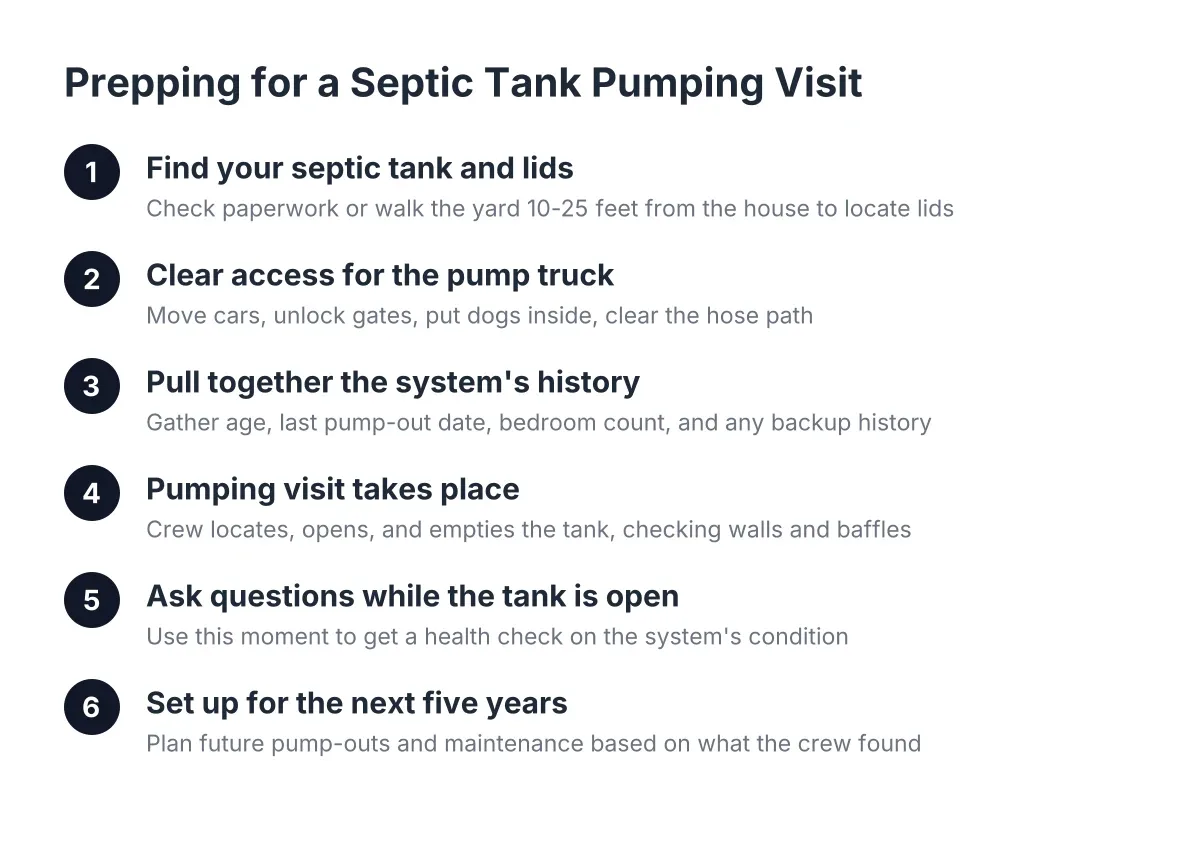
The short version: find your tank, clear a path to it, know a little history about the house, and have a few questions ready for the crew. The rest of this article explains each step, plus what the visit looks like, what it should cost, and how to tell a thorough job from a quick vacuum-and-leave.
Why Preparation Matters Before the Truck Arrives
A septic pump-out is straightforward work, but the setup around it decides how smooth the visit goes. The first task on any proper job is locating and uncovering the tank. If the crew has to spend an hour probing your yard to find a buried lid, that is time you may pay for and an hour you lose.
Preparation also protects your property. A pump truck is heavy. It needs a place to park where it will not crack a driveway edge, sink into soft ground, or crush the leach field. Knowing where things are before the appointment keeps the truck on solid ground and the hose where it belongs.
Finally, preparation changes what you get out of the visit. An empty tank is the best moment to see the true condition of the walls and baffles. If you come prepared with the right questions, a routine pump-out doubles as a basic health check on a system you probably know nothing about yet. For a first-time septic owner, that information is worth as much as the pumping itself.
Step 1: Find Your Septic Tank and Lids
Start with paperwork. Your closing documents, home inspection report, or county permit records often include a site diagram showing the tank location. If the seller left any service receipts, those may note where the lids are and when the tank was last pumped. In San Bernardino County, permit records can also tell you the tank size, which matters because the county's minimum capacity table requires a 1,000-gallon tank for a 3-bedroom home and 1,500 gallons for a 5-6 bedroom home, according to the San Bernardino County Department of Public Health.
No paperwork? Walk the yard. The tank usually sits 10 to 25 feet from the house, on the side where the main drain line exits. Look for a slight rectangular depression or mound, grass that grows differently, or concrete lids at or just below grade. A metal probe rod pushed gently into the soil can find the tank edges without digging up half the lawn.
If the lids are buried, dig them out before the appointment if you can do it safely. Most are under a few inches to a foot of soil. Exposing the lids yourself saves labor time on the visit. However, if the lids are deeper than about a foot, or you are not sure what you are looking at, leave it. A local crew can locate and uncover the tank; just tell them in advance so they bring what they need and quote the visit accordingly. Many Fontana homeowners searching for a septic pumper near me do not realize that "I can't find my tank" is a normal thing to say when booking. Say it.
One safety note that is not optional: never lean over an open septic tank, and never let kids or pets near an open lid. The gases are dangerous and the tank is a drowning hazard. Leave open-tank work to the crew.
Step 2: Clear Access for the Pump Truck
The truck needs to get its hose to your tank. Most pump trucks carry enough hose to reach a tank that sits a reasonable distance from the street or driveway, but every extra section of hose slows the job. Before the appointment, handle these:
- Move cars out of the driveway or off the street spot nearest the tank.
- Unlock gates and measure the opening if the tank is in a fenced backyard; tell the company the gate width when you book.
- Put dogs inside for the duration of the visit.
- Move trash cans, trailers, firewood, or anything else blocking the hose path.
- Trim back branches or brush over the tank lids if they block the work area.
- Never ask the truck to drive over the leach field or the tank itself; the weight can crush pipes and lids.
In addition, mark anything fragile along the hose path. Irrigation heads, low-voltage lighting, and drip lines are easy to snag. A few flags or a quick heads-up to the crew prevents a small repair bill nobody wanted.
Step 3: Pull Together the System's History
Before a visit, a good septic company asks about the house: how old it is, when the tank was last pumped, whether there have been backups or slow drains, and whether any repairs were done. If you just bought the place, dig this out of your inspection report and seller disclosures.
For example, suppose your home inspection flagged "tank needs attention" and the realtor mentioned it had not been pumped in years. Write down exactly what the inspector said, and have the report handy when the crew arrives. A vague note like that could mean anything from an overdue pump-out to a damaged baffle, and the crew can only confirm which once the tank is open and empty.
Useful facts to gather before the appointment:
- Approximate age of the house and, if known, the septic system.
- Date of the last pump-out, even a rough guess.
- Number of bedrooms and the number of people living there.
- Any history of backups, slow drains, odors, or wet spots in the yard.
- Whether the property has a garbage disposal or a water softener that drains to the tank.
- For landlords: how many units share the system, and tenant complaints on file.
That last point matters if you own rentals. Say you manage a duplex in Rialto or a small mobile home lot in Colton where two or three units feed one tank. That tank fills faster than a single-family tank of the same size, and the pumping schedule should reflect it. Bringing unit counts and occupancy numbers to the first visit lets the crew set a realistic service interval instead of guessing.
What Happens During a Septic Tank Pumping Visit
A proper pump-out removes everything in the tank, not just the liquid. Inside the tank, solids settle to the bottom as sludge, grease and lighter material float on top as scum, and liquid sits in the middle. Those solid layers are what cause problems, so a real septic tank service pulls out all three layers, from both chambers if the tank has two.
Here is how a typical visit runs. The crew confirms the tank location, uncovers the lids, and opens the tank. They note the liquid level before pumping, because a level that is too high or too low tells them something about the drain field or the tank itself. Then they pump the contents into the truck, breaking up the sludge layer so it comes out rather than staying caked on the bottom. A thorough crew rinses the tank interior with a hose and pumps out the rinse water too.
With the tank empty, the crew should look inside. The inlet and outlet baffles need to be present and in position; a missing outlet baffle lets solids escape into the leach field, which is how drain fields die early. The outlet pipe should sit lower than the inlet, since solids float on the liquid and only liquid should leave toward the drain field, as the University of Nebraska-Lincoln Extension explains. Cracks, root intrusion, and signs of past overfilling are all visible at this stage and nowhere else.
Afterward, the waste does not stay on your property or get dumped somewhere unofficial. Pumped septic waste is hauled by truck to a sewage treatment plant for disposal, according to the New Hampshire Department of Environmental Services. The crew closes the lids, and you should walk away knowing the tank's condition, not just that it is empty.
One honest caveat: pumping is maintenance, not a cure. If your drains were backing up because the leach field is saturated or failing, an empty tank buys you days or weeks, not a fix. In that scenario you need a septic system inspection and likely a leach field evaluation, and you should get a professional opinion before spending money on repeat pump-outs.
How Much Should It Cost to Have a Septic Tank Pumped Out?
A routine residential pump-out in the Fontana area generally runs a few hundred dollars as of 2026, commonly somewhere in the $250 to $500 range depending on tank size, access, and condition; treat that as an illustrative estimate, not a quote. The U.S. Environmental Protection Agency cites the same $250 to $500 figure for regular septic maintenance every three to five years, compared with $5,000 to $15,000 to repair or replace a failed conventional system. That gap is the whole argument for staying on schedule.
Several things push the price of septic tank pumping up or down:
- Tank size. A 1,500-gallon tank takes longer and holds more than a 1,000-gallon tank.
- Access. Buried lids that need digging, long hose runs, or tight gates add labor.
- Condition. A tank that has gone many years without a pump-out has thick, compacted sludge that takes longer to remove.
- Extras. Locating an unmapped tank, replacing a damaged lid, or installing risers costs more, and should be discussed before the work, not after.
Therefore, when you call septic tank pumping companies near me and compare prices, ask what the quoted number includes. Does it cover both chambers? Digging up the lids? A baffle check? A low quote that covers only "pumping the liquid" is not the same service as a full pump-out, and it leaves the solids that cause the damage.
How Often to Pump a Septic Tank After the First Visit
Most households should plan on a pump-out every three to five years, and busier homes need it sooner. Penn State Extension advises that an active family of four generally pump every two to three years because of higher solids and liquid production. Tank size, household size, and habits like heavy garbage disposal use all move the interval.
For rental properties, shorten the interval further. Multiple units on one tank, tenant turnover, and the fact that renters rarely baby a septic system all add load. Scheduled pump-outs ahead of lease turnover beat emergency calls during a tenancy, both for cost and for keeping units occupied.
Do not wait for symptoms. Slow drains, gurgling, sewage odors, or soggy ground over the leach field mean solids have likely already pushed past the tank. By the time you see a warning sign, some damage may be done. A standing schedule, or a maintenance arrangement where a local crew tracks your interval for you, is the reliable way to know when the next pump-out is due. This is less common knowledge than it should be: septic systems serve only about 10% of California homes according to the U.S. Environmental Protection Agency, so most new owners here learned plumbing habits on city sewer and have to relearn them.
Between pump-outs, two habits protect the system more than anything else. Fix running toilets fast, since a single leaky toilet can waste as much as 200 gallons of water per day per the U.S. Environmental Protection Agency, and all of that lands in your tank. And keep grease out of the drains; fat, oil, and grease are a leading cause of clogged lines in general, and a septic tank handles them poorly.
Should I Use Rid-X or Additives in My Septic Tank?
Additives are not a substitute for pumping a septic tank, and a healthy system does not need them. The bacteria that break down waste arrive free of charge every time someone flushes. No additive removes the settled sludge and floating scum that build up over the years; only a pump truck does that.
Some additives are harmless, and some can do damage by stirring up solids so they wash into the leach field. If a company's main pitch is a monthly additive instead of a pumping schedule, be skeptical. Spend the money on regular septic tank pumping instead; it is the one maintenance step with a clear, proven payoff for system life.
Questions to Ask the Crew While the Tank Is Open
The twenty minutes while your tank sits empty are the best diagnostic window you will get. Stand at a safe distance and ask:
- How thick was the sludge layer, and what interval does that suggest for my household?
- Are both baffles present and intact?
- Do you see cracks, roots, or signs the tank has been overfull?
- Did the liquid level look normal before pumping, or was it high or low?
- Should I add risers so the lids sit at grade for the next visit?
- When should I book the next pump-out?
Ask for photos of the empty tank interior. An empty tank gives a clear view of the walls and baffles, and photos give you a baseline record. For a first-time owner, that record is your defense against future upsells; if someone later claims your tank is failing, you have dated pictures showing its condition.
If the crew recommends work beyond the pump-out, such as baffle replacement or a leach field inspection, ask them to show you the problem while the tank is open. A straightforward local operator can point at the issue. A script-reader cannot. That difference is why many Fontana homeowners prefer a crew that only does septic system services over a dispatch line that treats septic as a sideline.
After the Visit: Set Yourself Up for the Next Five Years
Before the truck leaves, write down three things: the date, the tank size and condition notes, and the recommended next pump-out date. Put the next date in your calendar now. Keep the receipt and any photos in a folder with your home documents; future buyers, inspectors, and your own memory will thank you.
Next, mark the lid locations. Measure from two fixed points, like house corners, and sketch it. Better yet, ask about risers if your lids sit deep; they bring access to the surface and cut labor on every future visit.
For landlords with units across Rialto, Rubidoux, Colton, or Highgrove, take it one step further. Build a simple log per property: tank size, last pump-out, next due date, and any crew notes. A standing schedule with one local septic tank service costs less over ten years than reacting to tenant backup calls one emergency at a time.
The work itself takes an hour or two. The preparation takes an afternoon the first time and almost nothing after that. Do it once, keep the records, and your first pump-out becomes the start of a maintenance routine instead of the first chapter of an expensive surprise.
If you need septic tank pumping, Fontana Septic can help.
Prefer to talk it through? Call (909) 316-2368 — a quick call is usually the fastest way to get a straight answer for your situation.