
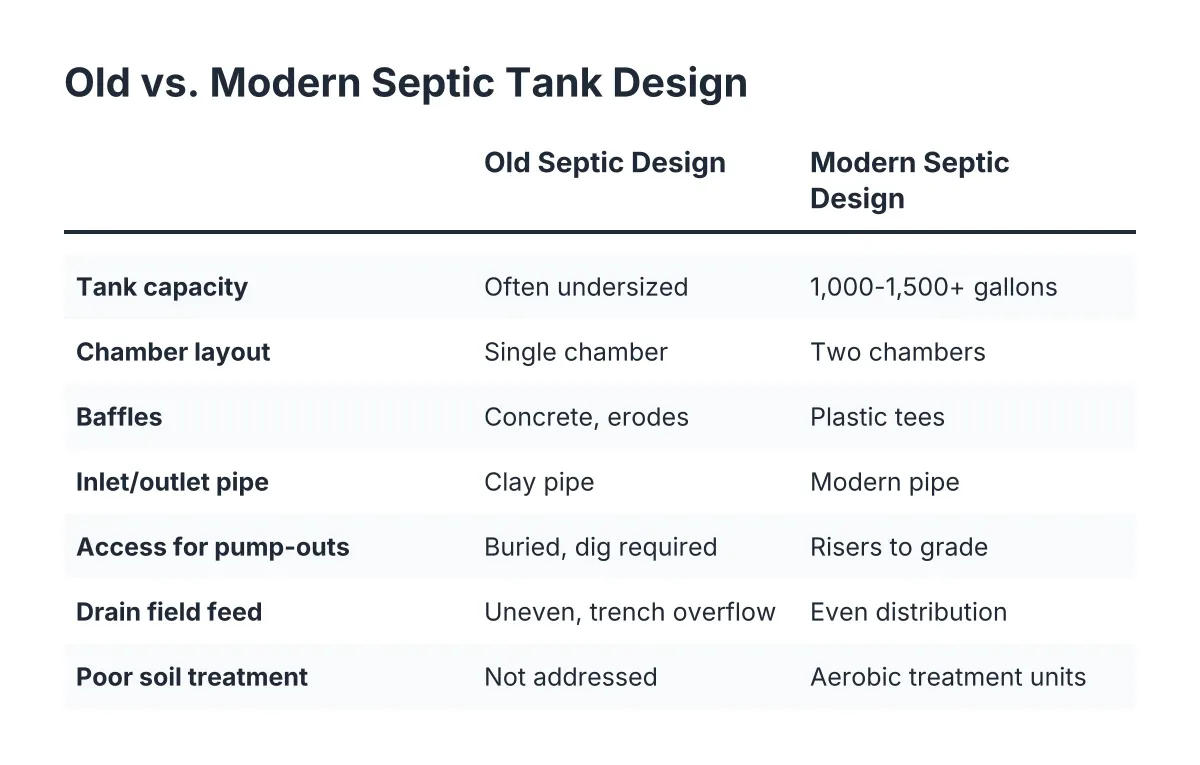
Old Septic Tank Design vs. Modern Systems: Upgrades and Compatibility in Fontana, CA
If your Fontana property has a tank that went in decades ago, you are probably wondering whether that old septic tank design still works, what has changed since it was installed, and whether a modern replacement will even connect to the pipes you already have. Those are the right questions. An old septic tank upgrade may be on your mind if you're deciding whether to keep servicing an aging system or replace it before a new build or a sale.
This guide walks through how old tanks were built, how modern tanks differ, which design flaws cause the recurring problems homeowners in Fontana, CA call about, and what an upgrade actually involves. The goal is simple: give you enough to make a clear decision without having to decode county paperwork or industry jargon on your own.
How an Old Septic Tank Design Actually Works
An old septic tank design uses the same basic principle as a new one: slow the wastewater down, let solids settle, and send clarified liquid out to the soil. According to the U.S. Environmental Protection Agency, a conventional septic system has two main components, the septic tank and the drain field. That has not changed in a hundred years. What has changed is how each part is built.
Older tanks around the Inland Empire tend to fall into a few categories:
- Old concrete septic tank designs. Poured or precast concrete, often a single chamber. Many still hold water fine, but the baffles inside were sometimes concrete lips that crack or erode over time.
- Old brick septic tank designs. Brick-and-mortar tanks were built on site, one course at a time. Mortar joints degrade, and many of these were never fully watertight to begin with.
- Steel tanks. Less common here, but where they exist, the lids and walls rust. A rusted steel lid is a safety hazard, not just a maintenance problem.
- Cesspits and seepage pits. Not true septic tanks at all. These let sewage leach directly into the surrounding soil with no real settling stage. Counties stopped approving them long ago.
Two other details mark an aging system. First, older designs often used clay pipe for the inlet and outlet lines. Clay pipe cracks, shifts at the joints, and invites roots. Second, some older properties used two separate tanks in a line instead of one tank with an internal wall. That setup can still work, but it doubles the number of lids, pipes, and failure points a septic tank inspector has to check.
One more quirk you may find on older Fontana-area lots: instead of a distribution box feeding the drain field evenly, some old septic system designs ran a primary trench with a solid overflow pipe to a secondary trench. When the first trench clogs, everything dumps into the second, and the system fails in stages instead of giving you a clear warning.
What's Changed: Modern vs. Old Septic Tank Upgrade Options
Modern septic tank design made three big moves: bigger tanks, better internal separation, and easier access. None of it is exotic. All of it came from watching old systems fail the same ways over and over.
Bigger capacity. Modern households push more solids into a tank than the bacteria inside can break down, so tanks got larger to buy settling time. San Bernardino County's minimum capacity table reflects this; according to the San Bernardino County Department of Public Health, a 3-bedroom home needs at least a 1,000-gallon tank and a 5 to 6 bedroom home needs 1,500 gallons. Many old tanks on Fontana lots fall short of those numbers.
Two chambers instead of one. Most new tanks use a two-chamber layout. Wastewater enters the front chamber, where the heavy solids settle, then flows through an opening to a second chamber for additional settling before it exits. One tank, one excavation, cleaner effluent reaching the drain field. This replaced the older two-tanks-in-a-line approach with fewer lids and fewer pipe joints to fail.
Proper baffles and tees. According to University of Nebraska-Lincoln Extension, tanks use a baffle at both the inlet and outlet, a downward-facing tee that stops floating solids and forces them to settle. The same source notes the outlet pipe must sit lower than the inlet, since solids float on top and only liquid should leave toward the drain field. Old concrete baffles erode; modern plastic tees do not, and they can be replaced without replacing the tank.
Risers to grade. New installations typically bring access risers up to ground level. The trade-off is a visible lid or two in the yard, but pump-outs and inspections no longer require digging up two feet of dirt to find the tank. For a homeowner paying for routine septic tank pumping every few years, that digging time is money.
Aerobic treatment units. Where soil conditions are poor, modern aerobic systems add forced air to speed up treatment. These are usually built as a single precast concrete tank with three internal compartments, a trash and treatment section, an aeration section, and a pump section, rather than three separate tanks as older designs sometimes used.
Shapes vary by region too. According to the International Code Council, some areas use rectangular concrete tanks while others use circular tanks, so do not assume your tank matches a picture you found online. Searches for old septic tank design pictures turn up everything from UK brick chambers to Midwest steel drums, and most of it will not match what is buried in a Fontana yard.
Common Problems Tied to an Old Septic Tank Design
The most frequent problems tied to an old septic tank design are failed baffles, undersized capacity, cracked clay inlet and outlet pipes, and uneven drain field loading. Each one shows up as a symptom the homeowner notices first: a slow drain, a backup after laundry day, a sewage smell, or a soggy strip of yard that never dries.
Here is how the design flaw connects to the symptom:
- Eroded or missing outlet baffle. Solids escape into the drain field and clog it. The tank looks fine at pump-out, but the yard gets wet and smells. Drain field damage is the expensive failure; according to the U.S. Environmental Protection Agency, repairing or replacing a failed conventional system runs $5,000 to $15,000, versus $250 to $500 for routine pumping every three to five years.
- Undersized tank. Wastewater moves through too fast for solids to settle. The household gets recurring slow drains even after a pump-out, because the problem is capacity, not sludge level.
- Clay pipe failure. Roots find the joints, pipes sag or crack, and sewage either backs up into the house or leaks into the soil before it ever reaches the tank.
- Trench overflow layout. The series-trench design fails quietly. By the time the second trench saturates, both are compromised, and a repair becomes a replacement.
- Deteriorating lids. Old concrete lids crack and steel lids rust through. Beyond the service headache, a failing lid over an open tank is a genuine safety risk for kids and pets.
Household habits make old designs fail faster. For example, a single leaky or running toilet can push as much as 200 gallons of water per day into the system, according to the U.S. Environmental Protection Agency. An undersized old tank has no margin for that. Grease is the other quiet killer; research in the International Journal of Environmental Science and Technology estimates roughly 30 to 40 percent of sewer clogs trace back to fat, oil, and grease deposits. If your property has a grease trap, keeping it cleaned protects the tank behind it.
One thing worth saying plainly: additives do not fix design problems. Commercial septic additives marketed to dissolve sludge lack strong scientific backing, according to Washington State University Extension. If an old tank keeps backing up, the answer is in the design or the pipes, not a bottle.
Does an Old Tank Have to Be Replaced?
No, age alone does not condemn a septic tank. An old tank can keep working if the structure is sound, the baffles are intact, the outlet flow is normal, and the water level sits where it should between pump-outs. Plenty of older concrete tanks around Fontana pass inspection year after year with nothing more than regular service.
The honest way to find out is a septic system inspection with the tank pumped and the walls visible. A septic tank inspector checks the inlet and outlet baffles, looks for cracks and root intrusion, confirms the liquid level, and watches how the drain field accepts water. That is a far cheaper decision point than digging on a guess.
Regular pumping and keeping the wrong things out of the drains are the two habits that stretch the life of an old absorption system. Keep wipes, grease, and heavy chemical cleaners out of the tank. Pump on a 3 to 5 year cycle, sooner for a small tank with a full house. Fix running toilets fast. Those three habits alone can delay a five-figure replacement by years.
However, some situations tip the decision toward replacement regardless of how the tank looks:
- The tank is brick, steel, or a converted cesspit. These rarely meet current standards and usually cannot be repaired to compliance.
- The tank is undersized for the bedroom count under San Bernardino County's capacity table, and you are adding a bedroom, an ADU, or selling the home.
- The drain field has failed. A new field often means a new tank anyway, since the county reviews the whole system.
- Backups keep recurring within months of each pump-out. That pattern means the design, not the sludge, is the problem.
When to Consider an Old Septic Tank Upgrade
Upgrading from an old septic tank design to a modern two-chamber tank is usually a compatibility question before it is a construction question. The good news: the new tank can almost always work with your existing house plumbing. The common approach is to set the new tank uphill of or adjacent to the old one, as long as the inlet and outlet pipes can stay properly aligned and keep fall toward the drain field.
In practice, an old septic tank upgrade in the Fontana area follows a sequence like this:
- Inspection and assessment. Pump the old tank, evaluate its condition, and test how the drain field is accepting water. This determines whether you need a tank, a field, or both.
- Design and county review. San Bernardino County requires the system to meet current standards, including minimum tank capacity for the bedroom count. New construction or a full replacement typically needs a perc test and a permit before anyone digs. A septic tank designer sizes the tank and lays out the field to match your soil and lot; on straightforward residential jobs, the installing contractor often handles that design work and the county paperwork together, which is worth confirming before you sign anything.
- Excavation and set. The crew excavates, sets the new precast tank, and connects the inlet from the house and the outlet toward the field. If the old lines are clay, this is the time to replace them with PVC rather than marry new tank to failing pipe.
- Abandonment of the old tank. Counties do not let you leave an empty tank in the ground. The old tank gets pumped, the lid gets broken in or removed, and the cavity gets filled, usually with sand, gravel, or slurry.
- Final inspection and backfill. The county signs off before the hole closes. Then risers come to grade and the yard goes back together.
Suppose a homeowner in north Fontana has a 1960s single-chamber concrete tank serving a 4-bedroom house, and the outlet baffle has eroded away. In that scenario, a realistic path is a pump-out and inspection in the $300 to $600 range as an estimate, which confirms the field is still healthy. The upgrade then becomes a new properly sized two-chamber tank set beside the old one, new PVC inlet and outlet runs, and abandonment of the old tank, rather than a full system replacement at the top of the EPA's $5,000 to $15,000 range. Catching the baffle failure before solids wrecked the field is what kept the project on the smaller side.
Timing matters most for anyone building on vacant land or replacing a failed system before construction. The perc test and permit review sit on the critical path, so start the county process before you need the trench open. Delays there cost more than the digging does.
Keep in mind that every lot is different. Soil type, slope, setbacks from wells and property lines, and the condition of the existing field all shape what the county will approve, so have a professional evaluate the specific site before you budget the project. Good septic tank design is site work first and tank selection second, and a plan that fits your soil is what passes inspection the first time.
What This Looks Like for Fontana, CA Homeowners in 2026
California is not a heavy septic state overall; EPA data puts the state's septic use at about 10 percent of homes, compared to a high of 55 percent in Vermont. But Fontana's semi-rural pockets, along with Bloomington and the surrounding unincorporated areas, sit squarely in that 10 percent. Homes in cities typically connect to municipal sewage treatment, according to the Environmental Finance Center Network, which is exactly why septic knowledge is thinner here, and why a lot of local homeowners inherit an old tank with no paperwork and no idea what is underground.
As of 2026, the practical playbook has not changed:
- If you do not know your tank's age, layout, or last pump-out, start with an inspection and a pump-out. That single visit answers most of the design questions in this article for your specific tank.
- If the tank is old but sound, commit to the 3 to 5 year pumping cycle and protect the drain field. Maintenance is the cheapest design upgrade there is.
- If the tank is brick, steel, undersized, or failing repeatedly, price the upgrade now rather than after a backup forces the timeline. Planned replacements cost less stress than emergency ones.
- If you are building new or replacing a failed system, get the perc test and county permit moving early, and confirm whether your contractor handles the design and paperwork or only the digging.
An old tank is not automatically a problem, and a new tank is not automatically necessary. The design tells you which one you have. A straightforward local crew that pumps and inspects tanks of every age can tell you in one visit where your system stands, and that answer is what turns a vague worry about an aging tank into a plan with a number attached.
If you need septic tank pumping, Fontana Septic can help.
Prefer to talk it through? Call (909) 316-2368 — a quick call is usually the fastest way to get a straight answer for your situation.