
Septic Tank Design Components: Chambers, Baffles, and the Outlet Pipe
If you own a home or rental property on septic in Fontana, the septic tank design components inside that buried box decide whether your drains run clean or back up into a bathtub. Three parts do most of the work: the chambers that let waste separate, the baffles that control flow, and the outlet pipe that sends liquid to the leach field. When one of them fails, the whole system follows. This guide walks through each component in plain language, compares old and modern tank designs, and shows you how design flaws turn into the problems that get a tenant calling you at 9 p.m. Understanding septic tank baffles and other design components matters more than most owners think.
Understanding these parts matters more than most owners think. A septic tank has no moving parts in its basic form, so when something goes wrong, the cause is almost always one of these components doing its job poorly or not at all. Know what each one does, and you can ask smarter questions at the next pump-out instead of just paying the bill.
How a Septic Tank Fits Into the Whole System
A conventional septic system has two main components: the septic tank and the drain field, according to the U.S. Environmental Protection Agency. Everything else, from the inlet pipe to the distribution box, exists to move wastewater between those two parts in the right condition.
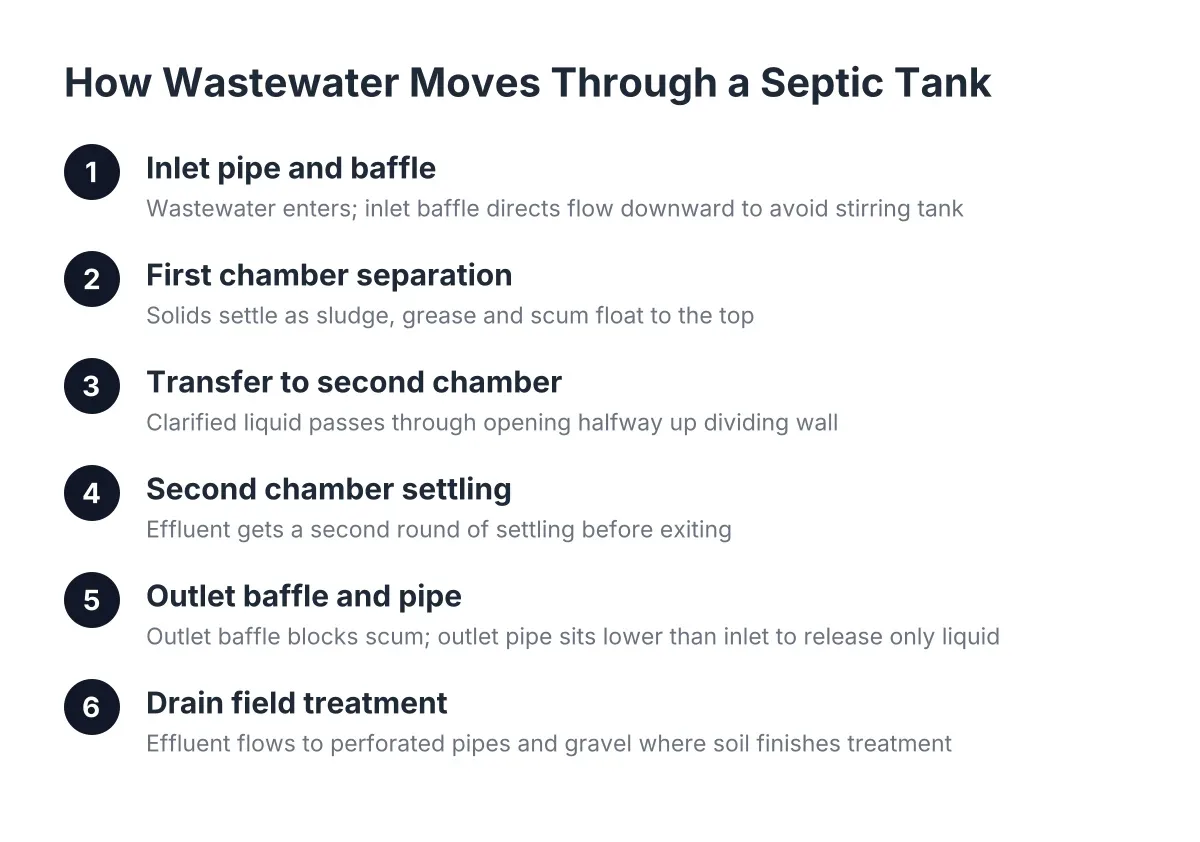
Here is the path wastewater takes. A single pipe carries everything from your household drains to the tank, according to the US EPA. Inside the tank, solids settle to the bottom as sludge. Grease and lighter material float to the top as scum. The clarified liquid in the middle, called effluent, flows out to perforated pipes surrounded by gravel in the drain field, where soil finishes the treatment.
The tank's only job is separation. It holds wastewater still long enough for solids to drop out so that only liquid reaches the leach field. Every design component inside the tank serves that one goal. When the tank stops separating well, solids escape into the drain field lines, and that is where the expensive damage happens.
The EPA puts numbers on that gap. Routine maintenance runs $250 to $500 every three to five years, while repairing or replacing a failed conventional system costs $5,000 to $15,000, according to the U.S. Environmental Protection Agency. The design components below are what stand between those two price ranges.
Septic Tank Baffles and Other Core Design Components
Strip away the regional variations and every septic tank relies on the same handful of parts. Each one has a specific job, and each one fails in a specific way.
The Inlet Pipe and Function of Inlet Baffles in Septic Tanks
Wastewater enters the tank through the inlet pipe from the house. Right where that pipe meets the tank sits the inlet baffle, usually a downward-facing tee fitting. Its job is to slow and direct the incoming flow downward so it does not churn up the settled layers or push floating scum across the tank.
Septic tanks use a baffle at both the inlet and outlet, each consisting of a downward-facing tee with a pipe section, which stops solids from floating to the top of the outlet and forces them to settle, according to University of Nebraska-Lincoln Extension. Without that inlet baffle, every toilet flush stirs the tank like a spoon in a cup of coffee.
The inlet baffle also matters when things go wrong. A clogged inlet baffle is a common cause of septic backups and should be one of the first things checked when troubleshooting a blocked line into the tank, according to Washington State Department of Health. If every drain in the house backs up at once, the blockage often sits right at this fitting, not deep in the system.
The Chambers
Many tanks, especially older ones, are a single open compartment. Modern designs often split the tank into two chambers with an internal wall. The first chamber takes the raw flow and holds most of the sludge and scum. A connecting opening, positioned about halfway up the dividing wall, lets only the clearer middle layer pass into the second chamber.
That halfway placement is the whole trick. Solids sink below the opening. Scum floats above it. Only the clarified liquid in between moves forward. The second chamber then gives that liquid a second round of settling before it heads to the outlet, so the effluent leaving the tank carries fewer suspended solids.
For a landlord comparing properties, this is worth noting during an inspection. A two-chamber tank sends cleaner liquid to the leach field, which tends to mean a longer drain field life. A single-chamber tank can work fine, but it leaves less margin for error if pump-outs slip past schedule.
Protecting Your Drain Field: The Outlet Baffles and Pipe
The outlet side is where most expensive failures start. The outlet baffle, another tee fitting or a molded concrete box in older tanks, blocks the floating scum layer from riding out with the effluent. It pulls liquid from the middle of the tank, below the scum and above the sludge.
Height matters here too. A properly designed outlet pipe must sit lower than the inlet pipe, since solids float on top of the liquid and only liquid should exit toward the drain field, according to University of Nebraska-Lincoln Extension. That elevation drop keeps flow moving in one direction and keeps the scum layer where it belongs.
If the outlet baffle breaks off, rots away, or was never installed right, scum and solids flow straight into the leach field lines. Those perforated pipes and the gravel around them clog from the inside. Unlike a clogged inlet, which backs up into the house and announces itself, a failed outlet baffle does quiet damage for years before the yard turns soggy.
The Tank Shell Itself
The tank body holds everything together, and its shape varies by region. Some areas use rectangular concrete tanks while others use circular tanks, according to the International Code Council. Around Fontana and the surrounding unincorporated areas, size is set by county rules. San Bernardino County's minimum capacity table requires a 1,000-gallon tank for a 3-bedroom home and 1,500 gallons for a 5-6 bedroom home, according to San Bernardino County Department of Public Health.
Capacity is a design component in its own right. An undersized tank does not hold wastewater long enough for solids to settle, so it pushes dirty effluent to the drain field even when every baffle is intact. If you bought an older Fontana property that gained a bedroom or a second unit over the years, the tank may now be undersized for the actual load on it.
How Old Tank Designs Differ From Modern Ones
Septic systems are less common in California than in much of the country; EPA data shows the state at about 10% septic use, compared to a high of 55% in Vermont, according to the U.S. Environmental Protection Agency. However, the Fontana area's semi-rural lots carry plenty of them, and many of those tanks were built decades ago to older design standards.
The differences show up in a few specific places:
- Baffle construction. Older tanks often used a molded concrete three-sided box at the outlet, cast as part of the tank. Concrete baffles erode over decades from the gases inside the tank and can crumble away entirely. Modern tanks use PVC tee fittings, which resist that corrosion and can be replaced if damaged.
- Flow path. Some older designs route flow underneath a submerged wall rather than over a raised opening. That layout lets solids build thick on the inlet side while the outlet side runs mostly liquid, which throws off how full the tank reads and how often it needs a pump-out.
- Chamber count. Single-compartment tanks dominated older construction. Two-compartment tanks, with the connecting pipe set about halfway up the dividing wall, became the common standard later because they send cleaner effluent to the leach field.
- Effluent filters. Many modern outlet tees accept a slide-in filter that catches fine solids before they leave the tank. Older tanks have no provision for one, though a septic pumper can often retrofit a filter during service.
- Access and risers. Older tanks frequently sit buried with no riser to grade, so every inspection starts with digging. Newer installations bring access lids to the surface, which makes routine service faster and cheaper.
None of this means an old tank must be replaced. A concrete tank from the 1970s with intact baffles and a healthy leach field can keep working for decades. The point is that old septic tank design puts more weight on inspection, because the parts most likely to be missing or degraded, the baffles, are also the parts you cannot see without opening the lids.
Design Flaws Behind Common Septic Tank Problems
Most recurring septic tank problems and solutions trace back to one of the components above. Matching the symptom to the component saves you from paying for the wrong fix twice.
Backups and Slow Drains Point to the Inlet Side
Sewage backing up into the house, or every fixture draining slow at once, usually means a blockage between the house and the tank. First on the checklist is the inlet baffle, where paper and solids can bridge across the tee. A single slow drain in one bathroom, by contrast, is more likely a plumbing clog inside the house than a septic system problem.
Water habits feed this failure mode. A single leaky or running toilet can waste as much as 200 gallons of water per day, according to the U.S. Environmental Protection Agency. That constant flow pushes wastewater through the tank faster than solids can settle, which loads the baffles and the drain field at the same time. In a rental, a running toilet a tenant never reports can quietly overload a tank for months.
Soggy Yard and Odors Point to the Outlet Side
Wet patches over the leach field, sewage smell outdoors, or grass that grows greener in stripes all suggest the drain field is taking on more than it can absorb. The design question to ask is whether the outlet baffle is still intact. After separation in the tank, wastewater should distribute through perforated lateral pipes and filter through gravel, sand, and soil, according to the U.S. Environmental Protection Agency. Solids slipping past a failed outlet baffle clog that filtering path, and there is no cheap way to unclog a saturated drain field.
Grease makes this worse. Fat, oil, and grease are major clog drivers in sewer piping generally; research estimates roughly 30-40% of sewer clogs come from grease deposits, according to the International Journal of Environmental Science and Technology. In a septic tank, grease thickens the scum layer and is the first material to escape when the outlet baffle degrades.
Short Pump-Out Intervals Point to Capacity or Chamber Design
Suppose a landlord owns three rentals around Fontana and Bloomington, and one of them needs a pump-out every 18 months while the others go four years. That pattern is a design signal, not bad luck. The frequent-pumping property may have an undersized tank for its occupancy, a single-chamber tank handling a heavy load, or a submerged-wall flow path stacking solids on the inlet side. A septic system inspection that measures sludge and scum depth in each compartment will usually identify which one.
In that scenario, the fix might be as modest as a retrofitted outlet filter and a tighter pump-out schedule, or as involved as a larger tank. Either way, knowing the design component at fault keeps the money aimed at the actual problem.
What a Good Inspection Checks on These Components
A pump-out that only removes solids misses half the job. Proper service includes a visual check that the inlet and outlet baffles are present and sitting correctly, because an empty tank is the only time anyone can see them. A septic tank inspector typically works a mirror and flashlight into the tees to confirm placement and condition.
For a Fontana homeowner or a landlord building a maintenance file, here is what a thorough septic system inspection should cover on the design side:
- Inlet baffle condition. Is the tee intact, clear, and still attached where the house line enters the tank?
- Outlet baffle condition. Is it present at all? On older concrete-baffle tanks, this is the most common missing part.
- Chamber wall and connecting opening. In two-compartment tanks, is the dividing wall sound and the pass-through clear?
- Sludge and scum depth in each chamber. This tells you whether the pump-out interval fits the actual load.
- Liquid level relative to the outlet. A level above the outlet pipe suggests the drain field is not accepting flow; a level below it suggests the tank is leaking.
- Evidence of solids at the outlet. Staining or solids in the outlet tee means material has been reaching the leach field.
Documenting these points visit after visit does two things. For a homeowner, it turns the next real estate sale inspection from a gamble into a formality. For a landlord running several septic properties, it creates a paper trail showing each system was maintained, which matters if a habitability question ever comes up.
Knowing Your System Before There Is a Problem
You do not need to become a septic tank designer to protect your property. You need to know three things: where your tank and baffles sit, whether your tank has one chamber or two, and when it was last pumped and inspected. Most of what goes wrong with septic tank design traces back to owners who could not answer any of the three.
Start with the paper trail. San Bernardino County permit records often include the original layout for the parcel. If no records exist, the next pump-out is the right time to map the system, since the lids are already open and the baffles are visible. Ask the crew to note tank size, chamber count, baffle material, and baffle condition, then keep that note with the property file.
One honest caveat: diagnosing septic tank design components from symptoms alone has limits. A soggy yard can mean a failed outlet baffle, a saturated drain field, a broken lateral pipe, or an irrigation leak that has nothing to do with the septic system. If the symptoms point to the drain field, bring in a local crew to open the tank and confirm before committing to any repair, because leach field work is where the budget gets decided.
The components are simple. Chambers hold the water still, baffles keep the layers apart, and the outlet pipe sends only liquid forward. Keep those three doing their jobs, and a Fontana septic system will stay off your list of problems for a long time.
If you need septic tank pumping, Fontana Septic can help.
Prefer to talk it through? Call (909) 316-2368 — a quick call is usually the fastest way to get a straight answer for your situation.