
How Grease Trap Cleaning Works: What the Crew Actually Removes, Step by Step
If you own a small rental property or just bought your first place on septic, grease trap cleaning probably sounds like something only big restaurants worry about. It is not. Any kitchen that sends fat, oil, and grease down a drain needs a trap, and that trap needs cleaning on a schedule. The good news for property owners around Fontana is that the same local crew that handles septic tank pumping can usually handle the grease trap too. One truck, one phone call, one person who already knows your property.
This guide walks through the job the way a technician actually does it, step by step. By the end, you will know what gets removed, where it goes, and how to tell whether the crew that showed up did the work right.
What Is a Grease Trap and Why Does It Matter?
A grease trap is a small tank, installed between a kitchen drain and the sewer line or septic system, that catches fat, oil, and grease before they reach the pipes. Wastewater flows in, slows down, and cools. Grease floats to the top, food solids sink to the bottom, and the cleaner water in the middle flows out.
That separation matters because grease does not stay liquid. It cools and hardens inside pipes, coating the walls until the line chokes shut. According to the U.S. Environmental Protection Agency, grease from restaurants, homes, and industrial sources is the most common cause of reported sewer blockages, at 47 percent. On a septic property, the stakes are even higher, because hardened grease can clog the inlet baffle of your tank or carry over into the leach field, where it is expensive to fix.
The same physics works inside a septic tank. The U.S. Environmental Protection Agency describes how fats, oils, and grease float to form a scum layer on top while solids sink into sludge on the bottom. A grease trap is a smaller, earlier version of that separation, built to be cleaned out often.
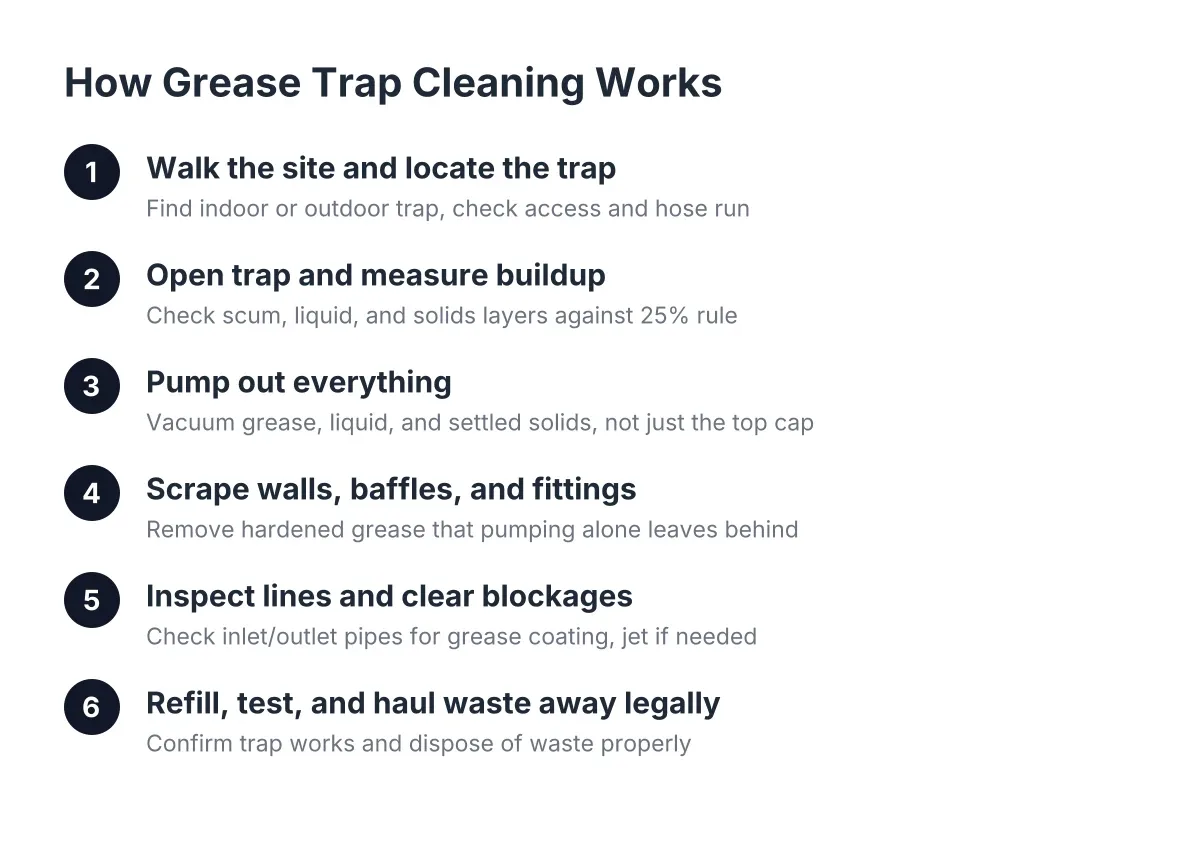
Step 1: Walk the Site and Locate the Trap
Before anyone opens a lid, the technician finds the trap and sizes up the job. Indoor traps sit under or near the sink, usually a metal box in the floor or cabinet. Outdoor units, often called a grease trap interceptor, are larger concrete or plastic tanks buried outside the kitchen with access lids at grade.
The tech also checks where the truck can park and how far the hose needs to run. For a landlord, this first visit matters most. A crew that asks about your past pump-out history, your drain layout, and whether tenants have reported a slow drain is doing the job right. A crew that opens the lid and starts pumping without looking at anything is guessing.
Step 2: Open the Trap and Measure the Buildup
Next, the technician removes the lid and checks how thick the grease and solids layers have gotten. On larger traps, crews use a measuring tool, similar to the sludge judge used in septic system inspection, to take a vertical sample and see each layer at once: scum on top, liquid in the middle, solids on the bottom.
This measurement answers the question every property owner should ask: how full was it? Many jurisdictions in California follow a 25 percent rule as a working standard, meaning the trap should be cleaned before grease and solids fill a quarter of its depth. If your trap hits that mark in two months, you need cleaning more often. If it takes six, you can stretch the interval. A good technician tells you the number, not just "it was dirty."
Step 3: Pump Out Everything, Not Just the Grease Cap
Here is the part that separates a real grease trap cleaning from a shortcut. The technician vacuums the entire contents of the trap: the floating grease layer, all the liquid, and the settled food solids on the bottom. This full evacuation matters because leaving the bottom sludge behind means the trap refills to a problem level in half the time.
Some operators skim only the top grease cap and leave the rest. The trap looks serviced, the invoice gets paid, and the owner calls back with a backup six weeks later. When you hire a crew, ask directly whether they pump the trap empty. The answer should be yes, every time.
The volume involved surprises first-time owners. According to the U.S. Environmental Protection Agency, a single restaurant can discharge between 800 and 17,000 pounds of grease into the sewer system each year if it is not properly managed. Your duplex kitchen or small cafe tenant produces less, but the material still adds up fast.
Step 4: Scrape the Walls, Baffles, and Fittings
Pumping removes what floats and settles. Scraping removes what sticks. After the trap is empty, the technician scrapes hardened grease off the walls, the baffles, and the inlet and outlet fittings. Grease adheres to surfaces the way candle wax coats a wick, so a trap that gets pumped but never scraped builds a permanent crust that shrinks its working capacity year after year.
The baffles deserve special attention. They are the internal walls that force water to slow down and separate, and a grease-caked baffle stops doing its job. On outdoor interceptor tanks, the tech also checks that baffles are intact and not cracked or collapsed, the same check a septic tank inspector makes during a routine inspection.
Step 5: Inspect the Lines and Clear Any Grease Blockage
With the trap empty, the technician can see the inlet and outlet lines and check for grease buildup in the pipes themselves. This step matters because grease clogs behave differently than paper clogs. A small auger can punch a hole through a grease blockage, but the grease coating the pipe walls stays behind, and the line closes up again within weeks.
Therefore, if the lines show heavy coating, the right fix is a tool that cleans the full pipe wall, such as a jetter, rather than a quick snake pass. This is one honest limitation of a routine cleaning visit: if the line downstream is already badly coated, the trap service alone will not solve a recurring backup, and you should expect a separate drain cleaning recommendation. A crew that explains that tradeoff before the problem recurs is worth keeping.
Step 6: Refill, Test, and Haul the Waste Away Legally
Finally, the technician refills the trap with water so it separates properly from the first use, then runs water through the kitchen drains to confirm flow. Test flushes after a cleaning or clog removal are standard practice; they confirm the line is clear before the truck leaves, not after the tenant complains.
The waste itself leaves the property on the truck. Grease trap waste cannot go into a dumpster or down a storm drain; it is hauled to a licensed disposal or treatment facility. That is the same disposal path septic pumpers follow. According to the New Hampshire Department of Environmental Services, waste pumped from residential septic tanks is trucked to a sewage treatment plant rather than processed on site. Ask for the disposal record or manifest; in 2026, most California jurisdictions expect commercial kitchens to keep cleaning and disposal records on file for inspection.
How Often Should You Schedule Grease Trap Cleaning in Fontana?
Most small commercial kitchens and multi-unit properties around Fontana need grease trap cleaning every one to three months, with the exact interval set by how fast the trap reaches about a quarter full. A rarely used kitchen might stretch longer; a busy tenant frying food daily might need monthly service. Your local requirements and your measured buildup rate, not a calendar guess, should set the schedule.
For example, suppose a landlord owns a fourplex in Fontana with a small taqueria tenant on the ground floor. The first cleaning shows the trap at 40 percent capacity after an unknown stretch without service. In that scenario, a sensible crew would clean it, schedule a follow-up in 60 days to measure the refill rate, and then lock in an interval based on the actual number. Two visits turn guesswork into a maintenance schedule.
Watch for these signs between scheduled visits:
- Slow drains at the kitchen sink that keep coming back
- A rancid or sour smell near the drain or the trap lid
- Grease visible at the trap lid or backing up into the sink
- Water pooling around an outdoor interceptor lid
Can You Clean a Grease Trap Yourself?
A homeowner or landlord can clean a small under-sink grease trap by hand, but larger outdoor interceptors need a vacuum truck and legal waste disposal, which means a professional. The DIY version involves bailing out grease and solids with a scoop, bagging the waste for the trash, and scraping the walls. It is messy, slow, and only practical for small indoor units.
The same rule applies inside a septic tank. During a septic system inspection, floating globs of kitchen grease should be scooped out and thrown away in the trash, not left to recirculate. However, skip the additive products that promise to dissolve grease or sludge. According to Washington State University Extension, commercial additives marketed to decompose sludge lack strong scientific backing. They can also push liquefied grease downstream into your pipes or drain field, trading a cheap trap problem for an expensive one.
Why One Local Crew for Septic and Grease Trap Work Makes Sense
The equipment and skills overlap almost completely. A septic pumper already runs a vacuum truck, already measures sludge and scum layers, already inspects baffles, and already hauls waste to a licensed facility. Grease trap work uses the same truck and the same judgment, just on a smaller tank.
For a first-time rural property owner or a small landlord, that overlap simplifies everything. One local Fontana crew can pump your septic tank on its three-to-five-year cycle, clean the grease trap on its monthly or quarterly cycle, and spot problems in the drain lines that connect them. You manage one vendor relationship instead of three, and the person who answers the phone has seen your tanks before. When a 2 a.m. backup hits, that history is worth more than any directory listing.
If you need septic tank pumping, Fontana Septic can help.
Prefer to talk it through? Call (909) 316-2368 — a quick call is usually the fastest way to get a straight answer for your situation.