
Can You DIY Grease Trap Cleaning, or Should You Hire a Pro? A Step-by-Step Guide
Can you DIY grease trap cleaning, or does the job need a professional crew? Short answer: a small under-sink trap can be a do-it-yourself job if you follow the right steps and dispose of the waste legally. A large in-ground trap or interceptor is a different animal, and that work belongs to a crew with a pump truck. This guide walks through both paths step by step, with the cost and risk trade-offs at each stage, so you can decide what to handle yourself and what to hand off. For property owners around Fontana who already deal with septic systems, there is one more point worth knowing up front: the same local crew that handles your septic tank pumping can usually pump your grease trap on the same visit, which means one vendor, one schedule, and one invoice instead of two.
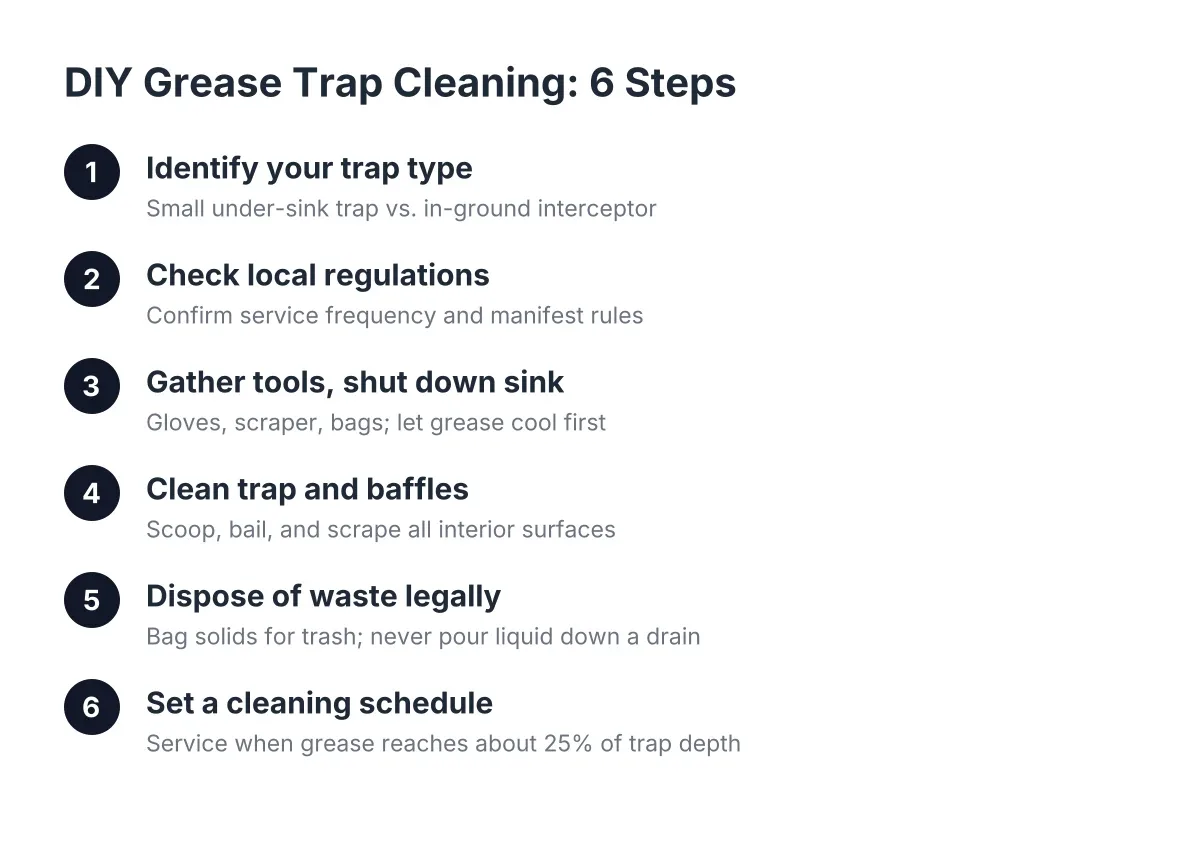
Step 1: Figure Out Which Kind of Trap You Have
Before you touch anything, identify the trap. The answer to "can you DIY grease" trap work depends almost entirely on size and location.
There are two common setups:
- Small passive trap. A metal or plastic box under or near the sink, usually 10 to 50 pounds of grease capacity. Common in small food prep areas and some multi-unit properties. This is the only type where a DIY cleaning is realistic.
- In-ground interceptor. A concrete or fiberglass tank outside the building, often 500 to 2,000 gallons, serving grease traps for commercial kitchens and larger properties. You cannot clean this yourself with a shop vac and a bucket. It requires a vacuum truck and legal hauling.
If you are a builder putting a new system in on an unsewered parcel, the plans the county approved will show which type you have and where it sits. Pull those plans before you open anything. Grease trap installation cost on new construction also varies with this choice; an under-sink unit is a plumbing line item, while an in-ground interceptor involves excavation and a larger budget.
If you have an in-ground interceptor, skip to Step 7. The DIY path ends here for you.
Step 2: What Regulations Cover DIY Grease Trap Cleaning
Next, confirm what your jurisdiction requires. As of 2026, most Southern California jurisdictions, including the Fontana area, regulate how often traps get serviced and how the waste gets hauled and documented. Many require a manifest showing the grease went to a licensed disposal facility.
This matters because the waste itself is the biggest DIY risk. Grease trap waste cannot go down a drain, into a dumpster as liquid, into your septic tank, or onto the ground. On a septic property the stakes are higher; according to the U.S. Environmental Protection Agency, fats, oils, and grease float and form a scum layer at the top of a septic tank, and adding trap waste accelerates that buildup and shortens the time between pump-outs.
Call your local health department or sewer authority and ask two questions: how often must the trap be serviced, and what documentation do I need to keep. Write the answers down. If you rent the building to a food tenant, keep copies in the property file.
Step 3: Gather Tools and Shut Down the Sink
For a small passive trap, assemble everything before you start. Grease sets up fast once you stop working, so you want the job done in one pass.
You will need:
- Heavy rubber gloves and eye protection
- A putty knife or plastic scraper
- A small bucket or scoop for bailing
- Heavy-duty trash bags or a sealable container for the waste
- Shop towels and a wet/dry vacuum if you have one
- A screwdriver or wrench for the lid bolts
Shut off water use at the connected sink and let the trap sit until the contents are at room temperature. Warm grease smears and splashes; cooled grease scoops cleanly.
Step 4: Clean the Trap, Baffles Included
First, remove the lid slowly; gaskets tear easily and a damaged gasket lets sewer gas into the kitchen. Scoop the floating grease layer off the top and bag it. Then bail or vacuum the gray water in the middle, and scrape the settled solids off the bottom.
The part most people skip is the part that matters most. Grease does not just float; it clings to walls, baffles, and the inlet and outlet fittings. A trap that looks empty but has a half inch of hardened grease coating the baffles will clog again in weeks. Scrape every interior surface down to bare metal or plastic, wipe it, and check that the inlet and outlet flow paths are fully open.
Reinstall the baffles in the correct orientation, seat the gasket, and bolt the lid down. Run water and check for leaks. A typical small trap takes a careful person 45 to 90 minutes the first time.
Step 5: Dispose of the Waste Legally
Bag the cooled, solidified grease and small solids, seal the bags, and place them in the trash if your local rules allow solidified grease in municipal waste. Liquid waste is where DIY grease trap cleaning efforts often go wrong. Never pour it down any drain.
The stakes are not small. According to the U.S. Environmental Protection Agency, grease is the most common cause of reported sewer blockages at 47 percent, and a single restaurant can discharge between 800 and 17,000 pounds of grease into the sewer annually if the trap is not managed. On a septic property, that same grease ends up in your tank and pipes instead of the city's.
Log the date, what you removed, and where it went. If your jurisdiction requires a manifest from a licensed hauler, understand that a DIY cleaning may not satisfy that requirement at all. In that case the decision is made for you: hire the service.
Step 6: Set a Cleaning Schedule and Stick to It
A common rule of thumb is to clean the trap when the combined grease and solids reach about 25 percent of its depth. For a small trap under a busy kitchen, that can mean monthly. For a light-use setup in a multi-unit property, quarterly may hold.
Do not wait for symptoms. A slow drain, a sour smell near the sink, or a backup at the lowest fixture means the trap filled a while ago and grease is already moving into the line. Grease clogs are worse than paper clogs because grease coats the pipe walls; punching a hole through the blockage with a snake does not stop it from closing again. Clearing a greased line fully usually takes jetting equipment that cleans the pipe wall, which is professional territory.
Step 7: When DIY Grease Trap Cleaning Is Not the Right Choice
So, can you DIY grease trap service long term, even on a small trap? Sometimes, but run the honest math first. Hire a professional instead when any of these apply:
- The trap is an in-ground interceptor. No exceptions; this needs a pump truck and legal hauling.
- Your jurisdiction requires manifested disposal by a licensed hauler.
- The line downstream is already slow, which means grease is coating the pipe, not just filling the trap.
- The property is on a septic system and you are not certain where the trap waste has been going.
- Your time is worth more than the service call. A messy 90-minute job every month adds up.
For example, suppose a builder finishing a fourplex on an unsewered parcel near Fontana puts a small trap on each unit's kitchen line. In that scenario, four DIY cleanings a quarter means roughly six hours of unpleasant work plus disposal logistics, against one scheduled visit where a crew services all four traps and documents it. For an owner juggling county inspections and a build timeline, the service call usually wins, and the paperwork trail helps at final inspection.
There is a real trade-off to name here. Professional grease trap cleaning costs money every visit, and on a single small trap with light use, a careful owner can do the job acceptably. The risk is not the scooping; it is the disposal, the missed baffle buildup, and the slow slide into a greased line that costs far more to jet out than years of service visits would have.
Why One Local Crew for Septic and Grease Beats Two Vendors
If the property is on a septic system, the strongest argument against DIY is coordination. Grease that escapes a neglected trap ends up in your septic tank, builds the scum layer, and can clog the inlet baffle, which is one of the first things a septic tank inspector checks when a line backs up, according to the Washington State Department of Health.
A local septic pumper that also handles grease trap service sees both sides of that line. During a septic system inspection, floating globs of kitchen grease in the tank are a direct sign the trap upstream is failing, and the crew can pull the grease out and flag the trap on the same visit. One vendor, one point of contact, and one schedule for the pump-out and the trap service. For a Fontana property owner managing tenants, permits, or a construction timeline, that is one less contractor to chase.
The math backs up staying ahead of it either way. According to the U.S. Environmental Protection Agency, routine septic maintenance runs about $250 to $500 every three to five years, while repairing or replacing a failed system runs $5,000 to $15,000. Whether you clean the small trap yourself or put it on a service schedule, the goal is the same: keep grease out of the pipes, out of the tank, and off your repair budget.
If you need septic tank pumping, Fontana Septic can help.
Prefer to talk it through? Call (909) 316-2368 — a quick call is usually the fastest way to get a straight answer for your situation.