
8 Signs Your Septic Pump Is Failing and When Replacement Gets Urgent
If your toilets are slow, your yard smells like sewage, or an alarm just went off in the garage, you need answers fast. The signs your septic pump is failing usually show up in a specific order, and knowing that order can be the difference between a straightforward pump swap and sewage on your bathroom floor. This guide walks through eight warning signs, from early hints to full emergencies, so you can judge how urgent your situation is before you call a local Fontana septic pumper.
One thing to clear up first. A septic pump is not the same as pumping out your tank. The pump is a mechanical device, usually an effluent pump, that pushes wastewater from a pump chamber up to the drain field when gravity cannot do the job. Many homes in the Fontana area have these pump-assisted systems. When that pump dies, wastewater stops moving, and the clock starts ticking.
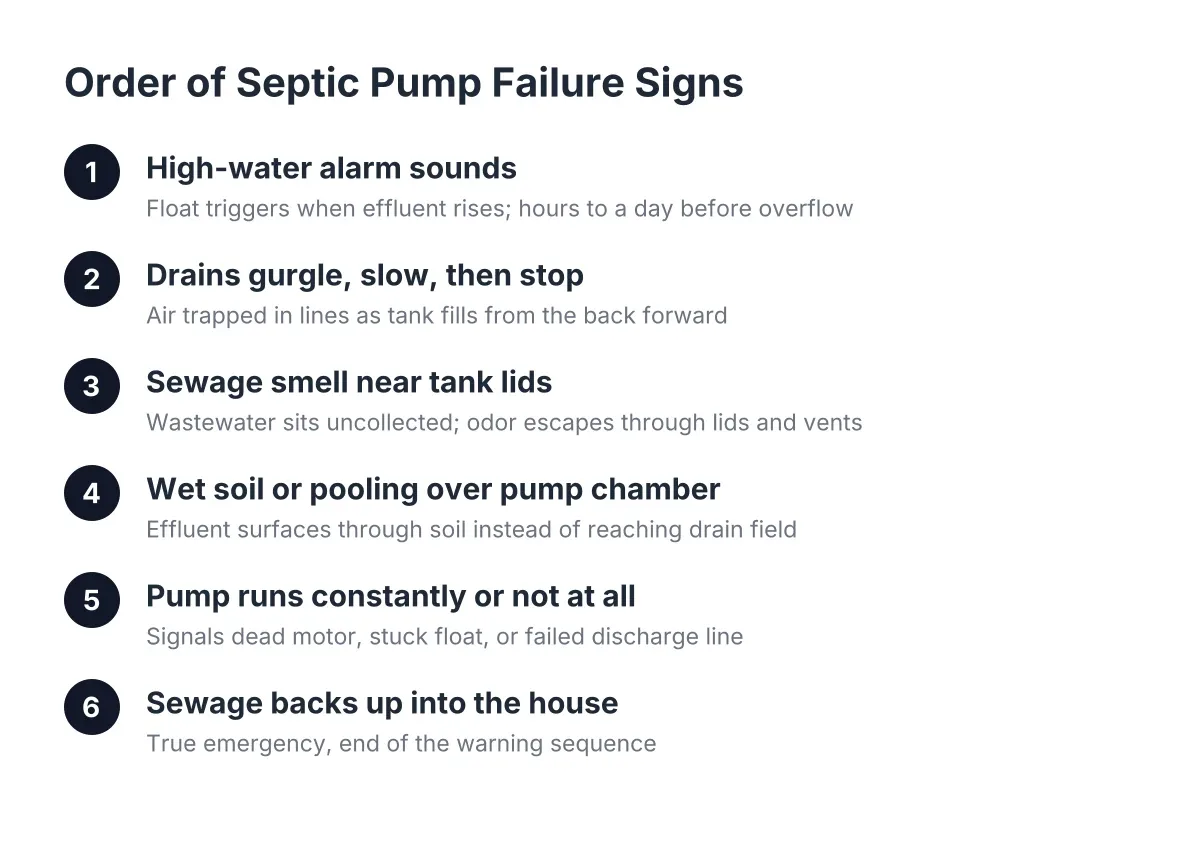
Here are the eight signs, roughly in order of urgency.
1. The High-Water Alarm Is Going Off
Start here, because this is the sign your system was built to give you. Pump systems include a high-water alarm with a float that triggers when the pump fails and effluent rises past its normal level. If the alarm is sounding or the red light is on, your pump chamber is filling and nothing is leaving.
An alarm does not always mean the pump itself is dead. It can mean a stuck float, a tripped breaker, or a power problem. However, treat every alarm as a real warning. You typically have hours to a day or two of normal water use before the chamber tops out, depending on tank size and household habits. Cut water use immediately and get someone out to look at it.
2. Drains Gurgle, Then Slow, Then Stop
Gurgling toilets and slow drains are usually the first signs your septic pump, or your whole system, needs attention. When the pump stops moving effluent out, the tank fills from the back forward. Air gets trapped in the lines, and you hear it as gurgling in sinks and tubs.
The pattern matters. One slow drain is often a simple clog, and drain cleaning handles it. Every drain in the house slowing down at once points at the septic system, not a single pipe. If the lowest drains in the house, like a shower or floor drain, start backing up first, stop running water and treat it as urgent.
3. Sewage Smell in the Yard or Near the Tank Lids
A strong sewage odor near the tank, the pump chamber, or the drain field means wastewater is sitting where it should not be. When a septic pump is failing and the effluent pump fails, the chamber fills to the top because nothing is being discharged, and odor escapes through lids, risers, and vents.
Smell alone gives you a short window. It means the system is full but has not forced sewage back into the house yet. Suppose a Fontana homeowner notices the smell on a Saturday morning and keeps running laundry all weekend; by Monday that same house can have sewage in the hall bathroom. The smell is the warning. Act on it.
4. Wet Soil or Pooling Water Over the Pump Chamber
Soggy ground, unusually green grass, or standing water near the tank or drain field is a sign wastewater is surfacing. With a failed pump, effluent can overflow the chamber and seep up through the soil instead of being pushed out to the leach field in controlled doses.
This one carries a health risk, not just a plumbing problem. Keep kids and pets off the wet area. Also note where the water is pooling. Wet soil directly over the pump chamber points at the pump. Wet soil spread across the drain field can mean the field itself is failing, which is a bigger repair than a septic tank pump replacement.
5. The Pump Runs Constantly or Not at All
A healthy effluent pump cycles. It kicks on when the float rises, runs for a few minutes, and shuts off. Two failure patterns should get your attention:
- The pump never runs, even when the chamber is full. That suggests a dead motor, a failed float switch, a tripped breaker, or a wiring problem.
- The pump runs nonstop and never shuts off. That suggests a stuck float, a worn impeller that cannot build pressure, or a leak in the discharge line.
A pump that runs constantly is burning itself out and running up your electric bill at the same time. Either pattern means the pump needs service soon, before the quiet problem becomes a backup.
6. Your Electric Bill Jumped for No Clear Reason
This is the sneaky one. A pump that short-cycles or runs continuously pulls power around the clock. If your bill climbed and nothing else in the house changed, the septic pump is worth checking.
In addition, watch your water use, because extra water makes a weak pump work harder. According to the U.S. Environmental Protection Agency, a single leaky or running toilet can waste as much as 200 gallons of water per day, and all of that extra load passes through your septic system. Fixing a running toilet is one of the cheapest ways to take strain off a struggling pump.
7. The Pump Is Past Its Working Life
Effluent pumps are mechanical, and every mechanical device fails eventually. That is the whole reason systems include alarms, so you get warned before sewage backs up into the house. Most residential effluent pumps last somewhere in the range of 7 to 15 years, depending on quality, water habits, and how often the tank gets pumped out.
Therefore, if your pump is past the ten-year mark and showing any sign on this list, lean toward replacement rather than another repair. Neglected maintenance shortens that life further. Skipping pump-outs lets solids reach the pump chamber, where they clog and grind the impeller. For an active family of four, pumping the tank every two to three years is generally advisable, according to Penn State Extension, and that schedule protects the pump as much as the tank.
8. Sewage Is Backing Up Into the House
This is the end of the line, and it is a true emergency. When the pump chamber and tank are both full, wastewater has nowhere to go but back up the inlet line and into your lowest fixtures. Stop all water use in the house. Do not flush, do not run the dishwasher, and do not do laundry.
A backup is not always the pump's fault, which is worth knowing before anyone starts digging. A clogged inlet baffle is a common cause of septic backups and should be one of the first things checked when troubleshooting a blocked line into the tank, according to the Washington State Department of Health. Additionally, a good septic tank inspector will check the baffles, the filter, and the pump before declaring anything dead.
How to Recognize Signs Your Septic Pump Is Failing or If the Tank Is Full
You can tell a failed pump from a full tank by where the water sits and whether the pump cycles. A full tank that simply needs a pump-out shows solids near the outlet and responds to pumping. A bad pump shows a full pump chamber, a silent or constantly running motor, and an alarm that will not clear.
Here is a quick way to sort it before the crew arrives:
- Check the breaker and the alarm panel. A tripped breaker is the cheapest fix in the septic world.
- Listen at the pump chamber lid. No hum when the chamber is full usually means a dead pump or float.
- Note the pattern of your drains. Whole-house slowdowns point at the system; one fixture points at a clog.
- Think back to your last pump-out. If it has been more than three to five years, a full tank is a strong suspect.
Diagnosing beyond this point means opening lids and working around electrical equipment over sewage, which is where a professional earns their fee. An inspection sorts it in one visit instead of you guessing from the lawn.
Can You Replace the Pump or Pump the Tank Yourself?
Realistically, no. People search "how to pump out a septic tank yourself" every day, and the honest answer is that it is not practical for a homeowner. Pumping a tank takes a vacuum truck, a legal place to dispose of the waste, and the stomach to work over an open tank of sewage gas, which can be deadly in confined spaces. Renting a trash pump to move sewage into your yard is illegal dumping, and it just moves the problem ten feet.
Swapping the pump for the septic tank itself is closer to possible for a handy homeowner, but it is still a rough job. You are pulling a sewage-covered pump out of a chamber, matching the replacement's horsepower and head height to your system, and rewiring floats correctly. Get the float heights wrong and the new pump short-cycles itself to death. Most Fontana homeowners who price it out find that having a crew that carries a pump for a septic tank on the truck is worth it, especially when the chamber is already full and time is short.
Why Acting Early When Signs of a Septic Pump Failing Appear Saves Real Money
Catching the signs your septic pump is failing early keeps the problem at the pump instead of the whole system. A pump that fails quietly for weeks pushes a full tank's problems downstream. Solids escape into the leach field, and a soaked, clogged drain field is a far bigger repair than any pump.
The math is lopsided. EPA guidance puts regular septic maintenance at $250 to $500 every three to five years, versus $5,000 to $15,000 to repair or replace a failed conventional system, according to the U.S. Environmental Protection Agency. Septic systems tend to fail gradually, then suddenly, so the alarm or the gurgle you hear this week is the cheap version of this problem.
One honest caveat: no article can diagnose your system from a distance. Soil, tank size, pump type, and system age all change the picture, and a failing drain field can mimic a failing pump. If you are seeing two or more of the signs above, a septic system inspection by a local crew that works in Fontana soil every week will tell you whether you need a pump, a pump-out, or something bigger, with the price laid out before anyone starts digging.
If you need septic tank pumping, Fontana Septic can help.
Prefer to talk it through? Call (909) 316-2368 — a quick call is usually the fastest way to get a straight answer for your situation.