
Can You Pump Out a Septic Tank Yourself? A Step-by-Step Reality Check
If your toilets stopped flushing an hour ago, you are probably asking whether you can pump out a septic tank yourself or whether you need a professional crew. The short answer: there are parts of DIY septic tank pumping you can and should do, and parts where DIY costs more than it saves. This guide walks through the real steps, in order, so a Fontana homeowner with a backup, or a landlord with a duplex full of unhappy tenants, knows exactly where the line sits.
Here is the honest framing before we start. A septic pumper's truck does three things a shop-vac, a trash pump, or a rented tote never will. It pulls the settled sludge off the bottom, it breaks up and removes the floating scum layer, and it hauls the waste to a licensed treatment plant. Septic waste pumped from residential tanks must be trucked to a sewage treatment plant for disposal, according to the New Hampshire Department of Environmental Services. You cannot legally dump it in your yard, a storm drain, or a dumpster. Keep that in mind as you work through the steps below.
Step 1: Confirm the Problem Is the Tank, Not the Pipe
First, figure out what is actually backing up. If one toilet gurgles but the shower drains fine, you may have a clogged branch line, which is a drain cleaning job, not a pump-out. If every fixture in the house is slow, or sewage is coming up in the lowest drain, the problem sits at the tank or beyond it.
Walk the yard. A sewage smell over the tank or standing water over the leach field points to a full tank or a saturated drain field. In a septic system, one pipe carries all household drains to the tank, where solids settle and liquid flows out to perforated pipes in the drain field, according to the US EPA. When solids fill the tank, there is nowhere for new wastewater to go except back toward the house.
In addition, check for a running toilet before you blame the tank. A single leaky or running toilet can waste as much as 200 gallons of water per day, according to the U.S. Environmental Protection Agency. That extra water can flood a tank and drain field that would otherwise be fine.
Step 2: Stop Adding Water to the System
Next, cut the water load immediately. Every gallon you send down a drain right now ends up on your bathroom floor or in your yard. This step costs nothing and buys you time whether you DIY or call a pump out septic tank service.
- Stop all laundry and dishwasher cycles.
- Limit toilet flushing to what is unavoidable.
- Skip showers until the tank is pumped.
- If you are a landlord, tell tenants in writing to hold off on laundry; one more wash cycle can push sewage into a ground-floor unit.
Step 3: Locate and Expose the Tank Lid
Now find the tank. Look for the spot where the main sewer line exits the house, then follow that line 10 to 20 feet into the yard. Probe gently with a thin rod, or check your property records; San Bernardino County permits often show the tank location on the original site plan.
Dig down to the lid and set the soil aside on a tarp. This is the single best DIY move you can make when doing DIY septic tank pumping, even if you hire out the rest. Pumping companies typically charge extra to dig out access themselves, so exposing the lid before the truck arrives saves real money on the visit. For reference on what you are uncovering, San Bernardino County Department of Public Health requires a minimum 1,000-gallon tank for a 3-bedroom home and 1,500 gallons for a 5-6 bedroom home.
A safety note that is not optional: never lean into an open septic tank, and never enter one. The gases inside can knock an adult unconscious in seconds. Open the lid, look, and step back.
Step 4: Should You Handle DIY Septic Tank Pumping Yourself?
Can you pump a septic tank yourself? Legally and practically, almost no homeowner can do the full job. You would need a pump to pump out a septic tank's full contents, a sealed tank to haul roughly 1,000 to 1,500 gallons of raw sewage, and a licensed disposal site that will accept it. Rental trash pumps move liquid, not the compacted sludge and scum that cause backups in the first place.
That last point matters most. Effective pumping has to remove the settled sludge on the bottom and the floating scum on top, because those solids are what plug your outlet and poison your drain field. Sucking out the liquid with a rented pump makes the tank look emptier for a week, then the backup returns. You also cannot pump a meaningful amount from a cleanout pipe; the cleanout reaches the line, not the sludge blanket at the bottom of the tank.
Therefore, the realistic DIY split looks like this:
- You handle diagnosis, water shutoff, and digging out the lid.
- A local septic pumper handles the vacuum work, the sludge and scum removal, and the legal disposal haul.
- You handle the backfill and the follow-up habits that keep the tank from filling early.
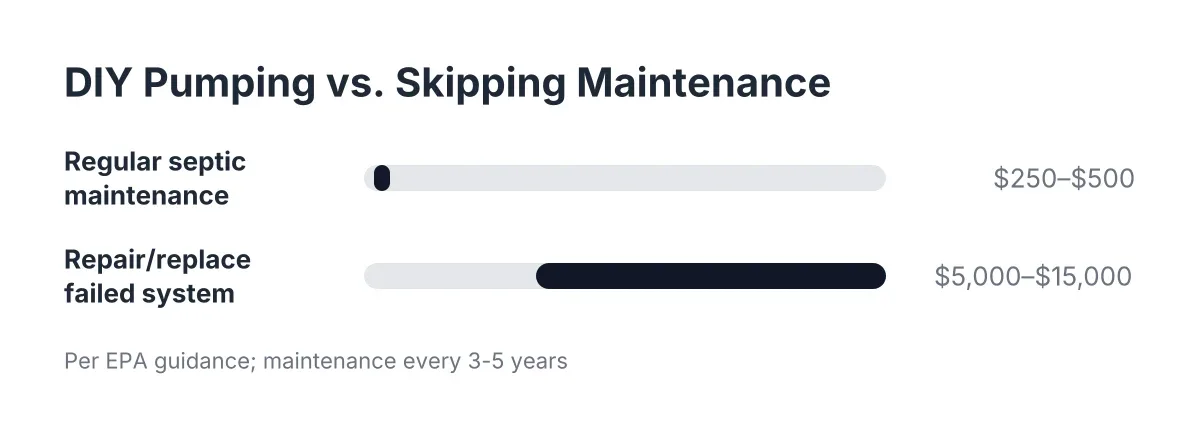
For context on what the professional visit costs versus what skipping it costs, EPA guidance puts regular septic maintenance at $250 to $500 every three to five years, versus $5,000 to $15,000 to repair or replace a failed conventional system, according to the U.S. Environmental Protection Agency. The DIY savings on a pump-out are small; the downside of a cooked leach field is not.
Step 5: Check the Effluent Pump if Your System Has One
If your system uses an effluent septic pump to push wastewater uphill to the drain field, a dead pump mimics a full tank. The signs overlap: slow drains, backup, alarm sounding on the control panel. Open the pump chamber (usually a second, smaller lid) and check whether the float switch is stuck or the breaker tripped before assuming the pump died.
However, if the pump has failed, this is where DIY gets more reasonable for a handy owner on a non-emergency timeline. A septic tank pump replacement is a bolt-and-wire job on paper, but the pump sits in a chamber of sewage, the discharge piping has to seal, and the float heights have to match the original settings. Get one float wrong and the pump short-cycles until it burns out again. Many Fontana homeowners have the chamber pumped down first, then decide on the spot whether to swap the pump themselves or have the crew set the replacement while the chamber is empty and safe to work in.
Say a landlord in Rialto has a duplex on a shared pump-assisted system and the alarm goes off Friday afternoon. In that scenario, the practical play is a same-visit pump-down plus pump swap, because every day the chamber sits full is a day both units are limping on half-working plumbing. An inspection-only visit costs nearly as much as a pump-out anyway, so combining them is usually the better spend.
Step 6: Get the Most From the Professional Pump-Out Visit
When the truck arrives, a few moves turn a routine pump-out into a real system checkup. Ask the crew to note the sludge and scum depth before pumping; that tells you whether your pumping interval is right. Ask them to look at the baffles and the outlet tee while the tank is empty. The outlet pipe must sit lower than the inlet so only liquid leaves toward the drain field, according to University of Nebraska-Lincoln Extension, and a rotted baffle lets solids escape.
One misconception to drop: a pump-out does not involve scrubbing or bleaching the tank walls. The vacuum process removes the solid buildup along with the liquid; a tank with a thin film on the walls after pumping is normal and correct.
Know the limits of a pump-out, too. If your drain field is saturated, pumping the tank gives you days of relief, not a fix, and you will need a leach field inspection to find out why. That diagnosis is professional work; soil and system design questions go beyond what any homeowner should guess at.
Step 7: Set a Schedule So the Next One Is Maintenance, Not an Emergency
Finally, put the next pump-out on the calendar before you backfill the lid. For an active family of four, pumping every two to three years is generally advisable because of higher solids and water load, according to Penn State Extension. A lightly used two-person household can often stretch longer; a rental duplex with four adults per unit usually cannot.
For landlords with 2 to 10 units on septic, a standing schedule beats reacting to tenant complaints. One illustrative example: suppose you own two duplexes on separate tanks; staggering pump-outs so one property gets serviced each year keeps the cost predictable and means no unit ever goes more than its interval without service. As of 2026, that kind of recurring arrangement is also the cheapest way to buy pumping, since emergency pump out septic tank prices run higher than scheduled visits almost everywhere.
Skip the additive shortcut. Commercial septic additives marketed to dissolve sludge lack strong scientific backing, according to Washington State University Extension. Solids build up no matter what you pour in; only pumping removes them.
The Bottom Line on DIY Versus a Septic Pumping Service
You can do the diagnosis, the water discipline, the lid digging, and the scheduling. You cannot realistically do the sludge removal or the legal disposal, and you probably should not do an effluent pump swap in a full chamber during an active backup. Fontana sits in a state where only about 10% of homes use septic, according to the U.S. Environmental Protection Agency, which means fewer neighbors with hard-won advice; that makes a straightforward local septic pumper worth having in your phone before the next slow drain shows up.
If you need septic tank pumping, Fontana Septic can help.
Prefer to talk it through? Call (909) 316-2368 — a quick call is usually the fastest way to get a straight answer for your situation.