
How Often to Pump Your Septic Tank: A Fontana Homeowner’s Maintenance Schedule
If you just bought your first home on septic in Fontana, the pumping schedule is the one piece of septic tank maintenance you cannot skip. Get it right and the system runs quietly for decades. Get it wrong and you are looking at a backup in the house or a failed leach field, which is a much bigger bill. This guide walks through how often to pump a septic tank, what changes that number for your household, what a pump-out visit actually looks like, and how a steady maintenance schedule keeps you out of the repair-versus-replace conversation entirely.
One honest note before we start. Most septic problems we see in Fontana did not begin as broken parts. They began as a tank that went too long between pump-outs. The fix for that is not a full system replacement, no matter what a high-pressure salesperson tells you. The fix is a schedule.
How Often Should You Pump a Septic Tank?
Most households should pump a septic tank every three to five years. A smaller tank, a bigger family, or a garbage disposal pushes you toward the three-year end. A large tank with one or two people in the house can stretch toward five years. If nobody can tell you when the tank was last pumped, treat that as your sign to schedule a pump-out now.
That three-to-five-year window is the standard answer, and it matches what the U.S. Environmental Protection Agency recommends for regular maintenance. But it is a starting point, not a rule carved in concrete. The real answer depends on four things.
- Tank size. In San Bernardino County, the minimum tank capacity is 1,000 gallons for a 3-bedroom home and 1,500 gallons for a 5-6 bedroom home, according to the San Bernardino County Department of Public Health. A bigger tank holds more solids before it needs a pump-out.
- Household size. Four people fill a tank with solids faster than two. Every shower, load of laundry, and flush adds to the load.
- Water habits. Long showers, back-to-back laundry days, and leaks all push more water through the tank. The U.S. Environmental Protection Agency notes a single running toilet can waste as much as 200 gallons of water per day, which is a huge extra load on a septic system.
- What goes down the drain. A garbage disposal can add a meaningful amount of solids to the tank. Grease, wipes, and coffee grounds add more.
Here is a concrete example. Say you bought a 3-bedroom house in north Fontana with the county-minimum 1,000-gallon tank. You have four people in the home and you use the garbage disposal daily. Plan on pumping every three years, maybe sooner. Your neighbor with the same tank, two people, and no disposal might go five years between pump-outs and be fine.
Why the Pump-Out Schedule Matters More Than Anything Else
Your septic tank works by separating waste into three layers. Solids sink to the bottom and form sludge. Grease and fats float to the top as scum. The relatively clear water in the middle flows out to the leach field, where the soil finishes the treatment.
Pumping removes the sludge and scum layers before they grow too thick. When you skip pump-outs, those layers keep building until solids start flowing out to the leach field. The leach field is soil and gravel; it cannot pass solids. Once solids clog those lines, the field starts to fail, and a failed drain field is the most expensive problem a septic system can have.
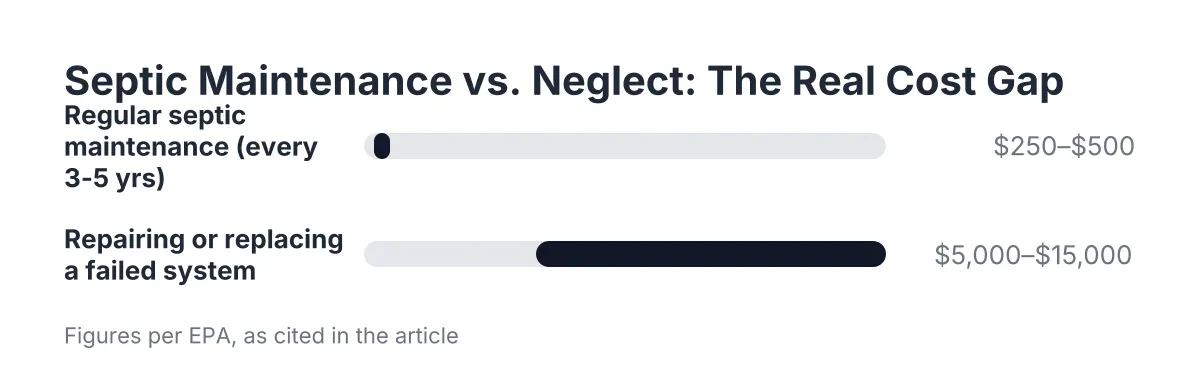
The math is not close. According to the U.S. Environmental Protection Agency, regular septic maintenance runs $250 to $500 every three to five years, while repairing or replacing a failed conventional system runs $5,000 to $15,000. A pump-out on schedule is the cheapest insurance a septic owner can buy.
This is also why we push back when a first-time owner gets told their whole system needs replacing. Sometimes it does. But often the tank just needs a pump-out, a baffle repair, or a septic system repair on one component, not a new leach field. A crew that inspects before it quotes will tell you which one you are facing.
New to Septic? Here Is What You Actually Own
Septic is less common in California than in most of the country. EPA data shows only about 10% of California homes use septic systems, compared to a high of 55% in Vermont. So if you feel like nobody around you can explain how this works, that is normal. Plenty of Fontana properties, and lots in the unsewered pockets nearby, still run on septic.
Your system has three main parts:
- The tank. A buried concrete or plastic box, usually 1,000 to 1,500 gallons in this county, that catches everything from the house and separates it into layers.
- The leach field. Also called a drain field. A set of buried perforated pipes that spread the liquid from the tank into the soil for final treatment.
- The pipes and baffles. The line from the house to the tank, the baffles inside the tank that keep solids from escaping, and the line out to the field.
Nothing about this requires daily attention. A septic system asks for two things: a pump-out on schedule and some care about what goes down the drain. That is the whole job.
Your First Pump-Out After Buying the House
If your home inspection flagged the tank, or the seller could not produce pumping records, book a pump-out and a septic system inspection in your first few months of ownership. Do not wait for a slow drain to force the issue.
Here is what a straightforward first visit should include:
- Locating and opening the tank. On older Fontana properties the lids are often buried. The crew finds them, digs them up, and can install risers so the next visit is easier and cheaper.
- Measuring the sludge and scum layers. This tells you how full the tank actually was, which sets your future schedule. A tank that was near capacity means shorten the interval. A tank with modest buildup means the standard three-to-five years is fine.
- Pumping the full tank. A proper pump-out removes both liquid and solids, not just the liquid layer. If a septic pumper offers to pump "just the top" for cheap, that is not a real pump-out.
- Checking the baffles and tank condition. Cracked baffles let solids escape to the leach field. Catching a bad baffle during a pump-out is a small repair. Missing it can cost you the field.
- Written notes on what they found. Date, tank condition, sludge depth, and any concerns. Keep this. It is the start of your maintenance record.
Ask questions during the visit. A local crew that only does septic work will answer them in plain terms. If the person on-site cannot explain what they are doing and why, that tells you something about the outfit.
Building a Septic Tank Maintenance Schedule That Sticks
A schedule you actually follow beats a perfect plan you forget. Here is a simple septic tank maintenance schedule that works for most Fontana households.
Every day. Watch what goes down the drain. Only human waste and toilet paper get flushed. No wipes, even the ones labeled flushable. No grease down the kitchen sink; pour it into a can and trash it. Fat, oil, and grease are a leading cause of clogged lines. Research published in the International Journal of Environmental Science and Technology estimates 30-40% of sewer clogs come from fat, oil, and grease deposits.
Every month. Spread out your water use. Run laundry across the week instead of five loads on Saturday. Fix any running toilet or dripping faucet the week you notice it.
Every year. Walk the yard over the tank and leach field. Look for soggy ground, sewage smell, or grass that is greener over the field than anywhere else. Any of these means call for an inspection before it gets worse.
Every three to five years. Schedule the pump-out. Set a reminder on your phone the day the truck leaves. Adjust the interval based on what the crew found: heavy buildup means shorten it, light buildup means you can hold or stretch it.
Before any major household change. Adding a bathroom, finishing an accessory unit, or moving more people in changes the load on the system. Mention it to your septic company so the schedule can adjust.
One thing you can skip: additives. Store shelves are full of septic tank maintenance products that promise to eat sludge so you never have to pump. No additive replaces a pump-out. The bacteria your tank needs arrive free of charge with every flush. Save the money for the actual service.
What Septic Tank Maintenance Costs Compared to Neglect
As of 2026, most Fontana homeowners should budget a few hundred dollars for a routine pump-out, in line with the EPA's $250 to $500 range for regular maintenance every three to five years. Spread over five years, that is well under $10 a month. Exact pricing depends on tank size, how deep the lids are buried, and how much digging the crew has to do to reach them.
Compare that to what neglect costs. The EPA puts repair or replacement of a failed conventional system at $5,000 to $15,000. Septic tank repair cost for smaller fixes lands in between: a baffle replacement or a broken inlet line might run a few hundred to a couple thousand dollars, depending on access and damage. Those are illustrative ranges, not quotes; every tank and yard is different.
The pattern is consistent, though. Every step you wait, the number grows:
- Pump-out on schedule: hundreds of dollars every few years.
- Small repair caught during an inspection: hundreds to low thousands.
- Backup into the house plus emergency service: more, plus the cleanup.
- Failed leach field: the five-figure conversation nobody wants.
For a first-time owner worried about surprise bills, this is the takeaway. The schedule is the protection. You control the cheapest line item on that list, and staying on it keeps you off the expensive ones.
Warning Signs Between Pump-Outs
Even on a good schedule, keep an eye out for these signs a septic system is struggling. Catch them early and the fix is usually small.
- Slow drains throughout the house. One slow sink is probably a clog in that line. Every drain slow at once points at the tank or the main line.
- Gurgling from toilets or drains. Air pushing back through the plumbing often means the tank is full or a line is blocked.
- Sewage odor indoors or in the yard. Any persistent smell near the tank or field deserves a call.
- Wet, spongy ground over the leach field. Especially in dry weather, standing water over the field means liquid is not soaking in the way it should.
- Sewage backing up into tubs or floor drains. This is the urgent one. Stop running water and call an emergency septic service.
A slow drain or gurgle a few months after a pump-out usually is not a full tank. It is more often a clog, a root in the line, or a baffle issue, all of which are fixable without touching the leach field. This is where the repair-versus-replace question gets honest. A crew that inspects the tank and field before quoting can tell you whether you need a $300 fix or a real repair. Anyone quoting a full replacement without opening the tank is guessing, or worse.
When to Bring in a Local Septic Pumper Instead of Guessing
Some things a homeowner should not do alone. Never open a septic tank lid and lean over it; the gases inside can knock a person out in seconds. Do not drive vehicles or park equipment over the tank or leach field. And if the yard is wet over the field or sewage is backing up, that is a professional diagnosis, not a weekend project.
For everything else, the routine is simple. Find a local septic company near Fontana before you need one. Get on their calendar for the first pump-out. Keep the paperwork. Follow the schedule they set based on what your tank actually showed.
That last part matters. A pumper who has opened your tank knows your system better than any chart on the internet. If your first pump-out shows heavy sludge after three years, your interval is three years, not five. If the tank looks light at four, you have room. A real septic tank maintenance schedule is built from your tank's history, and that history starts with the first visit.
Owning a septic system for the first time feels like a lot until you see how little it actually asks. Pump on schedule. Watch the drains. Call when something looks off. Do those three things and your system stays out of sight and out of mind, which is exactly where it belongs.
If you need septic tank pumping, Fontana Septic can help.
Prefer to talk it through? Call (909) 316-2368 — a quick call is usually the fastest way to get a straight answer for your situation.