
How Often Should You Get a Septic Tank Inspection? A First-Timer’s Guide
If you just bought your first home on septic, the words "septic tank inspection" probably showed up somewhere in your closing paperwork, and nobody explained what they meant. Maybe the home inspector wrote "tank needs attention" and moved on. Maybe your realtor mentioned the tank hasn't been pumped in years. Either way, you now own a small wastewater treatment plant buried in your yard, and you have no idea how often anyone should look at it. This guide answers that question in plain language, so you know what an inspection covers, when you actually need one, and what a flagged issue means for your wallet.
Here is the short version up front. Most homes on septic should get an inspection every one to three years, a pump-out every three to five years, and a full inspection any time the property changes hands. The rest of this article explains why those numbers exist, what happens during the visit, and how to read the report without getting talked into work you don't need.
Why Your New Home Came With a System Nobody Explained
When you buy a house on city sewer, your waste is somebody else's problem the moment it leaves the house. When you buy a house on septic, it stays your problem. Everything that goes down a drain flows into a buried tank, settles into layers, and then drains out into a leach field, which is a network of perforated pipes that lets treated water soak into the soil.
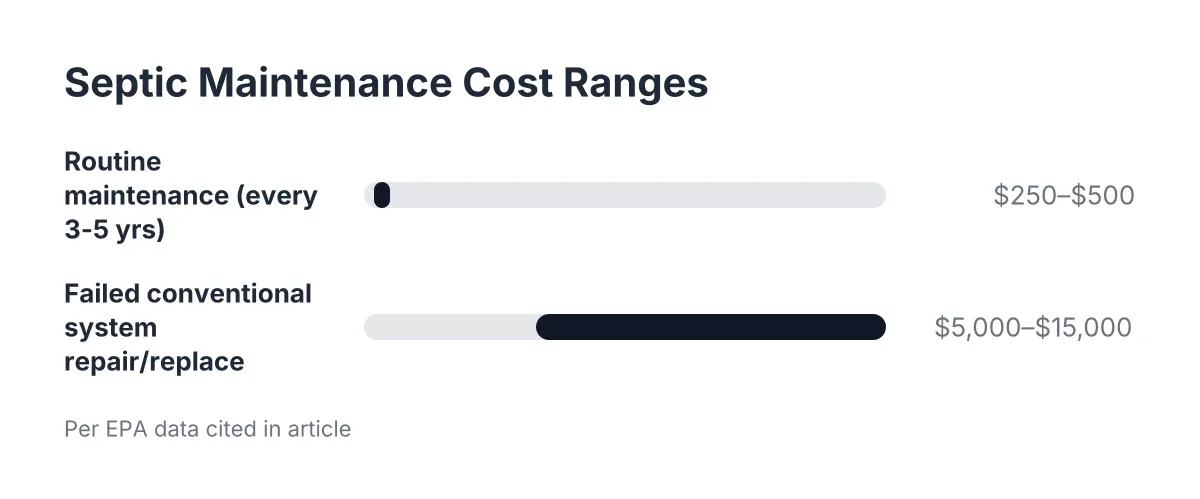
That setup works well for decades when someone watches it. It fails expensively when nobody does. According to the U.S. Environmental Protection Agency, routine maintenance runs about $250 to $500 every three to five years, while repairing or replacing a failed conventional system runs $5,000 to $15,000. That gap between a few hundred dollars and five figures is the entire reason inspection schedules exist.
Septic is also less common in California than most new owners expect. EPA data shows about 10% of California homes rely on septic systems, one of the lowest rates in the country. That matters for you in a practical way: your neighbors on sewer, your friends, and even some general home inspectors may not know much about septic. Around Fontana, though, plenty of homes on half-acre lots in the unincorporated pockets still run on private systems, and local septic crews see them every week.
How Often a Septic Tank Inspection Actually Needs to Happen
A septic tank inspection should happen every one to three years for a standard gravity-fed system, and every year if your system has a pump, float switches, or other mechanical parts. Pumping the tank is a separate task, usually needed every three to five years. Buying or selling a home calls for a full inspection regardless of when the last one happened.
Those ranges come from how a tank works. Solids settle at the bottom as sludge, grease floats on top as scum, and the liquid in the middle flows out to the leach field. An inspector measures those layers. When sludge and scum take up too much of the tank, solids start escaping into the drain field, and that is how a $400 pump-out turns into a $10,000 leach field repair.
Here is a schedule most Fontana homeowners can work from:
- Every 1 to 3 years: Routine septic tank inspection with sludge and scum measurement. Go with the shorter end if your household is large or your tank is small.
- Every year: Inspection for systems with pumps, alarms, or advanced treatment components, since mechanical parts fail without warning.
- Every 3 to 5 years: Septic tank pumping. Your inspector can tell you whether you can wait or need a pump-out now, based on the actual measurements.
- At purchase or sale: A full septic system inspection, ideally with the tank opened and pumped so the inspector can see the tank walls and baffles.
- Right away: Any time you notice a slow drain throughout the house, sewage odor in the yard, gurgling fixtures, or soggy green patches over the leach field.
Household size moves these numbers more than anything else. San Bernardino County's minimum capacity table requires a 1,000-gallon tank for a 3-bedroom home and 1,500 gallons for a 5-6 bedroom home, according to the San Bernardino County Department of Public Health. If six people live in a house with a tank sized for three bedrooms, that tank fills faster than the averages suggest. A family of two in the same house could stretch toward the longer end of every range.
What a Septic Tank Inspection Covers, Step by Step
A real septic tank inspection is more than someone lifting a lid and glancing inside. Knowing the steps helps you tell a thorough inspector from someone doing the minimum. It also helps you understand what you paid for when the report lands in your inbox.
Finding and opening the tank
First, the inspector locates the tank. On older Fontana properties this can take some work, since lids get buried under decades of soil and landscaping. Some tanks have a riser or an inspection port at grade, which makes access easy. Others need digging. If your tank has no risers, adding them during the first visit is one of the few upgrades genuinely worth paying for, because it makes every future pump-out and inspection cheaper and faster.
Measuring what's inside
Next comes the part that drives the whole schedule: measuring the sludge layer on the bottom and the scum layer on top. The inspector uses a measuring tool through the inspection port or open lid. As a rule of thumb, when solids fill about a third of the tank, it is time to pump. This measurement is the honest answer to "how often should I pump," because it reflects your actual household, not an average.
Checking baffles, tees, and the tank itself
The inlet and outlet baffles keep solids from washing out into the leach field. A rusted, cracked, or missing outlet baffle is one of the most common findings on older tanks, and it is a cheap fix compared to the drain field damage it prevents. The inspector also looks at the tank walls for cracks, checks that the lid and any inspection pipe caps are intact, and notes whether groundwater is leaking in.
Testing flow and the leach field
A good inspector runs water in the house and watches how the system responds. Water should flow into the tank and out to the drain field without backing up. Outside, they walk the leach field looking for wet spots, odor, or grass that is greener over the lines than anywhere else, which usually means effluent is surfacing instead of soaking in. Leach field problems are the expensive ones, so this walk matters.
The report
Finally, you get a written record: tank condition, sludge and scum levels, baffle condition, drain field observations, and a recommendation on when to pump next. Keep it. A folder of inspection reports is worth real money when you sell, because the next buyer's inspector will ask for service history.
How to Read the Report Without Panicking
Inspection reports use words that sound scarier than they are. Here is what the common findings actually mean for cost and urgency, in rough 2026 terms.
"Tank needs pumping" is routine, not a defect. It means the sludge and scum layers are high enough that solids could reach the leach field. Expect a normal pump-out charge, generally in the few-hundred-dollar range, and nothing more.
"Outlet baffle deteriorated" is common on concrete tanks from the 1970s and 1980s, which describes plenty of housing stock around Fontana and Bloomington. It is usually a modest repair. Ignoring it is what gets expensive, because the baffle is the only thing standing between solids and your drain field.
"Root intrusion" means tree roots found their way into the tank or lines. Depending on how far they got, this ranges from a cleaning job to a line repair. It is worth fixing promptly, but it is rarely an emergency on its own.
"Evidence of past backup" or high liquid levels above the outlet suggest the leach field is not accepting water the way it should. This is the finding to take seriously. It may mean the field needs rest, repair, or in the worst case, replacement. Get a leach field inspection before agreeing to anything major, and get the reasoning explained to you in plain terms.
However, one caution applies to all of these: an inspection report is a snapshot, not a prophecy. An inspector cannot see every foot of buried pipe, and a system that passes today can still fail if a household doubles in size or a toilet runs for months. Treat the report as your baseline, not a lifetime warranty. If a finding involves the leach field or possible tank replacement, get a second professional opinion before committing to a five-figure repair.
What This Looks Like for a First-Time Buyer in Fontana
Consider a realistic scenario. You close on a 3-bedroom house on a half-acre lot north of the 210, and escrow paperwork shows the septic tank was last pumped seven years ago. The general home inspector noted "septic system present, recommend evaluation by specialist" and nothing else. That single line is your cue, not a reason to panic.
You schedule a septic tank inspection with a pump-out at the same visit, which is the smart pairing because the inspector can see the empty tank walls and baffles clearly. The crew finds the sludge layer high, the outlet baffle worn but working, and the leach field dry and healthy. Total cost lands in the range of a routine pump-out plus an inspection fee, a few hundred dollars all in. You now have a baseline report, a known pumping date, and a local number to call. That is the entire job done right.
Contrast that with the owner who skips it. Three years later the family notices a slow drain, then a backup on a holiday weekend, then a soggy stripe in the yard. By that point solids have been flowing into the leach field for years. The repair estimate arrives with a comma in it. The difference between these two outcomes was one scheduled visit.
What Septic Inspections Cost, and What Changes the Price
Septic inspection cost depends mostly on how deep the inspection goes and how hard your tank is to reach. A basic visual check with sludge measurement sits at the low end. A full inspection with pumping, so the inspector can examine the empty tank, costs more but tells you far more. Digging to find buried lids adds labor. Rural buyers often bundle a well and septic inspection during escrow, and the combined well and septic inspection cost still runs a fraction of what either system costs to replace.
A few things move the price up or down:
- Access. Tanks with risers or an exposed inspection pipe cost less to service than tanks buried under two feet of soil or a patio.
- Scope. Measurement-only visits cost less than a full pump-and-inspect. For a home purchase, pay for the full version.
- Findings. Repairs like baffle replacement are quoted separately. A fair operator explains the finding, shows you if possible, and lets you decide.
- Urgency. An emergency backup call costs more than a scheduled visit. This is the strongest financial argument for inspecting on a calendar instead of waiting for symptoms.
When you compare quotes, ask exactly what the visit includes. "Inspection" means different things to different companies, and the cheapest quote is sometimes a lid-lift and a glance. Around Fontana, you want someone who measures the layers, checks the baffles, walks the drain field, and puts it all in writing.
Habits That Stretch the Time Between Inspections
Between visits, how you use the system decides how fast trouble builds. None of this requires additives or gadgets; it is mostly about what goes down the drain.
Fix running toilets fast. According to the U.S. Environmental Protection Agency, a single leaky or running toilet can waste as much as 200 gallons of water per day. All of that water flows through your tank, stirring up solids and pushing them toward the leach field before they settle.
Keep grease out of the sink. EPA's report to Congress found grease is the most common cause of reported sewer blockages, at 47%, and it behaves no better in a private tank. Grease builds the scum layer, clogs lines, and shortens the interval between pump-outs. Pour it in a can, not the drain.
A few more habits that pay off:
- Spread laundry across the week instead of running five loads on Saturday, which floods the tank.
- Flush nothing but waste and toilet paper. Wipes labeled "flushable" still end up in the sludge layer.
- Keep vehicles, trailers, and heavy equipment off the tank and leach field. Crushed lines are a common and avoidable repair on larger lots.
- Know where your tank, lids, and inspection port are, and mark them. Every future service call goes faster when nobody has to hunt.
The Bottom Line for New Septic Owners
Put two dates on your calendar and you have done most of the job. Schedule a septic tank inspection within your first year of ownership if you don't have a recent report from escrow, then repeat every one to three years. Plan on pumping every three to five years, adjusted by what the measurements show, not by a guess.
The inspection is the cheapest thing you will ever buy for this system. It replaces surprise with a schedule, and it turns "the tank needs attention" from a scary line in a report into a specific finding with a specific price. For a first-time owner in Fontana, that knowledge is the difference between managing a septic system and being ambushed by one.
If you need septic tank pumping, Fontana Septic can help.
Prefer to talk it through? Call (909) 316-2368 — a quick call is usually the fastest way to get a straight answer for your situation.