
DIY Septic Inspection vs. Hiring a Pro: What Fontana Owners Should Know
If you own a home or a few rental units on septic in the Fontana area, you will eventually face the question of DIY septic inspection versus hiring a professional. Maybe you are buying a property and the seller shrugged when you asked about the tank. Maybe a toilet gurgled last night and you want to know how bad it is before you spend money. Either way, the choice between checking the system yourself and paying a septic tank inspector comes down to what each option can actually tell you, and what each one can miss.
This guide walks through both paths in plain language. You will see what you can safely check on your own, what a real septic system inspection covers, roughly what it costs, and how to read the results without feeling pressured into work you do not need.
Why This Question Comes Up in the First Place
Most people do not think about their septic system until something forces the issue. Three triggers come up over and over.
First, a home sale. A buyer wants proof the system works before closing, or a lender or county requirement puts an inspection on the checklist. Failing to inspect before you buy can lead to an ugly surprise, like finding out six months in that the tank is cracked or the leach field is saturated, right when the system starts backing up.
Second, a warning sign. Slow drains, a sewage smell in the yard, soggy ground over the drain field, or a toilet that backs up when the washer runs. At that point you are not curious, you are worried, and you want to know whether this is a pump-out fix or a bigger repair.
Third, routine care. Landlords with duplexes or small apartment buildings on shared septic know that a tenant complaint or a code enforcement notice costs far more than a scheduled visit. For an active family of four, pumping the tank every two to three years is generally advisable, according to Penn State Extension. Multiply that load across several rental units and the schedule tightens.
In all three cases, the real question is the same: can I figure this out myself, or do I need to hire someone?
Performing Your Own DIY Septic System Inspection
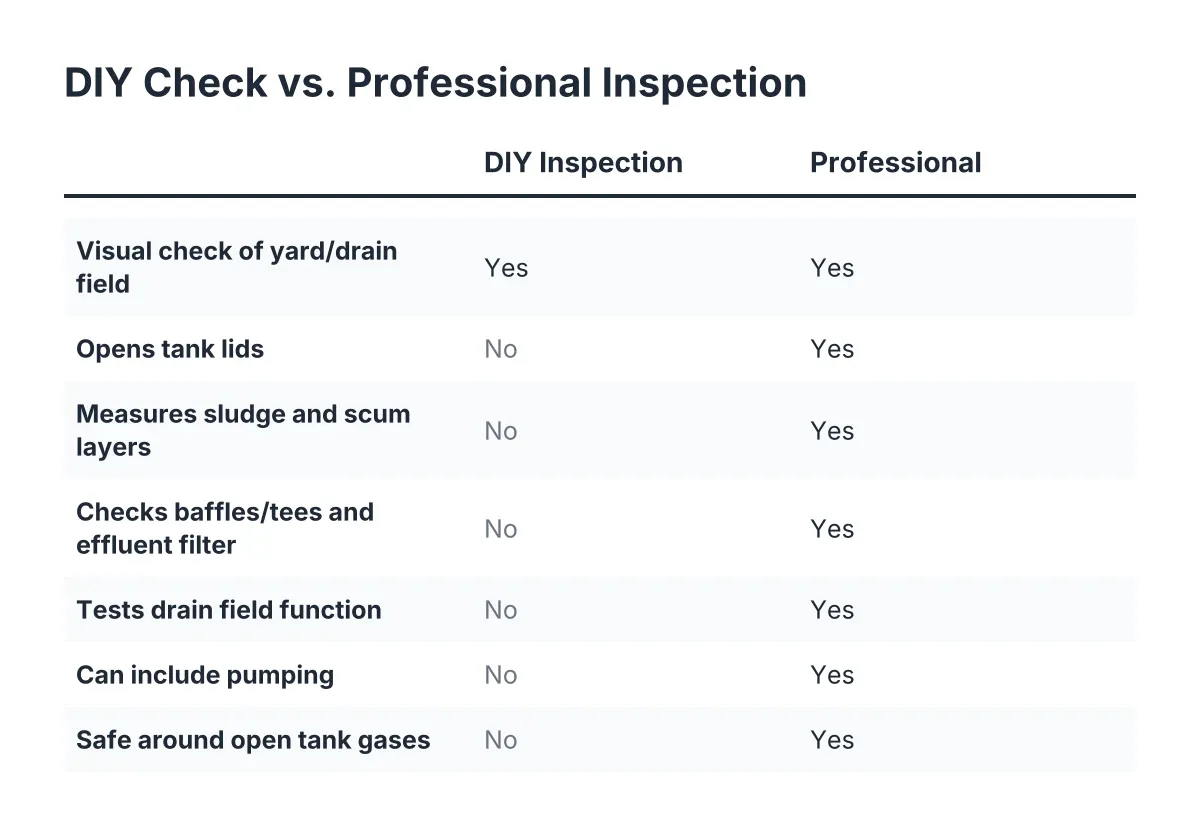
You can do a basic visual check of your septic system yourself, and it has real value. You cannot do a full inspection yourself, because a complete inspection requires opening the tank, measuring sludge, often pumping, and testing the drain field. Those steps need equipment, experience, and safety precautions that homeowners do not have.
Here is what a careful owner can safely check without opening anything:
- Walk the yard over the tank and leach field. Look for soggy spots, unusually green grass, standing water, or a sewage smell.
- Run water in sinks and tubs and watch how fast it drains. Note any gurgling from other fixtures.
- Flush toilets and listen. A toilet that burps air when another drain runs often points to a system under stress.
- Check for backups at the lowest drain in the house, usually a floor drain or a ground-floor shower.
- Confirm you know where the tank and drain field actually are. Many owners do not, and that alone causes expensive mistakes, like driving equipment over the tank or digging into a line.
- Review your records. When was the last pump-out? Any repairs? How old is the system?
That checklist can tell you whether something is wrong. It cannot tell you what is wrong or how bad it is. The tank lid stays closed in a DIY check, and that is where the important answers live.
One more thing a DIY check cannot do: keep you safe around an open tank. Septic tanks produce gases that can knock a person out in seconds, and an open lid is a fall hazard. Never lean over an open septic tank, and never enter one. This is the hard line in the DIY septic inspection and hiring debate. Surface checks are yours; anything below the lid belongs to a professional.
What a Professional Septic System Inspection Covers
A professional septic system inspection goes where a homeowner cannot. A thorough inspector in the Fontana area will typically do most or all of the following.
Before anyone digs
A good crew starts with questions, not a shovel. Expect them to ask the age of the house, the repair history, how often the tank has been pumped, how many people live there, and whether the lot sits on a slope or in a low spot. Those answers shape what the inspector looks for. A tank that has not been pumped in ten years gets a different level of scrutiny than one on a two-year schedule.
At the tank
The inspector locates the tank, uncovers the access lids, and opens them. From there, a complete inspection usually includes:
- Measuring the sludge and scum layers to see how full the tank is.
- Checking liquid levels. A level that is too high or too low each points to a different problem.
- Inspecting the inlet and outlet baffles or tees, which keep solids out of the drain field.
- Checking the effluent filter, if the tank has one. Finding and pulling these filters is tricky work, which is one reason they go ignored until they clog.
- Looking at the tank structure itself, often with photos of the interior, to check for cracks, corrosion, or root intrusion.
On many jobs, the most complete inspection includes pumping the tank. An empty tank lets the inspector see the walls, floor, and baffles clearly. There is also a practical money angle: an inspection-only visit often costs close to what a pump-out costs, so combining the two usually gets you more value from the same visit. Ask about this before you book.
At the drain field
The tank is only half the system. According to the U.S. Environmental Protection Agency, a conventional septic system has two main components: the tank that clarifies wastewater and a drain field that disperses the liquid into the soil. An inspector runs a function and flow test, sending water through the system and watching how the drain field handles it. They also walk the field looking for surfacing effluent, odors, and settling.
A failing leach field is the expensive problem. A tank issue might mean a baffle repair or a pump-out. Additionally, a saturated or collapsed drain field can mean a five-figure replacement, which is exactly why the flow test matters.
What It Costs and How Long It Takes
Septic inspection pricing varies by region, system type, and whether the visit includes a pump-out, so treat any number you read online as a rough estimate until a local crew quotes your specific property. As a general illustration, a standalone inspection often runs in the low hundreds of dollars, and adding a pump-out raises the total but also makes the inspection more complete. If you are buying rural property, bundled well and septic inspection pricing is common; searching for well and septic inspection near me usually surfaces providers who handle both or coordinate them.
Time on site is more predictable. A basic inspection with accessible lids often takes one to a few hours. Add time if the lids are buried and need to be located and dug up, if the tank gets pumped, or if the drain field needs a longer flow test. If no one knows where the tank is, locating it can be the longest part of the visit.
For context on why this money is worth spending, the U.S. Environmental Protection Agency puts regular septic maintenance at $250 to $500 every three to five years, versus $5,000 to $15,000 to repair or replace a failed conventional system. An inspection is cheap insurance against the second number.
Where DIY Septic Inspection Beats Hiring, and Where It Fails
DIY wins in one area: ongoing awareness. Nobody is better positioned than you to notice that the shower drains slower this month, or that one patch of lawn stays wet. Those free observations, done every month or two, are the early warning system that tells you when to pick up the phone. A landlord with units in Rialto or Colton can even hand tenants a one-page version of the surface checklist and ask them to report anything odd.
DIY fails everywhere else. A surface check cannot measure sludge depth, so you will not know the tank is overdue until solids are already pushing into the drain field. It cannot see a cracked baffle. It cannot pressure-test the leach field. Worst of all, it can give false comfort; a yard that looks fine today can sit over a tank at 90 percent capacity.
So the honest answer on DIY septic inspection versus hiring is not either-or. Do the free surface checks yourself on a regular rhythm. Hire a professional for anything that involves opening the tank, for any real estate transaction, and on a fixed schedule even when nothing seems wrong. In 2026, with repair costs where they are, that split is the cheapest way to own a septic system.
There is one scenario where you should skip the DIY step entirely: an active backup. If sewage is coming up in a tub or pooling in the yard, stop running water and call for emergency septic service. A backup is not an inspection question anymore; it is a stop-the-damage question.
A Hypothetical Fontana Example
Suppose a buyer is closing on a three-bedroom house on the north side of Fontana, on septic, with no service records. Under San Bernardino County's minimum capacity table, a three-bedroom home requires at least a 1,000-gallon tank, according to the San Bernardino County Department of Public Health, so the inspector starts by confirming the tank size and location.
Say the inspection finds heavy sludge, a deteriorated outlet baffle, and a drain field that passes the flow test. In that scenario, the report flags two items: pump the tank now, and replace the baffle before solids reach the field. That is a few hundred dollars of work, not a system replacement, and it gives the buyer real leverage to negotiate the fix before closing. Without the inspection, the same buyer inherits both problems plus whatever damage the baffle allows over the next year.
Now flip it. If the flow test had failed, the buyer learns before closing that the leach field needs major work, the kind of repair the EPA figures above describe. Painful news, but far better news in escrow than six months after move-in.
Who Pays for a Septic Inspection in a Home Sale?
Who pays for a septic inspection in a home sale is negotiable, like most inspection costs. In many transactions the buyer orders and pays for it as part of due diligence, the same way they pay for a home inspection. In other deals the seller pays for an inspection and pump-out up front to make the listing cleaner.
Either way, the buyer should insist the inspection happen and should get the full written report, not a verbal summary. The report should state the tank's location, condition, sludge levels, baffle condition, and the drain field result. If a seller resists an inspection on an older system with no records, treat that as information.
Whether to inspect at all before a purchase is a judgment call, not a universal rule. A five-year-old system with full service records carries less risk than a forty-year-old system with none. Most buyers of older rural or semi-rural properties are better off spending the money.
Reading the Report Without the Upsell Pressure
A flagged item on an inspection report is not automatically a crisis, and this is where plain language matters. Roughly speaking, findings fall into three buckets:
- Maintenance items. High sludge levels, a dirty effluent filter, or an overdue pump-out. These are normal and usually resolved in the same visit or soon after.
- Repair items. A broken baffle, a damaged lid, a root-invaded line, or a failed pump on systems that have one. Real work, but targeted and usually modest in cost compared to replacement.
- System-level problems. A cracked tank, a saturated leach field, or a drain field that fails the flow test. These are the findings that justify a second opinion and careful planning, because the fix can run into five figures.
Ask the inspector to put every finding in one of those buckets and to explain the consequence of waiting. A trustworthy septic tank inspector will tell you which items can wait a year and which cannot. If every single finding somehow requires immediate paid work, slow down and get another set of eyes on it.
One limitation worth naming: even a thorough inspection is a snapshot. It cannot predict exactly when a marginal drain field will fail, and soil conditions below ground can change. Treat the report as the best available evidence, not a warranty, and when the findings are serious, bring in a professional before making a five-figure decision.
How to Choose a Local Inspector Instead of a Call Center
Septic is a smaller trade in California than most states; EPA data shows about 10 percent of California homes use septic systems, one of the lowest rates in the country. That means fewer true specialists, and more generalist outfits and national directories that route your call through a distant dispatch. For a Fontana property, you want someone who works septic systems here, knows San Bernardino County requirements, and answers the phone themselves.
Three questions sort the field fast:
- What exactly does your inspection include? You want to hear tank opening, sludge measurement, baffle check, and a drain field flow test, not just "we take a look."
- Do you recommend pumping during the inspection, and what does the combined visit cost? A straight answer here tells you how they price and whether they combine work to save you a trip fee.
- What do I get in writing? A written report with findings and photos of the tank interior is the standard. A verbal thumbs-up is not an inspection.
A fair quote names the base inspection price, the pump-out price if you add it, and the conditions that add cost, like buried lids that need locating and digging. Vague quotes grow on site; specific quotes mostly hold.
The Bottom Line on Checking It Yourself vs. Calling Someone
Do the surface checks yourself, often and for free. Walk the yard, watch the drains, keep records, and know where your tank is. That habit catches most problems while they are still cheap.
Hire a professional for everything below the lid: scheduled inspections every few years, any purchase of a septic-served property, and any time your DIY check turns up a warning sign. The math favors it. A few hundred dollars on a regular schedule protects against a repair bill that the EPA pegs at $5,000 to $15,000 for a failed conventional system.
If you are in Fontana or the immediate surrounding area and need a septic system inspection, a pump-out, or a straight answer about a worrying smell in the yard, call a local septic crew and ask for an estimate. Describe what you are seeing, ask the three questions above, and get the scope in writing before anyone digs. A straightforward local operator will walk you through it on the phone, which is exactly how this decision should start.
If you need septic tank pumping, Fontana Septic can help.
Prefer to talk it through? Call (909) 316-2368 — a quick call is usually the fastest way to get a straight answer for your situation.