
Emergency Septic Inspection: When You Need Service Today, Not Next Week
If sewage is backing up into your tub or your yard smells like a problem, you need an emergency septic inspection, and you need it today. This guide walks you through what that inspection covers, how to tell a true emergency from a problem that can wait until morning, and what to do in the first hour while you wait for a crew. It is written for first-time septic owners in Fontana who just bought a property and never had to think about a tank before. No pressure, no upsell, just what the job actually involves.
How to Tell a Real Septic Emergency from a Problem That Can Wait
Start here, because not every slow drain is a crisis. A true septic emergency means wastewater is going somewhere it should not go, right now. That includes sewage backing up into a tub, shower, or floor drain; standing water or sewage pooling over the tank or drain field; or a red alarm light on a pumped or aerobic system.
A single slow drain in one bathroom is usually a plumbing clog, not a system failure. However, when every drain in the house slows down at once, or the lowest drain in the house gurgles when you flush upstairs, the problem is likely past the house and into the septic system. That pattern is the one that justifies an emergency call.
Here is a quick way to sort it:
- Call today: sewage backup indoors, sewage surfacing in the yard, a red high-water alarm, sewage odor inside the house, or a backup right before guests arrive or during a home sale.
- Call this week: all drains running slow, gurgling from multiple fixtures, a patch of lawn that stays wet and green over the drain field, or an inspection report from your home purchase that flagged the tank.
- Handle it yourself first: one slow sink or tub with everything else draining fine. Try a plunger or a drain snake before you pay anyone.
A red alarm light deserves its own mention. If your system has an alarm panel and the red light comes on, treat it as an emergency. Stop running water and call a septic technician. The alarm exists to warn you before sewage reaches the house, so the clock is already running.
What to Do in the First Hour, Before the Crew Arrives
The cheapest part of any septic emergency is what you do before anyone shows up. Every gallon you send down the drain right now has nowhere to go. Therefore, your first job is simple: stop adding water.
- Stop all water use. No flushing, no laundry, no dishwasher, no showers. If the backup is active, this alone can keep sewage from rising further into the house.
- Check for a running toilet. According to the U.S. Environmental Protection Agency, a single leaky or running toilet can waste as much as 200 gallons of water per day. On a stressed system, that steady flow is often the thing pushing a full tank over the edge.
- Keep people and pets away from any surfacing sewage. Rope off wet spots in the yard. Raw sewage is a health hazard, not just a smell.
- Find your tank lids and cleanouts if you can. If your home purchase paperwork included a septic diagram or the county record, pull it out. A crew that can find the tank in five minutes instead of forty-five gets you fixed faster.
- Do not pour anything down the drain. No chemical drain openers, no additives. They do not fix a full tank, and caustic chemicals make the pump-out messier and more hazardous for the technician.
Resist the urge to open the tank lid yourself. Septic tanks produce gases that can knock a person out, and an open tank is a fall hazard for kids and pets. Locating the lid is helpful; opening it is a job for the crew.
Why You Call a Septic Pumper First, Not a Plumber
When the backup starts at the septic system, a septic service should be your first call, not a plumber. Here is the logic. A plumber works on the pipes inside your house. A septic pumper works on the tank, the lines to it, and the drain field beyond it. If the tank is full or the drain field is saturated, a plumber can snake your line all afternoon and the sewage will still have nowhere to go.
The decision rule is straightforward. If one fixture is clogged and the rest of the house drains fine, the problem is probably inside your plumbing. If multiple drains back up together, or sewage appears at the lowest point in the house, call a septic service first. They can confirm whether the tank and field are the problem. If the system checks out, then the issue is in the house plumbing, and a plumber is the right next call.
This matters for your wallet too. Searching "septic pumper near me" and calling a local septic crew directly skips the dispatch layer that national brands put between you and the person who actually shows up. In Fontana, that local call usually means talking to someone who has worked tanks in your soil and your neighborhoods, not a call center reading a script.
What an Emergency Septic Inspection Covers When You Call
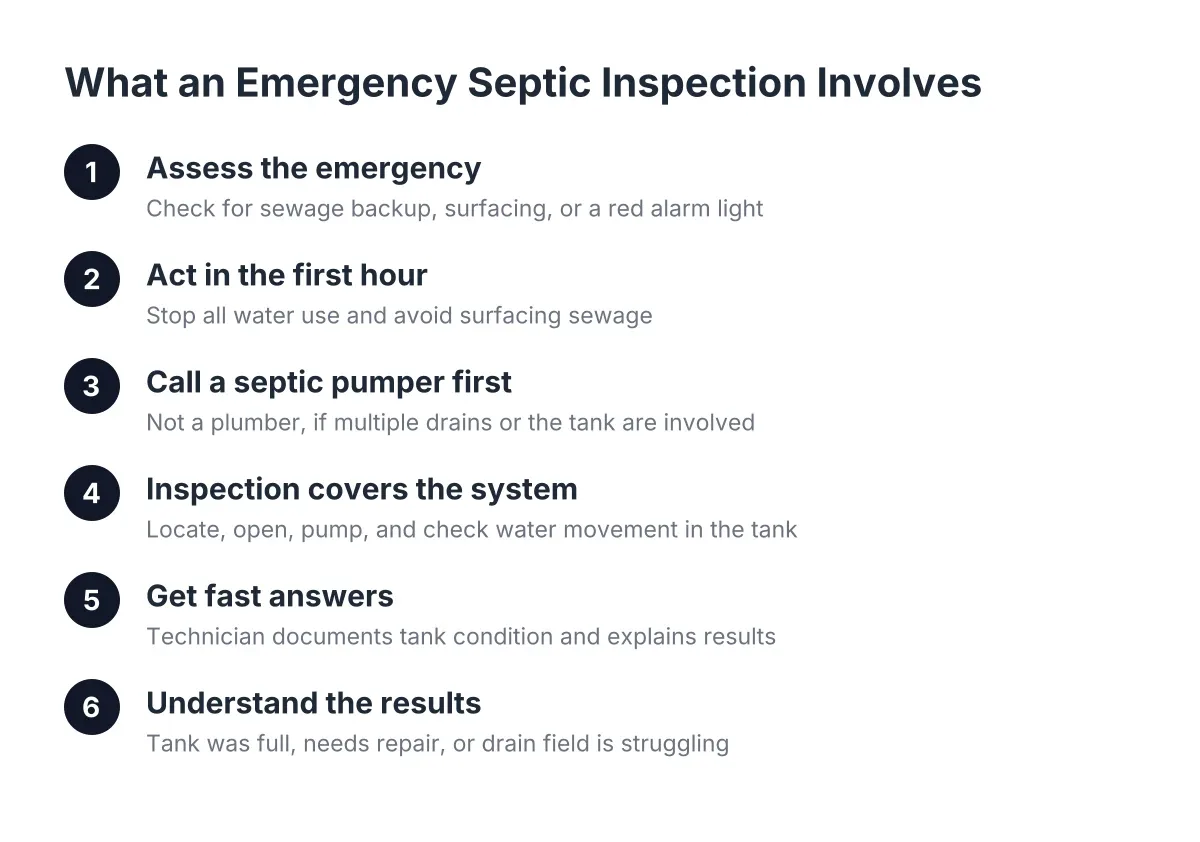
An emergency septic inspection covers four things: finding and opening the tank, pumping it down so the technician can see what is happening, checking how water moves through the system, and documenting the tank's condition. The goal is to stop the immediate backup and tell you plainly whether this was a maintenance problem or a system problem.
Expect the crew to ask questions before they roll. A good septic service wants to know the age of the house, when the tank was last pumped, any repair history, and whether the property sits on a hill or in a low spot. If you just bought the place and do not know, say so. "First time septic tank owner, no records" is a normal answer, and it tells the crew to plan for locating the tank from scratch.
On site, a thorough visit typically includes:
- Locating and uncovering the tank. If the lids are buried, digging them out may be part of the job or billed as extra time, so ask up front.
- Pumping the tank. In an emergency, pumping is usually step one. It relieves the backup and empties the tank so the technician can actually inspect it. Since an inspection alone often costs close to what a pump-out costs, combining them is generally the better value.
- A function and flow check. The technician runs water into a cleanout for about ten minutes to simulate normal household use, then watches how the system handles it. Water that flows into the tank and out to the drain field as designed is a good sign. Water that backs up points to a blocked line, a failed baffle, or a saturated field.
- Checking the inlet and outlet tees. Clogged tees are a common and fixable cause of backups. Finding one can turn a scary day into a modest repair.
- Photos and a written report. A proper report documents the address, date, work performed, tank material, whether the tank was over-full, the condition of the tees, and the overall tank integrity. Keep this report. It is the start of your maintenance file, and the next buyer of your home will want to see it.
A conventional system has two main components, the septic tank and the drain field, according to the U.S. Environmental Protection Agency. An honest emergency visit looks at both. If the crew only pumps and leaves without any look at how the field is taking water, you got a pump-out, not an inspection.
How Fast Can an Emergency Septic Inspection Get You an Answer?
An emergency septic inspection can usually tell you the same day whether your problem is a full tank, a clogged line, or a failing drain field. The pump-out and flow check happen in a single visit, and most residential emergency visits wrap up within a few hours once the crew is on site.
That said, no honest company promises an exact arrival time over the phone before they know the day's schedule, and you should be cautious of anyone who does. What a local Fontana crew can do is give you a straight answer about when they can get to you, instead of routing you through a dispatch queue in another state.
Timing also depends on your tank. If the lids are buried under two feet of soil or a patio, locating and uncovering them adds time. If you have the lid locations marked, say so when you call. It can shorten the visit meaningfully.
One more timing note for 2026 home sales: if your backup happens during escrow, get the inspection and the written report done before negotiations go further. A documented pump-out with photos answers the buyer's questions far better than a verbal "we had it looked at."
What the Results Mean, in Plain Language
The report from your emergency visit will land in one of three buckets. Knowing them ahead of time protects you from both panic and upselling.
The tank was just full
This is the best-case outcome and a common one, especially on a home where the seller admitted the tank "had not been pumped in a while." The fix was the pump-out itself. Your next step is a schedule, not a repair. For an active family of four, pumping every two to three years is generally advisable, according to Penn State Extension. Smaller households can often go longer. Put the date on your calendar and keep the report.
Something in the tank needs repair
Clogged or broken tees, a damaged baffle, or a cracked lid are repairs, not replacements. These are the mid-range outcomes. Ask the technician to show you the photos from inside the tank and point to the specific part that failed. A straightforward crew will explain what the part does and what happens if you wait. If the explanation does not make sense to you, ask again before agreeing to anything.
The drain field is struggling
This is the outcome that deserves the most care. Signs include water backing up during the flow test, sewage surfacing over the field, or a field that stays soggy. A failing leach field is the expensive end of septic work, so do not accept a replacement verdict from a single rushed visit if the evidence is thin. A proper leach field inspection, sometimes a follow-up visit after the tank has been pumped and the system rested, gives a clearer picture.
The stakes here are real. EPA guidance puts regular septic maintenance at $250 to $500 every three to five years, versus $5,000 to $15,000 to repair or replace a failed conventional system, according to the U.S. Environmental Protection Agency. That gap is the whole argument for maintenance, and it is also why you should want a clear, documented diagnosis before anyone starts digging up your yard.
Can You Do Your Own Septic Inspection?
You cannot safely do your own full septic inspection, because the core of the job requires pumping the tank and entering a confined, gas-filled space with professional equipment. Opening a septic tank without training risks exposure to toxic gases and a fall hazard. The inspection itself, checking tees, baffles, and tank walls, requires the tank to be pumped first.
What you can do as a homeowner is observe. Walk your yard monthly and note wet spots or strong odors over the tank and field. Listen for gurgling drains. Watch how fast fixtures drain after laundry day. Keep records of every pump-out and service visit. These observations are exactly what a technician asks about on the phone, and good notes make an emergency septic inspection faster when you do need one.
Skip the additive products while you are at it. A healthy tank maintains its own bacteria from normal household waste. Additives do not replace pumping, and they do not fix a full tank or a saturated field. The money is better spent on the pump-out schedule.
Local Factors for Fontana and the Surrounding Area
Septic systems are the exception, not the rule, in this part of California, which is exactly why first-time owners here often arrive with no experience. EPA data shows California has one of the lowest rates of septic use among states, at about 10 percent, according to the U.S. Environmental Protection Agency. Homes inside city limits generally connect to municipal sewer; septic serves the unsewered pockets around Fontana and nearby unincorporated county parcels.
Local rules shape your system more than most owners realize. San Bernardino County's minimum tank capacity table requires a 1,000-gallon tank for a 3-bedroom home and 1,500 gallons for a 5-to-6 bedroom home, according to the San Bernardino County Department of Public Health. If you bought a 4-bedroom house with an undersized older tank, that mismatch alone can explain frequent backups.
For builders and developers working unsewered parcels in the area, the county process adds its own clock. A percolation test must be performed before installing a septic system to confirm how well the soil drains, according to University of Nebraska-Lincoln Extension, and the local health department inspection typically follows as part of the installation process, according to Caroline County Health Department. New systems also generally need a final county inspection before sign-off. A septic service that knows the local inspection rhythm helps a project manager keep a permit timeline from slipping on lot after lot.
One kitchen note for any household, and especially for anyone managing rental or commercial property: grease is the enemy of every wastewater system. EPA's report to Congress found grease is the most common cause of reported sewer blockages, at 47 percent, according to the U.S. Environmental Protection Agency. Scrape pans into the trash, and if you run a commercial kitchen, keep the grease trap on a cleaning schedule.
How to Pick the Crew You Call at 7 a.m.
Suppose a first-time owner in Fontana wakes up to a shower full of gray water on a Tuesday. In that scenario, there is no time to research ten companies, which is why the smart move is picking your septic service before the emergency. When you search "septic system inspection near me" calmly, in daylight, you can actually compare.
Three questions sort the field fast:
- "Who actually answers your phone, and where are you based?" A local operator can tell you. A dispatch brand will dodge. You want the company doing the work, based in or around Fontana, not a lead-reseller.
- "Does your emergency visit include pumping and a flow check, or just one?" You now know a real septic system inspection includes both the tank and the drain field. A fair quote names what is included: locating, lid access, pump-out, flow test, and a written report with photos. Ask what counts as extra, such as digging out deeply buried lids.
- "Will I get a written report I can keep?" For a first-time owner, that paper trail is how you avoid paying twice for the same diagnosis, and it is what a future buyer's agent will ask for.
Be fair to the trade here too. Some findings genuinely need a second opinion or an engineer, especially a suspected drain field failure or anything involving county permits. A trustworthy company will tell you when a problem is beyond a same-day fix instead of selling you a quick patch.
The Takeaway for a First-Time Owner
A septic backup feels like a disaster the first time it happens. Most of the time it is not. It is a full tank or a clogged tee, solved in one visit by a crew with a pump truck and a camera. The emergency septic inspection you book today does two jobs: it stops the immediate problem, and it hands you a written baseline for everything that comes after, from your pump-out schedule to your next home sale.
If your drains are backing up right now in Fontana or the surrounding area, stop running water, keep everyone away from any surfacing sewage, and call a local septic service directly. Have your address, your home's age, and anything you know about the tank ready. One straight phone conversation with a local crew will tell you more than an hour of searching, and it gets a truck moving toward your driveway.
If you need septic tank pumping, Fontana Septic can help.
Prefer to talk it through? Call (909) 316-2368 — a quick call is usually the fastest way to get a straight answer for your situation.