
What Happens During Professional Septic Tank Pumping: Step-by-Step Process and Timeline
If you have never watched a pump truck work, you might picture a crew showing up, sticking a hose in the ground, and driving off. What actually happens during professional septic pumping is more methodical than that, and knowing the steps helps you judge whether the crew at your Fontana property is doing the job right or cutting corners. Understanding the septic pumping process steps will help you verify that the service meets professional standards. This guide walks through the full process, start to finish, including how long each step takes and what a fair visit should include.
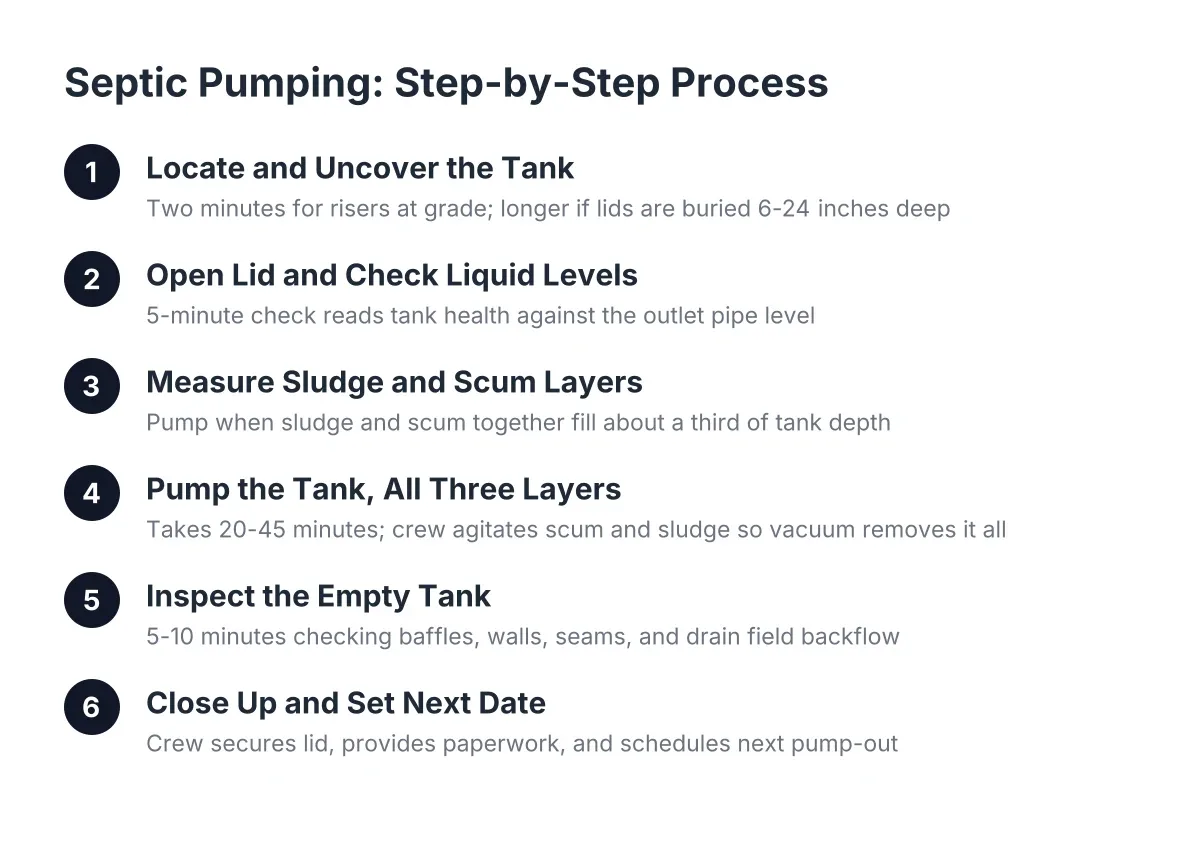
Most pump-outs run 45 minutes to 2 hours from arrival to cleanup. Here is what should happen in that window, step by step.
Step 1: Locate and Uncover the Tank
The visit starts with finding the tank, not pumping it. If your system is new construction, you may already have riser lids at grade, and this step takes two minutes. On older Fontana properties, the lids often sit 6 to 24 inches under soil, and the crew has to probe, check as-built drawings if you have them, or follow the sewer line out from the house.
If you are a landlord with several units on septic across the area, mark the lid locations after the first visit. A crew that has to dig for 30 minutes at every property adds time and, on many invoices, cost. Some septic pumpers charge extra for digging beyond a set depth, so ask about that when you book.
For new builds, this is one reason to insist on risers during septic tank design. San Bernardino County's minimum capacity table requires a 1,000-gallon tank for a 3-bedroom home and 1,500 gallons for a 5-6 bedroom home, according to San Bernardino County Department of Public Health. A tank that size buried without risers means digging at every future pump-out.
Step 2: Open the Lid and Check Liquid Levels
Before any pumping starts, the crew opens the access lid and reads the tank. This 5-minute check tells them more about your system's health than anything else in the visit.
A normal tank sits full to the bottom of the outlet pipe. Two readings signal trouble:
- Liquid above the outlet pipe points to a problem downstream, usually a clogged outlet baffle or a struggling leach field that cannot absorb water fast enough.
- Liquid well below the outlet pipe suggests the tank itself is leaking into the surrounding soil, which is a repair conversation, not a pumping one.
A crew that skips this reading and goes straight to the hose is missing the diagnostic value of the visit. If your drain field is failing, pumping buys you a few weeks of relief, then the backup returns. You want to know that before you pay for a second pump-out that will not fix anything.
Step 3: Measure the Sludge and Scum Layers
Next, the crew should measure how thick the sludge layer on the bottom and the scum layer on top have grown. This is usually done with a measuring stick or a clear sampling tube. The rule of thumb: when sludge and scum together take up about a third of the tank's depth, it is time to pump.
This measurement matters for timing your next visit. A 3-bedroom rental with four tenants fills a 1,000-gallon tank faster than a two-person household in the same house. For example, a small landlord with a duplex in the Fontana area might find one unit needs pumping every 2 to 3 years while the other stretches to 4, purely based on occupancy. Measured sludge depth, not a calendar guess, is what should set your schedule.
Water habits change the math too. According to the U.S. Environmental Protection Agency, a single running toilet can waste as much as 200 gallons of water per day. That water flows straight into the tank, pushes solids toward the leach field, and shortens the interval between pump-outs. If you manage rentals, a leaky toilet report is a septic issue, not just a water bill issue.
Step 4: Pump the Tank, All Three Layers
Now the vacuum work starts. The crew runs a hose from the truck to the tank and removes the contents. Done right, this takes 20 to 45 minutes for a residential tank, depending on tank size and how far the truck can park from the lid.
Here is the part that separates a real pump-out from a fast one. The tank holds three layers: floating scum, liquid in the middle, and settled sludge at the bottom. A proper septic pumping process removes all three. The crew should break up the scum mat and stir the sludge, often by backflushing some liquid into the tank, so the vacuum can pull the heavy solids out instead of leaving them caked on the bottom.
This is also where the pumping-versus-cleaning question gets answered. A pump-out that only sucks out the easy liquid and leaves compacted sludge behind is not a full service. If the invoice says the tank was pumped but a foot of hardened sludge stayed in the bottom, you paid for half a job. Watch for the crew agitating the contents; that is the sign the sludge is actually leaving.
Step 5: Inspect What the Empty Tank Reveals
An empty tank is the only time anyone can see its condition, so a good crew looks before closing up. This inspection takes 5 to 10 minutes and is where much of the visit's value sits, especially for landlords and owners of newer systems still under county scrutiny.
The crew should check:
- Inlet and outlet baffles or tees, which keep solids from washing into the drain field. A missing outlet baffle is a common, cheap fix that prevents an expensive leach field failure.
- Tank walls and seams for cracks, root intrusion, or signs of groundwater leaking in.
- Backflow from the drain field, meaning liquid running back into the empty tank from the outlet pipe. That is a strong sign the leach field is saturated or failing.
The stakes on this step are real. EPA guidance puts regular septic maintenance at $250 to $500 every three to five years, versus $5,000 to $15,000 to repair or replace a failed conventional system, according to the U.S. Environmental Protection Agency. A five-minute look inside the empty tank is what catches problems while they are still on the cheap side of that gap. That said, a pump-out inspection is a visual check, not a full septic system inspection with flow testing; if you are buying a property or the crew flags drain field trouble, schedule a dedicated inspection before making decisions.
Step 6: Close Up, Get Your Paperwork, and Set the Next Date
The visit ends with the lid sealed, the site restored, and documentation in your hands. The crew hauls the waste to a licensed disposal facility; you should not see anything dumped or left on site. Ask for a receipt that records the date, the gallons removed, and any conditions the crew noted in the tank.
That record matters more than most homeowners realize. If you built on a new permit, your paperwork trail with the county does not end at final inspection; a service history shows the system has been maintained if questions ever come up. For a landlord, pump-out records for each unit protect you if a tenant dispute or code enforcement notice ever lands on your desk.
Before the truck leaves, set the next interval. Most households in the Fontana area land between 3 and 5 years, but the sludge measurement from Step 3 should drive the actual date. Heavy-use rentals may need 2 to 3 years. Homes with a grease-heavy kitchen may need drains and traps addressed too, since fat, oil, and grease cause an estimated 30-40% of sewer pipe clogs, according to the International Journal of Environmental Science and Technology.
What Makes a Professional Septic Pumping Complete
The difference between a thorough visit and a cheap one is not the truck; it is the steps around the hose. A bare-minimum crew opens the lid, pulls liquid until the tank looks empty, and leaves in 30 minutes. What happens during a complete septic pumping process includes the level reading, the sludge agitation, the baffle check, and the record you keep.
As of 2026, quoted prices for residential septic tank pumping in the Inland Empire vary widely, and the lowest number on the phone often reflects the shortest version of the job. When you compare quotes, ask each company three questions:
- Do you remove and agitate the sludge layer, or pump liquid only?
- Do you inspect the baffles and tank condition while it is empty?
- Is digging to reach the lid included, and to what depth?
A local Fontana septic pumper who answers those questions directly, in plain terms, is telling you what your money buys. A dispatcher reading from a script usually cannot. Either way, you now know the six steps a full visit includes, roughly how long each takes, and where the shortcuts hide. That is enough to evaluate any crew that shows up at your tank.
If you need septic tank pumping, Fontana Septic can help.
Prefer to talk it through? Call (909) 316-2368 — a quick call is usually the fastest way to get a straight answer for your situation.