
Hydro Jetting vs. Snake Drain Cleaning: Which Clears a Clog for Good?
If you manage rental units on septic, the hydro jetting versus snaking question comes up fast the first time a tenant calls about a backup. When deciding between hydro jetting vs snaking for drain cleaning, both methods clear clogs. They do it differently, they cost differently, and they fail differently. Pick the wrong one and you pay twice, because the same drain clogs again in six weeks and the tenant calls again.
This guide walks through the decision step by step. The goal is simple: figure out whether your slow drain is a pipe problem a snake or jetter can fix, or a septic system symptom that no amount of cable work will solve. For a landlord with three or four properties around Fontana, getting that call right is the difference between a $200 fix and a surprise leach field repair.
Step 1: Rule Out a Septic Problem Before You Pay for Drain Cleaning
First, confirm the clog is actually in a pipe. In a septic home, every drain runs through one line to the tank, where solids settle and get removed at the next pump-out, according to US EPA. That means a full tank or a failing drain field can look exactly like a clogged pipe from inside the house.
Check these signs before you schedule any drain work:
- One slow drain, others fine: likely a local clog in that fixture's line. A snake usually handles it.
- Every drain slow, lowest fixtures first: points to the main line, the tank, or the drain field. Start with a septic system inspection, not a cable.
- Gurgling toilets or sewage smell outside: often a tank that needs pumping or a saturated leach field.
- Backup returns right after pumping or snaking: check the inlet baffle. A clogged inlet baffle is a common cause of septic backups and should be one of the first things checked, according to the Washington State Department of Health.
Here is the part most people miss. Running a snake through the cleanout will not fix a backup caused by a clogged effluent filter or a failing drain field. Those are not line obstructions, so there is nothing for the cable to grab. If the tank has not been pumped in years, start there. EPA guidance puts routine septic maintenance at $250 to $500 every three to five years, versus $5,000 to $15,000 to repair or replace a failed system.
Step 2: Identify What Is Actually Clogging the Line
Next, figure out what you are up against, because the clog type decides the tool. You will not always know for sure without a camera, but tenant reports and property history tell you plenty.
Soft blockages. Paper, wipes, or solid waste packed in the line. These tear apart easily. A small hand-crank snake from a hardware store often clears a single sink, tub, or shower once you pull the drain grate.
Grease. Grease does not sit in the pipe like a plug. It coats the walls and narrows the line over time. Punching a hole through it with a snake restores flow for a few weeks, then the hole closes again. Grease is also the heavyweight of clog causes; EPA's report to Congress found grease is the most common cause of reported sewer blockages, at 47%.
Roots. Tree roots enter through pipe joints and cracks, then grow into a mat that catches everything else. A cable with a cutting head can chew through them, but roots regrow. Heavy root intrusion usually means the pipe itself is damaged.
Scale and sludge buildup. Older cast iron lines build up rough deposits that slow flow everywhere. No single clog exists; the whole pipe wall is the problem.
Step 3: Know When to Snake a Drain and When to Hydro Jet It
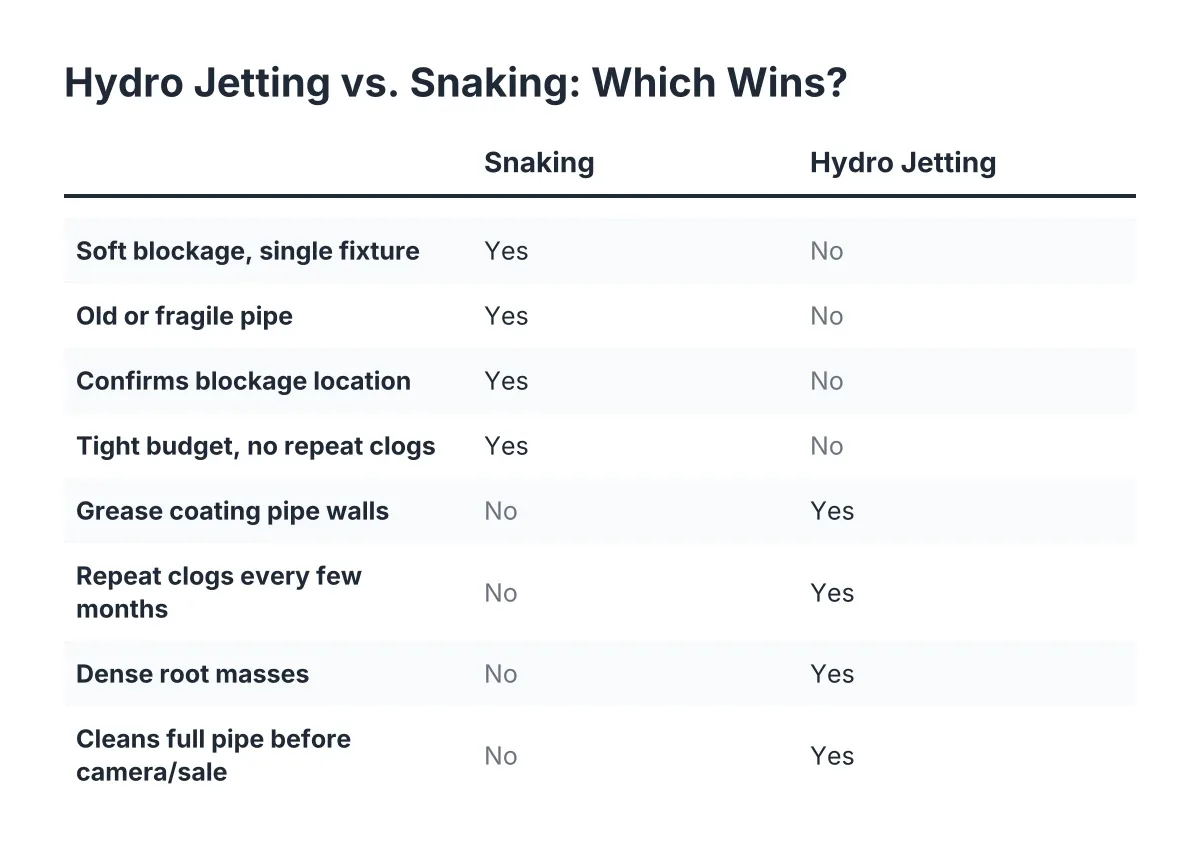
A snake, also called a cable or auger, is a flexible steel line that spins a cutting or grabbing head through the clog. Hydro jetting pushes a hose down the line and blasts the pipe walls with high-pressure water, scouring buildup back to bare pipe. The honest answer on which is better: it depends on the clog, and a straight comparison helps.
Where a snake drain wins over hydro jetting
Snaking is the right first move more often than jetting companies admit. Choose the cable when:
- The clog is a soft blockage in one fixture line. Fast, cheap, done.
- The pipe is old or fragile. High-pressure water can finish off a line that is already cracked or thin-walled.
- You need to confirm where the blockage sits. A cable tells you the distance to the obstruction.
- Budget is tight and the line has no history of repeat clogs. Cabling typically runs well under the cost of a jetting job.
The trade-off is thoroughness. A snake clears a path through the clog. It does not clean the pipe. Whatever coated the walls before is still coating them after.
Where hydro jetting beats the snake
Jetting earns its higher price when the pipe walls themselves are the problem. Choose jetting when:
- Grease is the culprit. A jetter strips the coating off the full circumference of the pipe instead of drilling a hole through it. For grease, that is the difference between a fix and a delay.
- The same line keeps clogging. Repeat clogs every few months usually mean buildup, not bad luck.
- Roots have formed a dense ball the cable cannot pull apart. A jetter can cut through heavy root masses that stall a snake.
- You want the main line genuinely clean before a camera inspection or a property sale.
The trade-off runs the other way here. Jetting costs more per visit, and it should not go into a pipe with known damage without a camera look first. If the line is collapsed or badly root-damaged, neither tool is a fix. Snaking buys weeks, jetting buys months, and the real answer is pipe repair or replacement.
Step 4: Match the Method to the Property, Not Just the Clog
As a landlord, you are not solving one clog. You are managing a system across units and years. Suppose you own a duplex in Fontana where the shared kitchen line backs up every spring. A typical crew could snake it each time for a modest fee, four visits in two years. In that scenario, one hydro jetting visit that strips the grease from the whole line likely costs less than the repeat cabling, and it ends the tenant calls.
For rentals, grease deserves special attention. Tenants pour bacon fat and fryer oil down kitchen sinks, and you only hear about it when the line closes up. Research cited by the International Journal of Environmental Science and Technology estimates 30 to 40% of sewer clogs come from fat, oil, and grease deposits. On a septic property, that grease also ends up in your tank as scum, which is one more reason to keep pump-outs on schedule.
A practical pattern for 2026 planning across a small portfolio:
- Snake first for one-off, single-fixture clogs. Keep the receipt per property for your records.
- Jet any main line with two or more clogs in a year, after a camera check if the pipe's condition is unknown.
- Pair main line work with septic tank pumping when the tank is due. Penn State Extension advises pumping every two to three years for an active family of four, and a full rental unit produces similar load.
- Log every visit by address so the next slow drain call starts with history, not guesswork.
Step 5: Protect the Septic System During and After the Work
A hydro jetting or snake drain job on a septic property is not the same as on a sewer property. Everything flushed downstream lands in your tank or drain field, so the method and timing matter.
Tell whichever drain cleaning crew you hire that the property is on septic before they start. Jetting a grease-packed line sends that grease into the tank; if the tank is already near capacity, you can push solids toward the leach field, which is the one part of the system you cannot clean out cheaply. Scheduling a pump-out alongside, or shortly after, a major jetting job protects the drain field.
A few more habits that keep lines clear between service visits:
- Skip chemical drain openers. They do not remove grease coatings, and harsh products are hard on the tank's bacteria.
- Be skeptical of additives. Commercial septic additives marketed to dissolve sludge lack strong scientific backing, according to Washington State University Extension.
- Fix running toilets fast. A single leaky or running toilet can waste as much as 200 gallons of water per day, according to the U.S. Environmental Protection Agency, and all of it floods your septic system.
- Give tenants a one-page sink and toilet rule sheet at move-in. It costs nothing and cuts grease clogs.
Step 6: Call in a Pro When the Line Tells You To
Some situations are beyond either tool, and recognizing them early saves money. Bring in a professional for a camera inspection or a septic system inspection when the main line clogs repeatedly despite jetting, when sewage surfaces in the yard over the drain field, when the cleanout is damaged or you cannot find one, or when a backup follows a recent pump-out. Those point to baffle, filter, pipe, or drain field problems that no cable or jetter resolves.
One honest limitation: no article can diagnose your line from a distance. A clog that looks like simple grease can sit on top of a root-cracked pipe, and only a camera settles it.
Quick Answer: Is Hydro Jetting Better Than Snaking?
Neither method is better across the board; each fits a different job. Snaking is the cheaper, faster fix for soft, single-fixture clogs and the safer choice in fragile pipes. Hydro jetting cleans the full pipe wall, so it wins on grease, buildup, and repeat clogs in main lines.
For a Fontana landlord running several septic properties, the working rule is short. Snake the one-offs. Jet the repeaters. Pump the tank on schedule, and inspect before you spend big on either. Do that, and the question of hydro jetting vs snaking answers itself one property at a time.
Prefer to talk it through? Call (909) 316-2368 — a quick call is usually the fastest way to get a straight answer for your situation.