
Grease Trap Residential System vs. Commercial Kitchen: FAQ for Landlords
If you own rental properties around Fontana, you may be asking whether a grease trap for landlords is different from the big interceptors behind restaurants, and who cleans either one. The short answer: same idea, different scale, and the same local crew can service both. That matters if you manage several properties on septic and want one vendor instead of three. This FAQ walks through what a grease trap does, how residential and commercial setups differ, and what to look for when you compare service options in 2026.
What is a grease trap and why is it important?
A grease trap is a box in the drain line that catches fats, oils, and grease before they reach the septic tank or sewer line. Grease floats, so the trap holds wastewater long enough for grease to rise and get captured while cleaner water flows on. Without one, grease coats pipes and hardens into blockages.
The stakes are bigger than most owners think. According to the U.S. Environmental Protection Agency, grease from restaurants, homes, and industrial sources is the most common cause of reported sewer blockages, at 47%. On a septic property, that same grease ends up as a scum layer in your tank or a clog at the inlet baffle.
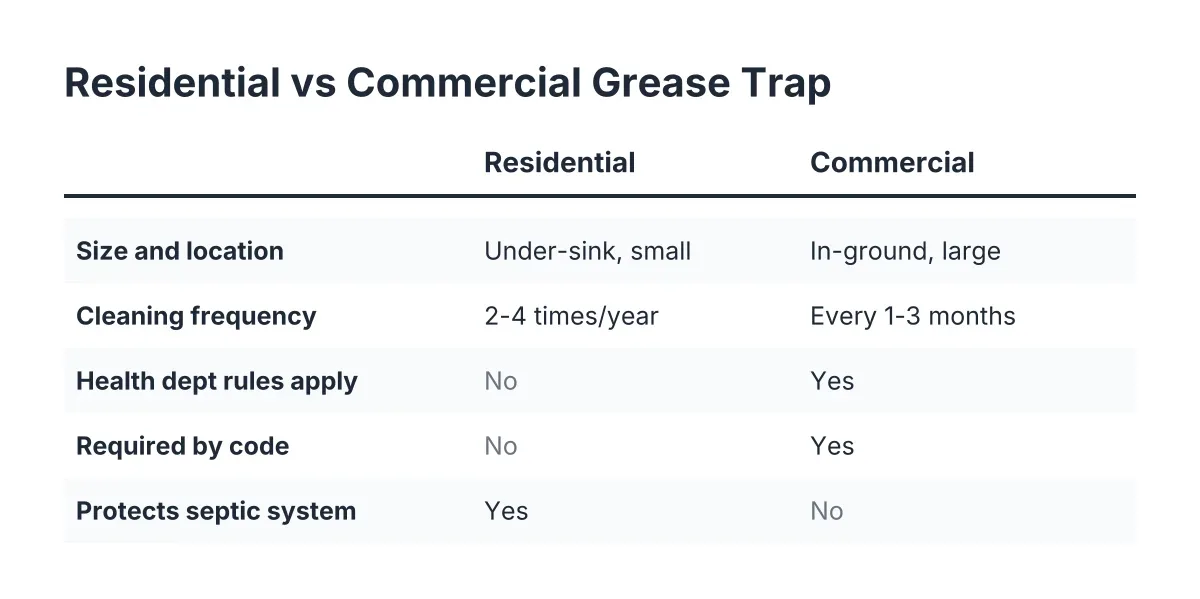
How does a grease trap residential system differ from a commercial one?
A grease trap residential system is small, often an under-sink or in-line unit rated for a single kitchen's flow. A commercial kitchen uses a larger trap or an in-ground grease interceptor that holds far more volume, because the load is far heavier. According to the U.S. Environmental Protection Agency, a single restaurant can discharge between 800 and 17,000 pounds of grease into the sewer system annually if not properly managed.
For a landlord, the practical differences come down to three things:
- Size and location. Residential units sit under or near the kitchen sink; commercial interceptors are often outside, in-ground, with a manhole-style lid.
- Cleaning frequency. A small residential trap may need attention a few times a year; a busy commercial trap can need monthly pump-outs.
- Rules. Commercial grease traps face health department and wastewater requirements. Residential units mostly answer to protecting your own septic system.
If your portfolio mixes single-family rentals on septic with a small commercial unit, say a corner strip with a taco shop, you are dealing with both types. One crew that handles septic tank pumping and grease trap work covers the whole list.
Does a rental home on septic need a grease trap for landlords?
Most single-family rentals on septic do not require a grease trap by code, but one can protect the system when tenants cook heavily. Inside a septic tank, fats, oils, and grease float and form a scum layer on top, according to the U.S. Environmental Protection Agency. A trap catches some of that grease before it reaches the tank.
Here is the honest trade-off. A small trap adds one more thing to clean, and tenants will not clean it. Some grease enters the system no matter what; body oils from showers go down the drain in every home. For many landlords, the better play is tenant education plus a steady pump-out schedule, with a trap reserved for properties that keep clogging.
What are the signs your grease trap needs cleaning?
The signs a grease trap needs cleaning are slow drains at the kitchen sink, a rotten or sour smell near the trap, grease backing up into the sink, and visible thick buildup when you open the lid. On a rental, the first signal is usually a tenant call about a slow drain that keeps coming back.
However, do not stop at the trap. If a Fontana rental on septic shows slow drains in more than one room, the problem may be the tank or the leach field, not the trap. A septic system inspection can sort out which one you are dealing with before you pay for the wrong fix.
How often should you get your grease trap cleaned in Fontana, CA?
In Fontana, a commercial grease trap typically needs cleaning every one to three months, while a small residential unit may only need service two to four times a year. The right interval depends on kitchen volume, trap size, and what goes down the drain. A common rule of thumb is to clean before the trap is one quarter full of grease and solids.
For landlords managing a grease trap for their rental properties, the schedule matters more than the number. Suppose you own three rentals in Fontana and one small commercial space in the surrounding area. Putting all four on a recurring calendar with one local company means no more scrambling when a tenant calls, and one set of service records for your accounting.
What happens if you don't clean your grease trap?
Skipping grease trap cleaning leads to blockages, backups, foul odors, and on commercial properties, possible fines or forced closure from the health department. Grease cools and solidifies inside pipes after it leaves the kitchen. Research published in the International Journal of Environmental Science and Technology estimates roughly 30 to 40% of sewer clogs come from fat, oil, and grease deposits in pipes.
On a septic property, the damage compounds. Grease that gets past a full trap builds the scum layer in your tank faster and can migrate toward the drain field. EPA guidance puts routine septic maintenance at $250 to $500 every three to five years, versus $5,000 to $15,000 to repair or replace a failed conventional system. One neglected trap is a cheap problem that can feed an expensive one.
Can you clean a grease trap yourself or do you need a professional?
You can clean a small under-sink residential trap yourself by scooping out the grease, bagging it, and putting it in the trash. It is a messy job, and the waste cannot go down any drain. Larger traps and in-ground interceptors need a grease trap cleaning service with a vacuum truck, because the volume and disposal rules are beyond a shop vac and a bucket.
There is also a pipe problem DIY cannot solve. Grease clogs coat the pipe walls, so punching a hole through with a small snake gives you a week of relief before it closes again. Clearing a grease line for good takes equipment that cleans the full pipe wall, which is professional territory. When in doubt, have a pro look before a slow drain becomes a habitability complaint.
How does professional grease trap service work?
A professional crew opens the trap, pumps out the full contents, scrapes the walls and baffles, checks the inlet and outlet, and hauls the waste for legal disposal. Septic waste and trap waste get trucked to a treatment facility rather than processed on site, a standard practice noted by the New Hampshire Department of Environmental Services. A residential unit takes well under an hour; a large interceptor takes longer.
This is also where vendor consolidation pays off. The same pump truck and crew that handle septic system pumping services can pump a grease trap on the same route. If you have been searching separately for a septic pumper near me and a commercial grease trap cleaner, you may only need one call.
Why hire one crew for septic and grease trap work for landlords?
Hiring one local crew for septic tank pumping, inspection, and grease trap service cuts your vendor list, keeps records in one place, and puts every property on a single schedule. A crew that already knows your tanks can spot grease problems early, like floating grease globs in a septic tank during a routine pump-out.
Compare that to the alternative. National directories and dispatch brands route your call through a distant center, and many drain outfits treat septic and grease work as an afterthought. When you search for grease trap cleaners near me, check whether the company actually services both grease traps and septic systems locally, or just resells the lead.
What should a multi-property landlord ask before committing?
Before committing to a grease trap or septic vendor, ask about recurring scheduling, per-property service records, pricing across multiple sites, and whether one crew handles both septic and grease work. Those four answers tell you whether the company fits a portfolio or just a one-off job.
Use this short checklist when you compare options:
- Can they put every property, residential and commercial, on one recurring pump-out schedule?
- Do they document each visit so you have records for accounting and any habitability dispute?
- Do they service a grease trap residential system and a commercial interceptor with the same crew?
- Are they actually local to Fontana and the immediate surrounding area, or dispatching from somewhere else?
No single article can size a trap or set your exact schedule; kitchen habits, tank condition, and county requirements vary by property. A local inspection of each site is the reliable way to set intervals you can hold to. Once that baseline exists, grease trap and septic service stops being a surprise expense and becomes a line item you can plan around.
If you need septic tank pumping, Fontana Septic can help.
Prefer to talk it through? Call (909) 316-2368 — a quick call is usually the fastest way to get a straight answer for your situation.