
8 DIY Septic Maintenance Mistakes That Cost Fontana Homeowners Thousands
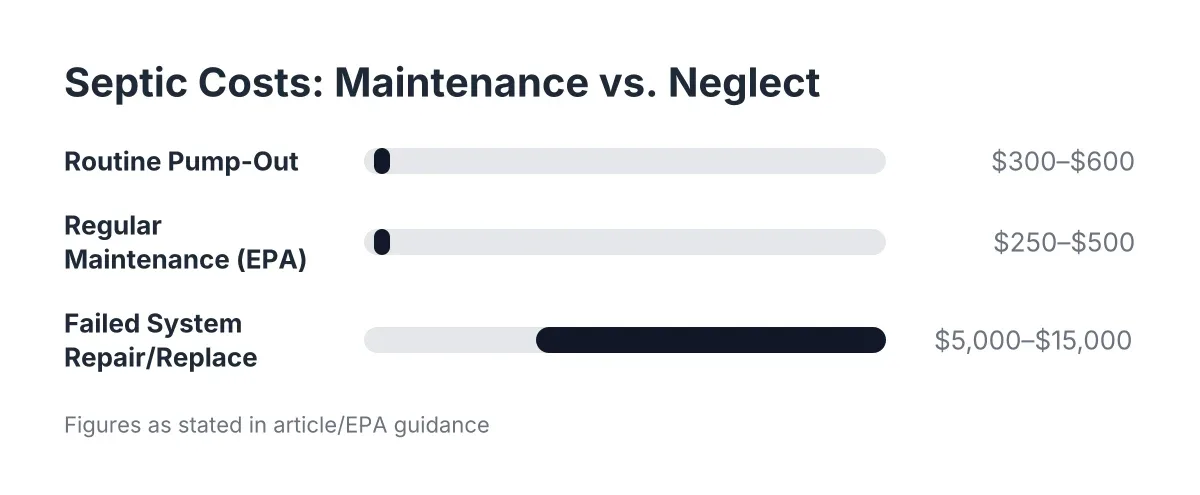
If you just bought your first home on septic in Fontana, you are probably tempted to handle the tank yourself. That instinct is understandable, but the most common DIY septic maintenance mistakes are the ones that turn a $300 to $600 pump-out into a four-figure repair. According to U.S. Environmental Protection Agency guidance, regular maintenance runs $250 to $500 every three to five years, while repairing or replacing a failed system runs $5,000 to $15,000. This list walks through the eight mistakes a local septic pumper sees most often, and tells you plainly which jobs you can do yourself and which call for a crew.
Before the list, one quick piece of context. A conventional septic system has two main parts: the septic tank and the drain field, according to the U.S. Environmental Protection Agency. The tank holds solids and lets liquid flow out to the leach field, where soil finishes the treatment. Every mistake below damages one of those two parts. Once you understand the septic system basics, the list almost explains itself.
1. Skipping the Pump-Out Schedule Because "Everything Seems Fine"
The number one mistake is waiting for a problem before scheduling septic tank pumping. Septic trouble builds slowly. By the time you see a backup, a slow drain, or a soggy patch over the leach field, solids may already be pushing into the drain field, which is the expensive part to fix.
For an active family of four, pumping the tank every two to three years is generally advisable, according to Penn State Extension. Smaller households can often stretch to three to five years. If your home inspection said the tank "needs attention" or the seller could not remember the last pump-out, treat that as year zero and book a pump-out now, then set a reminder.
In practice, homeowners who skip maintenance entirely tend to need pump-outs more often later, because a neglected tank pushes solids downstream and the whole system works harder. Regular service is the cheap habit; catch-up service is the expensive one.
2. Pouring in Additives Instead of Pumping
Store shelves are full of septic additives that promise to "eat" the sludge so you never need a pump-out. This is one of the DIY septic maintenance mistakes that feels like saving money while quietly costing it. A septic tank is a biological system that balances itself when you treat it normally; no jug of product removes the solids that physically build up at the bottom.
The approach technicians recommend for a neglected tank is simple: skip the additives, pump the tank first, then maintain it on a schedule going forward. If a company leads with additive sales instead of a pumping schedule, that tells you something about their priorities.
3. Opening or Entering the Tank Yourself
Never open a septic tank lid and lean in, and never climb in, period. The gases inside a tank can knock a person unconscious in seconds, and people have died trying to retrieve a dropped tool or rescue a pet. A professional crew has the equipment and the training to work at the tank safely.
Locating your lids and keeping them accessible is a good homeowner job. Prying one open to "check the level" with a flashlight is not. If you want to know how full the tank is, a septic system inspection answers that question safely and tells you far more at the same time.
4. Driving or Building Over the Tank and Leach Field
Fontana-area lots run half an acre and up, and it is tempting to park an RV, pour a slab, or put a shed on that open ground out back. Suppose a new homeowner in a semi-rural Fontana neighborhood parks a trailer over the drain field for a summer. The soil compacts, the pipes crack, and the first sign is sewage surfacing in the yard the following winter. In that scenario, the repair bill lands in leach field territory, not pump-out territory.
Keep the rules simple:
- No vehicles, trailers, or heavy equipment over the tank or drain field, ever.
- No structures, patios, or pavement over any part of the system.
- No trees or deep-rooted shrubs near the leach field; roots find pipes.
- Grass is the right cover. It is easy to remove for service and does not damage anything.
If you do not know where your system sits, ask for a leach field inspection or a system locate before your first landscaping project, not after.
5. Treating the Toilet and Drains Like a Sewer Connection
Homes in cities typically connect to municipal sewage treatment, according to the Environmental Finance Center Network, and city habits do not transfer to septic life. A sewer carries waste away to a plant. Your septic tank keeps everything you flush, so wipes, feminine products, grease, coffee grounds, and harsh chemical drain cleaners all land in your tank or your pipes.
Grease deserves special mention. Research published in the International Journal of Environmental Science and Technology estimates that fat, oil, and grease cause about 30 to 40 percent of sewer pipe clogs. In a septic home, that grease also coats the tank and can migrate to the drain field. Pour cooking fat into a can, not the sink, and if your property has a grease trap, have it cleaned on a schedule.
6. Ignoring Water Use and Leaky Fixtures
Your drain field can only absorb so much water per day. Therefore, hydraulic overload, meaning too much water too fast, is one of the quietest ways homeowners drown their own system. A single running toilet can waste as much as 200 gallons of water per day, according to the U.S. Environmental Protection Agency. That is like adding another household to your tank without adding any capacity.
San Bernardino County sizes tanks to the home, requiring 1,000 gallons for a 3-bedroom house and 1,500 gallons for a 5-to-6-bedroom house, per the San Bernardino County Department of Public Health. The county did that math assuming normal water use. Fix running toilets fast, spread laundry across the week instead of running five loads on Saturday, and route roof drainage away from the leach field.
7. Common DIY Septic Maintenance Mistakes in Attempting Your Own Repairs
Pumping and inspection are maintenance. Digging into the tank, replacing a baffle, re-grading a drain field, or adding capacity is construction, and it is regulated for a reason. Becoming a licensed septic installer requires certification beyond a pumping operation, including exams on soil types, percolation rates, system design, and local rules, according to the New Hampshire Department of Environmental Services. A percolation test must be performed before installing a system to confirm the soil drains properly, per University of Nebraska-Lincoln Extension.
The engineering details matter more than they look. For example, the outlet pipe must sit lower than the inlet pipe, because solids float and only liquid should exit toward the drain field, as University of Nebraska-Lincoln Extension explains. Get one detail like that wrong in a weekend repair and you can send solids straight into the leach field. Amateur repair work stands among the worst DIY septic maintenance mistakes, most likely to end in full system replacement.
One honest caveat: not every hands-on task is off limits. Keeping lids accessible, conserving water, watching what goes down the drain, and keeping records are all homeowner work. The line is anything that involves opening, digging, or altering the system itself.
8. Hiring on Price Alone Without Asking Basic Questions
When the first pump-out comes due, many new owners search "septic pumper near me" and book the cheapest number on the screen. In California, septic knowledge is scarcer than you might expect; EPA data shows only about 10 percent of California homes use septic systems, one of the lowest rates in the country. That means plenty of general plumbing outfits treat septic as a side job routed through a distant dispatch desk.
Before you book septic system pumping services, ask a few plain questions:
- Will you pump both compartments of the tank, not just the first one?
- Will you inspect the baffles and the filter while the tank is open?
- Will you tell me the tank's condition in writing, in plain language?
- Do you actually work in Fontana and the surrounding area, or dispatch from somewhere else?
A straightforward local crew answers all four without hesitation. As of 2026, a routine residential pump-out in the Fontana area typically lands in the $300 to $600 range as an estimate; a quote far below that often means a partial pump or an upsell waiting at the truck.
DIY Septic Maintenance Mistakes vs. Jobs You Can Safely Do Yourself
Here is the honest split. You handle the habits; a professional handles the hardware.
Safe homeowner tasks:
- Track your pump-out dates and keep service records with your house papers.
- Keep grass over the system and keep lids reachable.
- Fix leaks, stagger laundry, and keep grease and wipes out of the drains.
- Watch for warning signs: slow drains, odors, lush green stripes, or wet spots over the leach field.
Professional tasks:
- Septic tank pumping on a two-to-five-year cycle, depending on household size.
- Septic system inspection, especially before or after a home sale.
- Any repair involving baffles, pipes, the tank, or the drain field.
- Diagnosing a backup, because guessing at the cause wastes money.
Should I hire a professional or can I maintain my septic system myself?
You can maintain the habits yourself, but pumping, inspection, and repair belong to a professional septic crew. Homeowner maintenance means managing water use, keeping harmful items out of the drains, protecting the leach field, and keeping records. Everything that involves opening the tank or altering the system requires trained people with the right equipment.
The math backs this up. A pump-out every few years costs a few hundred dollars. A failed system costs thousands and can take your yard apart for weeks during the repair. For a first-time septic owner in Fontana, the winning move is boring: schedule the first pump-out, ask for a written condition report, put the next date on the calendar, and keep your habits clean in between. Avoid the eight mistakes above and your system should quietly do its job for decades.
If you need septic tank pumping, Fontana Septic can help.
Prefer to talk it through? Call (909) 316-2368 — a quick call is usually the fastest way to get a straight answer for your situation.