
Effluent Pump vs. Solids Pump: Which Septic Tank Pump Replacement You Need
If your pump-assisted septic system has stopped moving wastewater, the first question is not where to buy a pump. It is which pump your system actually needs. Most septic tank pump replacement mistakes in Fontana start right there: an owner buys a solids-handling pump when the system calls for an effluent pump, or the other way around. The two look alike on a shelf. They do different jobs, and swapping one for the other is how a new pump dies in a year instead of ten.
This guide walks through the decision step by step. It is written for anyone staring at a pump chamber that stopped working, whether you are building a new home on land without sewer hookup or you manage a few rental units on a shared system.
First, Know Why Your System Has a Pump at All
A conventional septic system has two main parts: the septic tank and the drain field, according to the U.S. Environmental Protection Agency. In a gravity system, wastewater flows downhill from the house to the tank, then downhill again to the drain field. No pump needed.
However, plenty of Fontana-area lots do not cooperate. If your drain field sits uphill from the tank, or far enough away that gravity cannot carry the flow, your system includes a pump. A typical setup has the main septic tank for solids settling, then a separate pump tank that pushes liquid uphill or across distance to the drain field.
That layout matters because it tells you what the pump is supposed to move. In most residential systems, the pump handles liquid that has already been clarified in the tank, not raw sewage. Only liquid effluent, never sludge, should travel from the tank to the drain field. That single fact drives the whole effluent-versus-solids decision.
Step 1: Identifying Your Septic Tank Pump Replacement Location in the System
Before you shop for anything, find out where the failed pump lives. Open the access lid on the pump chamber, or check your as-built drawing if you have one from the county permit file. New construction owners usually have this diagram from the septic system design and permit process; landlords with older buildings often do not.
The pump's location tells you its job:
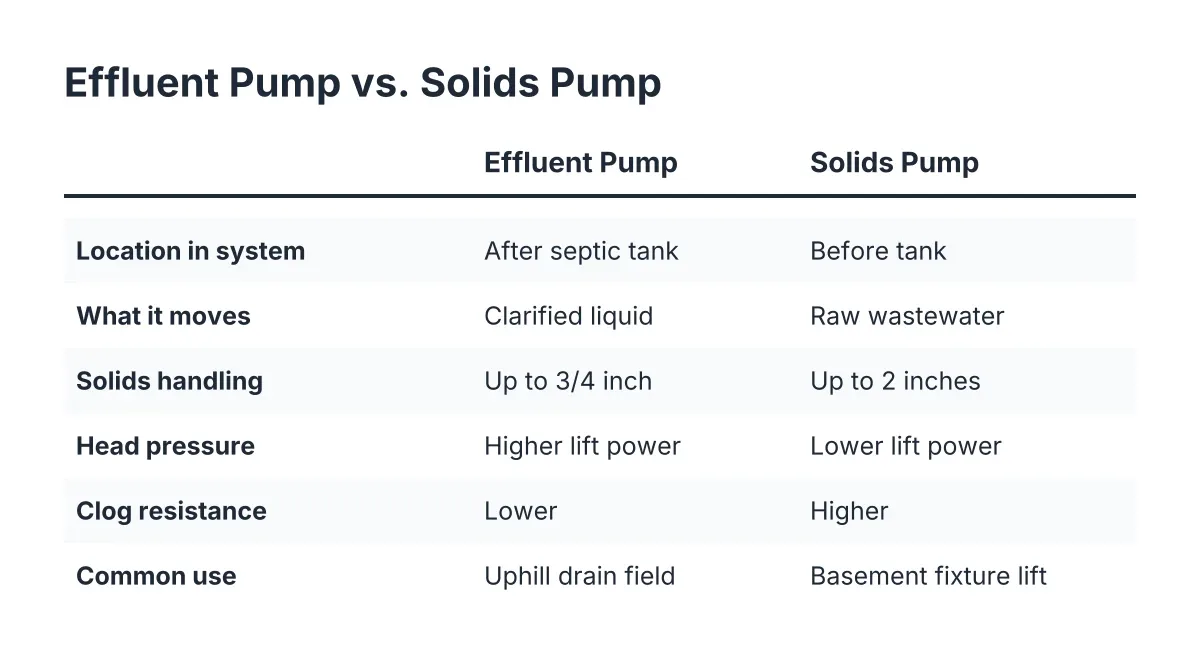
- Pump in a separate chamber after the septic tank: This is an effluent pump. It moves clarified liquid to the drain field or a distribution box. This is the most common setup.
- Pump in a basin before the septic tank: This is a sewage or solids-handling pump. It lifts raw wastewater from a low fixture, like a basement bathroom, up to the tank. It must pass solids without clogging.
- Air pump sitting above ground near an aerobic unit: This is an aerator, a different animal entirely. Aerator pump replacement follows its own rules and usually needs the manufacturer's matching part.
If you cannot tell which chamber you are looking at, stop and get a septic system inspection before buying anything. Guessing wrong wastes money twice: once on the pump, and again on the labor to swap it.
Step 2: Understand the Real Difference Between Effluent and Solids Pumps
An effluent pump moves clarified liquid, the water that has already separated from solids inside the septic tank. According to University of Nebraska-Lincoln Extension, tanks use baffles at the inlet and outlet, downward-facing tees that force solids to settle so only liquid exits toward the drain field. The effluent pump picks up where that design leaves off.
Because it handles mostly clear liquid, an effluent pump passes small solids only, typically up to about three-quarters of an inch. In exchange, it delivers more head pressure, the lifting power needed to push water uphill through a pressurized line. That lift is exactly what a sloped Fontana lot demands.
A solids-handling sewage pump is built the opposite way. It passes larger solids, often up to two inches, because raw wastewater has not been through a tank yet. It trades some lifting efficiency for clog resistance.
Here is the failure pattern when owners mix them up. Put a sewage pump in an effluent chamber, and it may lack the head pressure to reach an uphill drain field; the system backs up even though the pump runs. Put an effluent pump ahead of the tank where raw waste flows, and solids jam the impeller within months. Either mistake ends in a backup, a slow drain through the whole house, and a second repair bill.
Step 3: Match the Replacement to the Original Pump's Specs
Once you know the pump type, match the numbers, not the brand. The replacement should carry the same flow rate, horsepower, and voltage as the original. Bigger is not better here. An oversized pump can short-cycle, flood the drain field with more liquid than the soil can absorb, and wear out the float switches.
Pull the old pump and read the nameplate. Record these before you buy:
- Pump type: effluent, sewage, or aerator
- Horsepower, commonly one-third to one-half HP for residential effluent pumps
- Voltage: 115V or 230V, and confirm what your control panel supplies
- Gallons per minute at your required head height
- Discharge pipe size, usually 1.5 or 2 inches
- Float switch setup: piggyback plug or hardwired to a control panel
For new construction owners, the county-approved design already specifies these numbers. San Bernardino County sizes systems to the home; its minimum capacity table requires a 1,000-gallon tank for a 3-bedroom home and 1,500 gallons for a 5 to 6 bedroom home, according to the San Bernardino County Department of Public Health. The pump spec flows from that same design math, so deviating from it can put your final inspection at risk.
Step 4: Pump the Tank Before the New Pump Goes In
This step gets skipped constantly, and it is why some replacements fail fast. When a pump sits dead for days or weeks, solids build up in the chamber. Drop a new pump into that sludge and you feed it the exact material that kills it.
Therefore, plan on a pump-out when the new pump is installed. A septic pumper removes the settled sludge at the bottom and the floating scum on top, not just the liquid in between. All of the settled sludge needs to come out; leaving part of it behind invites blockages and repeat trouble. For an active family of four, pumping every two to three years is generally advisable anyway, according to Penn State Extension, so pairing the pump-out with the replacement often just moves up a service you already needed.
In addition, ask about an effluent filter at the tank outlet if your system does not have one. Any system with a pump chamber benefits from one, because the filter catches solids before they ever reach the pump. It is cheap insurance for the new motor.
Step 5: Decide What You Handle Yourself and What a Pro Should Do
Can you replace a septic tank pump yourself? A handy owner can sometimes swap a plug-in effluent pump: disconnect the union, pull the old pump by its rope, bolt the new one to the discharge pipe, and reset the floats. That is the best case, and even then the chamber holds sewage gases that can be deadly; never climb into a tank or chamber, ever.
The related question comes up just as often: can you pump a septic tank yourself? In practice, no. Removing sludge and scum takes a vacuum truck and a legal place to dispose of the waste. A shop vac and a rented trailer do not meet either requirement, and hauling septage without authorization creates a legal problem on top of a sanitation one.
Hire out the job when any of these apply:
- The pump is hardwired to a control panel or alarm system
- The system is aerobic, or the floats and timers need recalibration
- The chamber needs a pump-out first, which it usually does
- The property is a rental, where a failed DIY fix becomes a tenant habitability issue
- The system is new construction still awaiting county sign-off
Suppose you are a landlord with a duplex on a shared pump system and a tenant reporting gurgling drains on a Friday. In that scenario, a wrong pump or a botched float setting does not just cost a return trip; it can mean a sewage backup into an occupied unit over the weekend. The math favors a crew that carries the right pump, confirms the specs, and pumps the chamber in one visit.
What Septic Tank Pump Replacement Costs Compared to Waiting
Septic tank pump replacement typically runs from several hundred dollars to around two thousand, depending on pump type, chamber depth, electrical work, and whether the tank needs a pump-out at the same time. Those are illustrative 2026 ranges, not quotes; a local septic tank inspector can price your exact setup after seeing it.
Compare that to the cost of ignoring a failing pump. Effluent that cannot reach the drain field backs up into the tank, then the house, or it overloads the soil and drowns the leach field. EPA guidance puts regular septic maintenance at $250 to $500 every three to five years, versus $5,000 to $15,000 to repair or replace a failed conventional system, according to the U.S. Environmental Protection Agency. A dead pump left alone is how a pump problem becomes a drain field problem.
One honest trade-off to weigh: adding or upgrading a pump chamber raises the cost of any septic project compared to a straight gravity-fed replacement. If you are designing a new system and the lot allows gravity flow, that is worth a hard conversation with your designer before the county permit locks the plan in.
Quick Answers Before You Buy
How long does it take to replace a septic tank pump?
Replacing a septic tank pump usually takes two to four hours for a straightforward effluent pump swap, assuming the chamber is accessible and the replacement matches the original specs. Add time if the tank needs a pump-out first, the lid is buried, or the control panel and floats need rewiring. Hardwired and aerobic systems run longer.
How often do septic tank pumps need to be replaced?
Septic pumps in residential systems commonly last 7 to 15 years, and the biggest factor is how much solid material reaches them. A chamber protected by an effluent filter and regular septic tank pumping keeps the pump on the long end of that range. A neglected tank that sends sludge downstream can kill a pump in a few years.
What happens if you don't replace a failing septic tank pump?
A failing septic pump that goes unreplaced leads to wastewater backing up in the pump chamber, then the tank, and eventually the lowest drains in the building. On uphill systems, nothing reaches the drain field at all. The overflow can also push solids into the leach field, turning a pump swap into a field repair measured in thousands, not hundreds.
The Bottom Line
Match the pump to the job, not to the price tag. An effluent pump belongs after the tank, moving clarified liquid to the drain field. A solids-handling pump belongs ahead of the tank, lifting raw wastewater. Confirm the specs off the old nameplate, pump the chamber before the new unit goes in, and add an effluent filter if the system lacks one.
For Fontana owners, whether you are waiting on a county final for new construction or keeping rental units out of backup territory, getting the pump type right the first time is the whole game. Everything else in the replacement is plumbing.
If you need septic tank pumping, Fontana Septic can help.
Prefer to talk it through? Call (909) 316-2368 — a quick call is usually the fastest way to get a straight answer for your situation.