
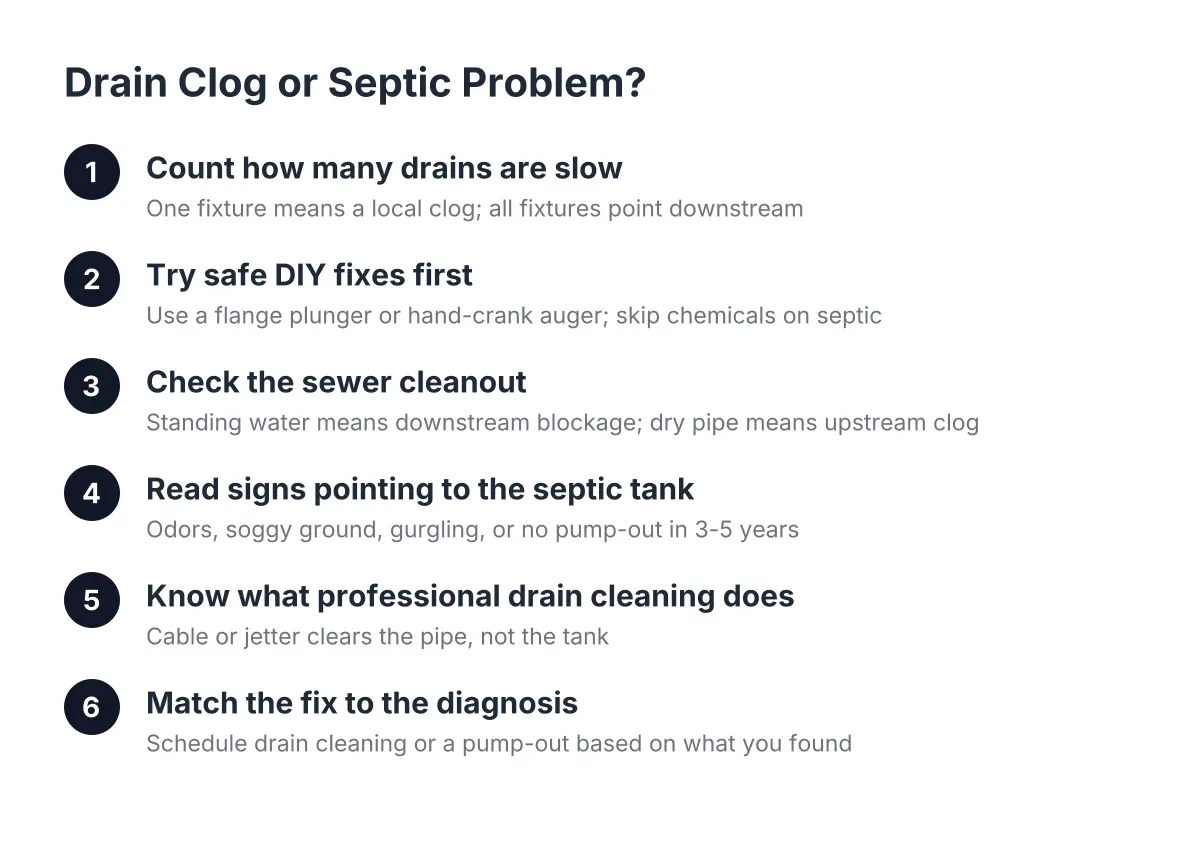
Slow Drain: When a Drain Cleaning Service Fixes It vs. Septic Pumping
If you just bought your first home on septic in Fontana and a drain is running slow, the first question is not who to call. It is what kind of problem you have. A drain cleaning service clears clogs in the pipes. Septic tank pumping removes solids from the tank. They fix different problems, and paying for the wrong one wastes money while the real issue gets worse. This guide walks you through checking the symptoms in order, so you know which fix your house actually needs before anyone rolls a truck.
Here is the short version. A clog in one fixture is almost always a pipe problem. Slow drains all over the house, plus gurgling or sewage smells outside, point at the tank or the drain field. The steps below sort it out.
Step 1: Count How Many Drains Are Slow
Start with a simple walk-through. Run water in the kitchen sink, the bathroom sinks, the tub, and flush each toilet. Note which ones drain slow, gurgle, or back up.
The pattern tells you most of what you need to know:
- One slow fixture, everything else fine. This is a local clog: hair in the tub trap, grease in the kitchen line, or a toy in the toilet. Drain cleaning handles it. Your septic tank is probably not involved.
- Every drain in the house is slow, and the lowest drains back up first. Water always backs up at the lowest point, usually a ground-floor shower or a floor drain. This pattern means the problem is downstream of the house, in the main line, the septic tank, or the drain field.
- Drains slow down when you run a lot of water, then recover. This often points at a tank or drain field that cannot absorb water fast enough, not a simple clog.
According to the US EPA, a single pipe connects all household drains to the septic tank. Solids settle in the tank, and liquid flows out to a drain field of perforated pipes in gravel. That single pipe is why the "one fixture versus all fixtures" test works. One fixture means the clog is upstream, in your house plumbing. All fixtures means the trouble is in that shared line or beyond it.
Step 2: Try Safe DIY Fixes Before Calling a Drain Cleaning Service
If Step 1 showed one slow fixture, you can try clearing it yourself before calling a clogged drain service near you. Stick to mechanical methods.
For a toilet, use a flange plunger, the kind with the extra rubber cup that seals the drain opening. Push slowly first to seal, then plunge with steady strokes. If plunging fails, a toilet auger reaches past the trap without scratching the bowl.
For sinks and tubs, pull the stopper and clear hair from the trap. A small hand-crank drain cleaning machine, sold at hardware stores as a drum auger, will reach clogs a few feet down the line.
However, skip chemical drain openers if you are on septic. Harsh chemicals can kill the bacteria your tank relies on to break down waste, and they rarely clear a solid blockage anyway. On the same note, skip the tank additives that promise to dissolve sludge. According to Washington State University Extension, commercial septic additives marketed to decompose sludge lack strong scientific backing. Nothing replaces a pump-out.
Step 3: Check the Sewer Cleanout Before You Call Anyone
The sewer cleanout is a capped pipe, usually white or black plastic, sticking a few inches out of the ground between your house and the septic tank. If you are a first-time septic owner, find it now; your inspection report or a previous owner's paperwork may mark its location.
If the whole house is draining slow, put on gloves and open the cleanout cap slowly. What you see tells you where the blockage sits:
- Water rushes up or the pipe is full of standing water. The blockage is downstream of the cleanout, toward the tank or drain field. That could be a main line clog or a full tank.
- The pipe is dry or nearly empty. The blockage is upstream, between the house and the cleanout. That is a pipe clog, and a drain cleaning service with a proper cable or jetter can clear it.
Here is the detail that saves first-time owners real money: a backup between the house and the tank does not mean the tank needs pumping. The line clog and the tank are separate issues. If the tank's liquid level is normal but water bubbles up at the cleanout, the blockage sits in that stretch of pipe, and a cable through the cleanout is the right fix, not a pump-out.
Step 4: Read the Signs That Point to the Septic Tank Instead
Sometimes the pipe is clear and the tank is the problem. When a tank gets too thick with solids, running a cable through the cleanout will not fix anything, because there is no mechanical clog to cut. The tank is simply full, and solids are pushing into places they should not go.
Watch for these septic-side symptoms:
- Sewage odor near the tank lids or over the drain field
- Soggy ground or bright green grass stripes over the leach field in dry weather
- Gurgling in multiple drains after every flush
- Backups that return within days of a drain cleaning visit
- No record of a pump-out in the last three to five years
That last one matters for new buyers. Suppose your home inspection in Fontana flagged that the tank "needs attention" and the seller could not produce pumping records. In that scenario, the smart first move is a pump-out with an inspection at the same visit, not a drain cleaning call. Since inspecting a tank often costs close to what pumping costs, having the tank pumped during the visit usually gives you more for the money: an empty tank plus a look at its condition.
For sizing context, San Bernardino County Department of Public Health requires a minimum 1,000-gallon tank for a 3-bedroom home and 1,500 gallons for a 5-to-6 bedroom home. A tank that size fills on a predictable schedule. According to Penn State Extension, an active family of four should generally pump every two to three years.
Step 5: What to Expect From Professional Drain Cleaning Services
Once you know which fix you need, hire for the right scope. A legitimate drain cleaning visit on a septic property should include locating the blockage, cabling or jetting the affected line, and running water afterward to confirm flow. Many crews can run a camera through the line for an added charge, which is worth it if the same line has clogged twice.
Two methods come up in every quote, so know the difference. Snaking runs a cable that punches a hole through the clog; it is faster and cheaper, and it works for most single-fixture and main line clogs. Hydro jetting scours the pipe walls with high-pressure water; it costs more but removes grease buildup instead of just poking through it.
Grease is worth taking seriously. According to the U.S. Environmental Protection Agency, grease is the most common cause of reported sewer blockages, at 47%. If your kitchen line clogs repeatedly, jetting plus a change in habits beats snaking it every six months. Landlords with rental units on septic in the Fontana area see this pattern constantly; tenants pour grease down kitchen sinks, and the same line clogs every lease cycle. A grease trap, cleaned on a schedule, breaks that cycle for multi-unit properties.
On price, be wary of anyone quoting a firm number before seeing the job. Ranges depend on where the clog sits and what it takes to reach it. Ask what the quoted price covers, what triggers an extra charge, and whether a camera inspection is included or added.
Step 6: Match the Fix to the Diagnosis, Then Get on a Schedule
Pull the steps together into one decision:
- One fixture clogged, cleanout dry: DIY or a local drain cleaning visit.
- All drains slow, cleanout full, tank level normal: main line drain cleaning through the cleanout.
- All drains slow, tank overdue or symptoms at the drain field: septic tank pumping first.
- Backups that keep coming back after pumping: have the leach field inspected, because repeated backups often mean the drain field itself is failing and repair or replacement, not another pump-out, is the real fix.
One honest limitation: if the system is completely stopped, with no water flow at all, no drain treatment or single pump-out will reliably restore it. That situation needs a professional evaluation of the tank and drain field before anyone sells you a fix.
The payoff for getting this right is large. According to the U.S. Environmental Protection Agency, regular septic maintenance costs $250 to $500 every three to five years, while repairing or replacing a failed system runs $5,000 to $15,000. Fix small things too. The EPA also notes a single running toilet can waste up to 200 gallons of water per day, all of it flooding into your tank and drain field.
When to Call a Local Fontana Crew
Call a professional now if sewage is backing up into the house, the ground over the drain field is wet, or you smell sewage outdoors. Those are not wait-and-see symptoms. Call soon, on your own schedule, if you bought a house with no pumping records or your 2026 to-do list still says "figure out the septic."
When you call, describe what you found in Steps 1 through 4: which drains are slow, what the cleanout showed, and when the tank was last pumped. A straightforward local crew can tell you over the phone whether the visit should start with a cable or a pump-out, instead of guessing after the truck arrives. That one conversation is the difference between paying for the fix you need and paying twice.
If you are in Fontana or the surrounding area and want a direct answer from a local septic and drain crew, reach out to schedule a pump-out, an inspection, or a drain cleaning visit, and get your system on a maintenance schedule before the next slow drain shows up.
If you need septic tank pumping, Fontana Septic can help.
Prefer to talk it through? Call (909) 316-2368 — a quick call is usually the fastest way to get a straight answer for your situation.