
Why Concrete Septic Tank Lids Crack: 8 Causes, Warning Signs, and When to Replace
A cracked concrete septic tank lid is one of those problems that looks small until it isn't. If you just bought your first home on septic in Fontana, your inspection report may have flagged "lid needs attention," and now you are trying to figure out what that means, how bad it is, and whether you need to act this week or this year. The causes of a cracked septic lid can range from age and gas corrosion to vehicle traffic and freeze-thaw cycles. This article walks through the eight most common reasons a concrete septic tank lid cracks, the damage signs that matter, and a realistic picture of what replacement involves, so you can decide between a repair, a full lid swap, or a call to a local septic pumper.
First, one point of reassurance. A damaged lid almost never means you need a new tank. The tank body is solid, reinforced concrete. The lid is a separate piece that sits over the access opening, and replacing just the lid costs far less than replacing the tank box. Knowing that difference is the single best defense against being upsold.
1. Age and Gas Corrosion: Why Septic Lids Crack From Below
The most common cause of a failing concrete septic tank lid is time plus the gases inside the tank. Sewage gases corrode concrete from the underside over decades, especially in tanks that have never been pumped or opened for inspection. The lid can look fine from the top while the bottom has turned soft and brittle.
This is why a lid sometimes breaks the first time a septic pumper pries it open on an older tank. The round lids on some tanks are more prone to this than older tapered designs, because gas collects against the underside and weakens it. If your home inspection mentioned the tank "hasn't been pumped in years," assume the lid deserves a close look during your first pump-out.
2. Vehicle Traffic Is the Fastest Way to Crack a Lid
Driving or parking over a septic tank cracks lids faster than anything else. Residential lids are built to hold soil and foot traffic, not a pickup truck or a delivery van. One pass by a heavy vehicle can crack a lid outright or stress it enough that it fails months later.
For a first-time rural property owner, the fix starts with knowing where the tank sits. Find the tank location, mark it, and keep vehicles off it. If a previous owner used that area as overflow parking, have the lid inspected before you trust it with any weight at all. This matters doubly on new construction sites, where concrete trucks and graders cross yards before anyone marks the tank.
3. Freeze-Thaw and Wet-Dry Cycling Widen Small Cracks
Concrete lives a hard life underground. Moisture soaks into hairline cracks, then expands and contracts with temperature swings. Fontana winters are mild, but overnight temperature drops plus irrigation runoff still cycle the concrete between wet and dry. Each cycle pushes a hairline crack a little wider.
Inside the tank, the same thing happens near the water line, where concrete sees the most repeated wet-dry exposure and chemical contact. A lid with a visible surface crack today will not heal itself; the question is how fast it gets worse, not whether it does.
4. Broken Handles and Pry Damage Shorten a Lid's Life
Plastic lift handles on older lids snap off when pulled, which forces whoever is opening the tank to pry at the edges. Repeated prying chips the rim and stresses the slab. Sometimes a brittle lid breaks during opening, and at that point the practical fix is to replace it, often with an access riser that makes every future pump-out easier. A cracked septic lid from pry damage can worsen quickly if the concrete below the surface is already compromised by gas exposure or moisture.
A riser brings the access point up to grade, so nobody digs or pries again. It costs more up front than a bare replacement lid, but it pays for itself in easier inspections and pump-outs over the life of the system. For a first-time owner planning decades in the house, it is usually the smarter spend.
5. The Damage Signs That Mean Act Now, Not Later
A cracked septic lid is a safety issue before it is a plumbing issue. A deteriorated or loose covering, including the makeshift rock or plywood some previous owners leave behind, can be dislodged easily and creates a fall-in hazard, especially for children and pets. Treat these signs as call-now conditions:
- Visible cracks wider than a hairline, or any crack that goes all the way through
- A lid that rocks, shifts, or sounds hollow when you step near it
- Sunken or settling soil around the lid, which can mean the lid or the fill beneath it is failing
- Chunks of concrete missing from the edge, or exposed rebar or foam core
- Any temporary covering: plywood, a rock, a trash can lid, anything that is not a fitted septic lid
- Sewage odor concentrated right at the lid, suggesting a bad seal or a gap
Minor surface spalling with no movement is a watch-it item. Anything on the list above is not.
6. Understanding What Causes a Cracked Septic Lid to Require Replacement
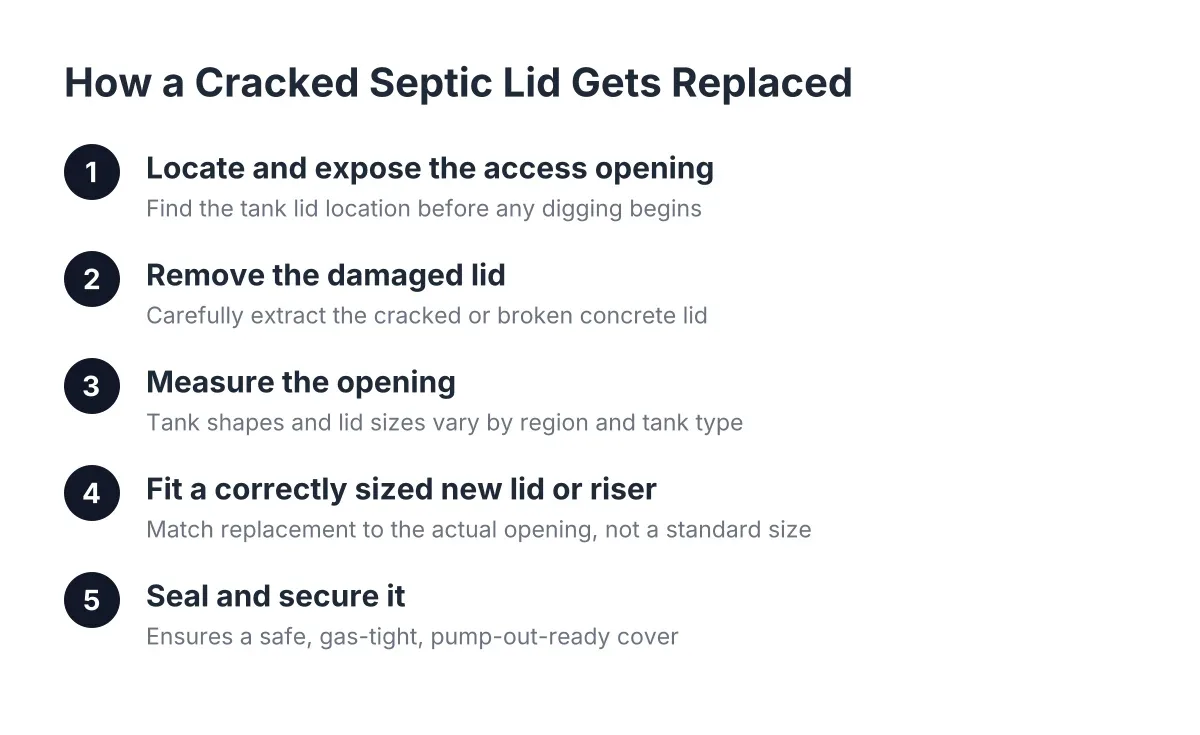
Concrete septic tank lid replacement means locating and exposing the access opening, removing the damaged lid, measuring the opening, fitting a correctly sized new lid or riser, and sealing and securing it. On a straightforward residential job, the work itself usually takes a few hours once the right lid is on hand; sourcing an odd size can add days. That is the scope a good provider delivers, and it is what you should see on a quote.
Sizing matters more than first-time owners expect. Concrete septic tank lid sizes are not universal. Tank shapes and configurations vary by region; according to the International Code Council, some areas use rectangular concrete tanks and others use circular ones, and lids follow the tank. A pro identifies the lid edge by the straight seam line in the exposed concrete, measures the actual opening, and matches the lid to it. For a nonstandard opening, a crew can pour a custom concrete lid to fit, which still costs far less than touching the tank itself.
Expect the lid to be lighter than you fear. Modern access lids use a foam core covered in concrete so they can be lifted for pumping without machinery. Expect the crew to secure every screw and fastener when they finish, so the lid cannot shift or be dislodged afterward.
7. What You Can Handle Yourself, and Where DIY Ends
A homeowner can safely locate the tank, mark it, keep vehicles off it, and watch for the warning signs above. You can also clear light soil off a lid to inspect it visually. That is the sensible limit.
However, do not open the tank yourself, and do not patch a cracked lid with mortar and call it fixed. An open or weakly covered tank is a fall hazard, and the gases inside can overcome a person quickly. A patched crack also hides how far the underside corrosion has gone; only someone who handles these lids regularly can judge whether the slab is still sound. This is the line where a septic system inspection by a local crew is worth the call, and a trade-off worth naming: paying for an inspection on a lid that turns out fine beats guessing wrong on one that isn't.
Suppose a buyer in north Fontana closes on a 1990s ranch house where the seller's disclosure says the tank was last pumped "a while ago." During the first pump-out, the lid's handle snaps and the lid cracks along an old hairline when pried. In that scenario, the practical path is a fitted replacement lid or a riser installed the same visit, not a new tank, and the cost difference between those two outcomes is enormous.
8. Costs, Local Rules, and How to Pick a Provider in Fontana
Lid replacement sits at the cheap end of septic work, and catching it early keeps it there. For scale, the U.S. Environmental Protection Agency puts routine septic maintenance at $250 to $500 every three to five years, against $5,000 to $15,000 to repair or replace a failed conventional system. A lid is a maintenance-scale expense. Letting water, soil, or debris pour through a broken lid into the tank pushes you toward the repair-scale number. We are not quoting a lid price here because openings, materials, and access vary; get a written estimate for your specific tank.
Local context matters too. Septic is less common in California than in most states, about 10% of households according to the U.S. Environmental Protection Agency, so plenty of contractors here rarely touch one. San Bernardino County also sets minimum tank capacities, 1,000 gallons for a 3-bedroom home and 1,500 gallons for a 5-to-6 bedroom home per the San Bernardino County Department of Public Health, which is one reason lid and opening sizes differ from house to house. Builders developing unsewered parcels around Fontana face county health department review on new systems, so lids and access points on new installs should match the approved design from day one.
When you compare providers for septic tank lid replacement, three questions separate a real septic crew from a dispatch service:
- Will you measure my opening on site before quoting a lid, or quote a standard size over the phone?
- Do you recommend a riser for my tank, and why or why not?
- Is the quote itemized: excavation, lid or riser, sealing, and securing fasteners?
A fair quote names the lid size or riser, states what digging is included, and commits to leaving the lid sealed and fastened. Vague "tank work" line items are a flag.
Don't Let a Cracked Lid Sit
A cracked concrete septic tank lid is a fixable, affordable problem in 2026, right up until someone steps on it or the tank starts taking in runoff and debris. If your lid shows any of the call-now signs above, or your inspection report flagged the tank and you are not sure what it means, talk to a local Fontana septic crew that does this work every week. One visit can confirm whether you need a simple lid swap, a riser, or nothing at all, and you will get the answer from the person doing the work, not a call center.
If you need septic tank pumping, Fontana Septic can help.
Prefer to talk it through? Call (909) 316-2368 — a quick call is usually the fastest way to get a straight answer for your situation.