
Leach Field Repair — Complete Guide
Leach Field Repair — The Complete Guide
Your leach field does the quiet work of your entire septic system, filtering wastewater through the soil after it leaves the tank. When it fails, you see the symptoms fast: soggy grass, sewage odors, and drains that back up on a Saturday morning. This guide covers leach field repair from the first warning signs through inspection, rehabilitation options, and the honest question of whether your field can be saved or needs replacing. If you own a septic-dependent home in Fontana, you will find straight answers here, not a sales pitch for a full system replacement you may not need.
What You'll Find in This Guide
Signs of Leach Field Failure You Should Never Ignore
Most leach field problems announce themselves early. However, homeowners often mistake the first symptoms for a plumbing issue or a wet season. Knowing the difference saves you money, because early leach field repair costs far less than a full replacement dug out of a ruined yard.
Watch for these warning signs:
- Soggy or spongy ground over the field, even during dry weather
- Grass that grows greener and faster in one strip of the yard
- Sewage odors near the field or around the tank
- Slow drains throughout the house, not just at one fixture
- Gurgling sounds from toilets or drains after you run water
- Sewage backing up into the lowest drains in the home
One of these signs alone does not condemn your field. For example, a single slow drain usually points to a clog, not a saturated drain field. That said, two or more symptoms together mean the soil no longer absorbs wastewater the way it should. At that point, adding more water only pushes the problem toward a backup inside your house.
Why Early Detection Matters for Your Wallet
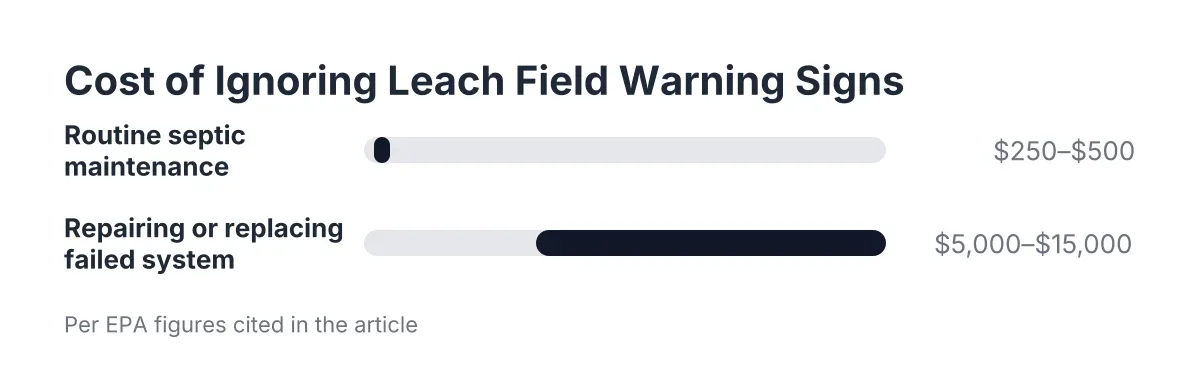
The financial case for acting early is simple. According to the U.S. Environmental Protection Agency, regular septic maintenance costs $250 to $500 every three to five years, while repairing or replacing a failed conventional system runs $5,000 to $15,000. In other words, the gap between routine care and crisis response is enormous. A soggy patch you address this month might need a jetting service or a distribution box fix, while the same patch left alone for a year might need entirely new trenches.
Water load matters too. As the EPA notes, a single leaky or running toilet can waste as much as 200 gallons of water per day, and that extra volume flows straight into a field that may already struggle to keep up. Consequently, fixing indoor leaks is often the cheapest first step in protecting your drain field. If you see symptoms now, our leach field inspection and repair service in Fontana starts with a diagnosis, not a quote for the biggest job we can sell.
Can a Leach Field Be Repaired or Does It Need Replacing?
This is the question every homeowner with a wet yard asks first, and it deserves a real answer. The honest response is that it depends on why the field failed. Some failures are fixable at a fraction of replacement cost, while others mean the soil itself is exhausted, and no amount of repair will bring it back.
Leach Field Problems That Repair Can Usually Fix
Several common problems respond well to targeted leach field repair. For instance, a cracked or tilted distribution box can send all your wastewater to one trench while the others sit dry. Replacing or releveling that box restores even flow across the whole field. Similarly, crushed or root-invaded pipes near the tank can choke the field even though the soil itself is fine. Repairing that section brings the system back without touching the trenches at all.
Biological clogging is another repairable condition in many cases. Over time, a black layer called biomat forms where wastewater meets soil. A thin biomat is normal and even helpful, but a thick biomat seals the trench and forces water to the surface. Depending on severity, options like resting the field, jetting the lines, or mechanical soil fracturing can restore absorption.
When Drain Field Replacement Becomes the Realistic Answer
Some situations point toward replacement instead. If the soil around the trenches stays fully saturated no matter what you try, the field has likely reached the end of its working life. A typical leach field lasts roughly 20 to 30 years with good care, though heavy water use, grease, and skipped pumping shorten that lifespan considerably. Additionally, fields built undersized for the home rarely recover, because the math never worked in the first place. San Bernardino County's minimum capacity table requires a 1,000-gallon tank for a 3-bedroom home and 1,500 gallons for a 5-6 bedroom home, according to the San Bernardino County Department of Public Health. As a result, a system built below the standard your household needs will fail early, no matter how carefully you treat it.
The only way to know which category your field falls into is a proper inspection. Beyond that, be wary of anyone who quotes a full replacement over the phone without looking at your system first.
How a Leach Field Inspection Works and What It Tells You
A real inspection separates guesswork from fact. Unfortunately, many companies skip this step because drain field work moves slower and pays less than pumping a tank and moving on. In practice, a thorough inspection follows a checklist that examines the whole system, because the tank and the field fail for different reasons.
What a Proper Inspection Checklist Covers
Expect an inspector to work through most of these items:
- Tank condition, sludge levels, and how recently it was pumped
- Inlet and outlet baffles, which protect the field from solids
- The distribution box, checking for cracks, tilting, and uneven flow
- Flow testing, running water to see how the field accepts it
- Probing or digging test spots to check soil saturation in the trenches
- Surface signs like ponding, odors, and vegetation patterns
Each item tells a piece of the story. For example, a tank overdue for pumping with damaged baffles suggests solids escaped into the field and clogged it. On the other hand, a clean tank paired with a saturated field points toward soil exhaustion or a groundwater issue. This means the inspection does more than confirm a problem — it identifies the cause, and the cause determines whether leach field repair is realistic or whether replacement is the smarter path.
Why Local Knowledge Changes the Diagnosis
Soil and climate shape how leach fields age, so local experience matters. Fontana sits in a region where septic systems are relatively uncommon by state standards. EPA data shows California has one of the lowest rates of septic system use among states, at about 10%, compared to a high of 55% in Vermont. As a result, many general plumbing outfits here see few drain fields and treat them as an afterthought. A crew that inspects and repairs leach fields regularly reads the signs faster and recommends fixes that actually match local soil conditions. That is exactly the gap our Fontana leach field inspection and repair work fills. For a deeper technical overview of how drain fields function, the EPA's septic systems resource is a solid reference.
With this in mind, treat the inspection as an investment in the right decision. A few hundred dollars of diagnosis can steer you away from a five-figure replacement you never needed, or confirm that replacement is truly the only path so you stop paying for repairs that will not hold.
Ready to Get Started?
If your yard is soggy, your drains are slow, or you simply want a straight answer about the health of your drain field, talk to a local crew that actually works on leach fields every week. We inspect first, explain what we find in plain language, and tell you honestly whether repair or replacement makes sense for your Fontana property. Call us and you reach the people doing the work, not a call center reading a script.