
7 Signs Your Leach Field Is Failing and Needs Repair Now, Not Later
If you just bought your first home on septic in Fontana, the leach field is the part of the system nobody explained at closing. Knowing the leach field failure signs matters more than knowing anything else about the system, because the field is the expensive part. A tank pump-out runs a few hundred dollars. A dead field can mean digging up half your yard. The good news: most fields give warnings before they quit, and a field caught early can often be repaired instead of replaced.
Quick refresher before the list. Your septic tank holds wastewater long enough for solids to settle. The liquid, called effluent, flows out to the leach field, also called a drain field. According to the US EPA, a drain field is built by laying gravel, setting perforated pipes on top, adding more gravel, and burying it all under soil. The soil does the final cleaning. When the soil or pipes stop accepting water, the whole system backs up toward your house.
Here are the seven signs to watch for, roughly in the order they tend to show up.
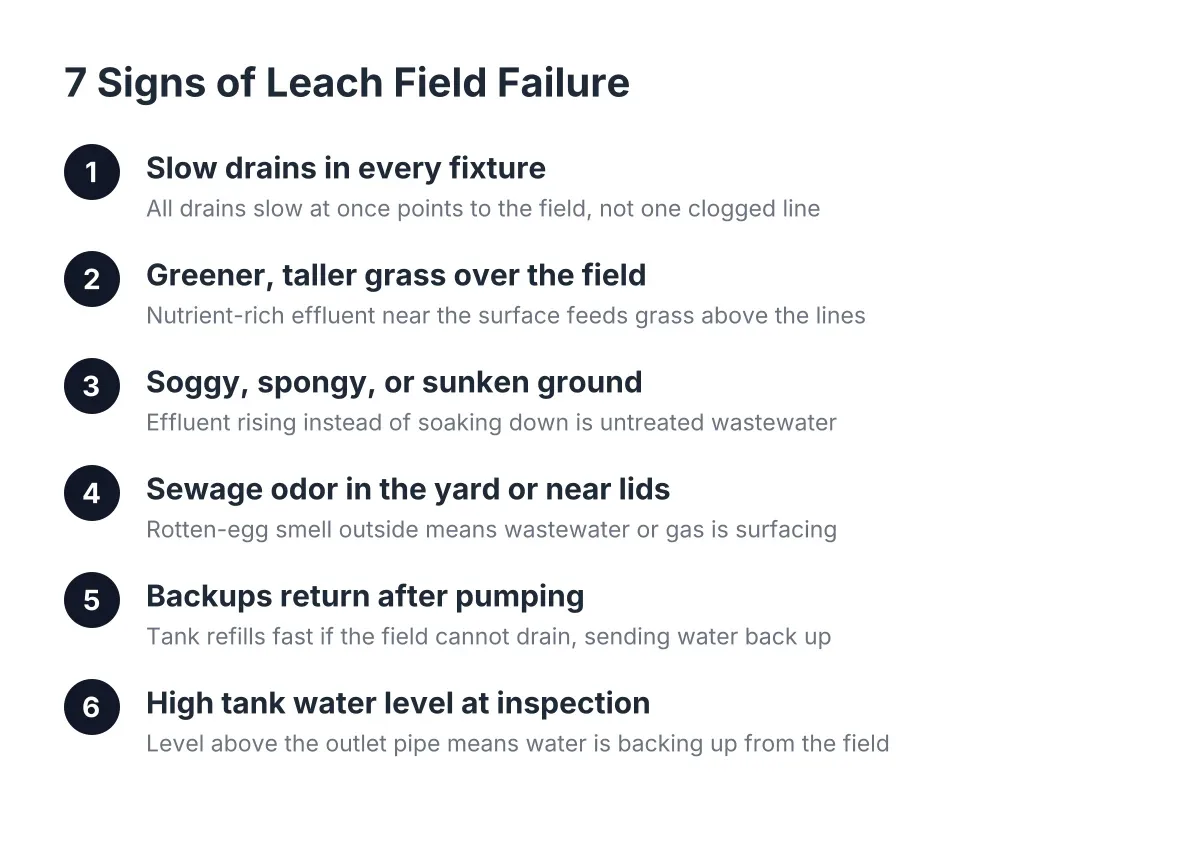
1. Drains Get Slow in Every Fixture, Not Just One
One slow drain usually means a clog in that line. Every drain in the house running slow at the same time points at the septic system, and often at the field. When the leach field cannot absorb water fast enough, the tank stays full, and wastewater has nowhere to go. Toilets gurgle, the shower pools around your ankles, and the washing machine drain creeps.
First, rule out the cheap fix. If the tank has not been pumped in three years or more, which is common on a just-purchased home, schedule septic tank pumping before assuming the field is bad. Sometimes a full tank is the whole problem. If drains slow down again within weeks of a pump-out, that is a field symptom, not a tank symptom.
2. A Patch of Grass Over the Field Is Greener and Taller Than the Rest
Grass that grows noticeably greener, taller, or faster over the leach field lines is one of the leach field failure signs. Effluent carries nutrients, and when the field is not absorbing properly, that nutrient-rich water sits closer to the surface and feeds the grass above it. In a dry Fontana summer, a green stripe across a brown yard is hard to miss.
This sign often shows up months before a backup. Therefore, it is the one most worth acting on early. A septic system inspection at this stage can tell you whether the lines are starting to saturate while the problem is still fixable.
3. The Ground Over the Field Is Soggy, Spongy, or Sunken
Walk your field area after a week with no rain. If the soil feels wet, spongy, or mushy underfoot, effluent is rising instead of soaking down. Standing water or visible sewage surfacing over the lines is the clearest sign the soil can no longer absorb the wastewater load. At that point the field is failing, not just struggling.
Keep people and pets off the wet area. Surfacing effluent is untreated wastewater and a genuine health hazard, which is why a soggy field needs attention now, not next season. Reducing water use inside the house buys time, but it does not fix saturated soil.
4. Sewage Odor in the Yard or Near the Tank Lids
A healthy septic system does not smell. A rotten-egg or sewage odor outside, especially over the drain field or around the tank lids, means wastewater or septic gas is reaching the surface. Odor by itself can have smaller causes, such as a loose riser lid or a dry vent. Odor combined with soggy ground or lush grass points squarely at the field.
For a first-time septic owner, this is the sign most people dismiss. Suppose you smell something off every time you water the back lawn, but the drains inside work fine. That early odor is the field telling you it is saturating. A leach field inspection now costs far less than the repair you will need after a full failure.
5. Backups That Keep Coming Back After Pumping
Here is the pattern that separates a tank problem from a field problem. You call a septic pumper, get a pump-out, and everything works for two or three weeks. Then the backup returns. A tank only holds so much; if the field is not draining, the tank refills fast and sends wastewater back up the lowest drains in the house.
Repeat backups after recent pumping mean the water is not leaving the system. In addition, a good crew will notice this at the pump-out itself: if effluent flows backward into the tank from the outlet pipe while pumping, the field is holding water it should have absorbed.
6. The Tank Water Level Is Abnormally High at Inspection
This sign your leach field is in trouble is one you will not spot yourself; it shows up when the lid comes off. A tank operating normally sits at the level of its outlet pipe. A level above the outlet means water is backing up from the field side. Additionally, a septic tank inspector checks this first, because it tells the story in one look.
This is one reason to have a septic system inspection done with the tank open, not just a quick glance at the lids. If you just closed on a house and the home inspection report said the septic "needs attention," ask specifically whether the inspector noted the liquid level relative to the outlet. That one detail hints at whether you have a tank issue or a field issue.
7. Problems Flare Up After Heavy Water Use or Winter Rains
A field on its last legs often works fine on a quiet Tuesday and fails when the load spikes. Holiday guests, back-to-back laundry days, or a stretch of winter rain pushes a marginal field over the edge. Most leach field failures come down to overload, either too much water volume or too much organic material reaching the field.
Watch for a pattern, not a single event. For example, a leaky or running toilet can waste as much as 200 gallons of water per day, according to the U.S. Environmental Protection Agency, and that constant flow alone can drown a field that would otherwise cope. Fixing indoor leaks and spreading out laundry loads is the cheapest field protection there is.
Recognizing Leach Field Failure Signs and What to Do
Act on the first sign, not the third. A field showing early symptoms can often be rehabilitated; a field that has been surfacing sewage for a year usually cannot. Here is the practical order of operations for a Fontana homeowner:
- Cut water use immediately. Shorter showers, fewer laundry loads, and fix any running toilets.
- Schedule a pump-out if the tank has not been serviced in three or more years.
- Get a leach field inspection, not just a tank check. The useful diagnostic is exposing a section of the leach lines away from the tank to see whether they hold standing water or sit dry, and whether roots have invaded.
- Ask directly: can this field be repaired, or does it need replacing? Make the crew explain the answer in terms of what they found in the lines.
- Keep vehicles, trailers, and heavy equipment off the field area while you sort it out. Compacted soil makes everything worse.
What they find in the lines determines the repair path. Dry lines with a backed-up tank often point to a clogged outlet, baffle, or distribution box, which is the component that splits flow evenly across the field lines, according to Penn State Extension. Those are the cheaper fixes. Root intrusion can sometimes be cleared. Fully saturated lines across the whole field mean the soil itself is exhausted, and that is when replacement enters the conversation.
Can the Field Be Saved, or Is Replacement the Only Option?
A leach field can often be repaired when the failure is mechanical or partial: a crushed pipe, a clogged distribution box, root intrusion in one line, or a field that was simply drowned by a fixable water leak. Replacement becomes necessary when the soil around the lines is biologically clogged and saturated across the whole field.
The cost gap is the reason early action pays. According to the U.S. Environmental Protection Agency, routine septic maintenance runs $250 to $500 every three to five years, while repairing or replacing a failed conventional system runs $5,000 to $15,000. A targeted leach field repair, such as replacing a distribution box or one damaged line, typically lands somewhere between those extremes, as an illustrative range rather than a quote.
Replacement is also a bigger project than most new owners expect. Swapping in a new field generally means treating it as a new system: a fresh percolation test to confirm the soil can absorb effluent, engineering evaluation, and health department sign-off. In San Bernardino County, system sizing is regulated too; the county's minimum tank capacity table requires 1,000 gallons for a 3-bedroom home, according to the San Bernardino County Department of Public Health. None of that is DIY territory, and as of 2026 permit requirements in unincorporated San Bernardino County still apply to field replacement, so bring in a professional before anyone touches a shovel.
One honest limitation: no article can tell you from a distance whether your specific field is repairable. Soil type, field age, and what the opened lines actually show decide that. What you control is timing. A homeowner who calls at the green-grass stage usually has options. A homeowner who waits for sewage in the shower usually has one.
Say a first-time buyer in Fontana closes on a half-acre property in spring, notices a lush green strip in July, and books an inspection in August. In that scenario, the crew might find one root-blocked line and a tired distribution box, clear and replace them, and the field keeps working for years. The same symptoms ignored until the following winter's rains could mean a saturated field and a five-figure replacement. The signs your leach field gives you are the discount; use them.
If you need septic tank pumping, Fontana Septic can help.
Prefer to talk it through? Call (909) 316-2368 — a quick call is usually the fastest way to get a straight answer for your situation.